<<--->>
NEXTERUPTIONS
Major types:
- Effusive eruption
- – dominated by the flow of lava and formation of fountains and lakes; generated by lavas with low silica content, thus less viscous and flow more rapidly
- Explosive eruption
- – ejects ash and larger fragments of broken pyroclastic materials, forming ash clouds that eventually collapse and cover the slopes of the volcano; generated by lavas with high silica content, thus more viscous
Minor types:
Hawaiian Eruption
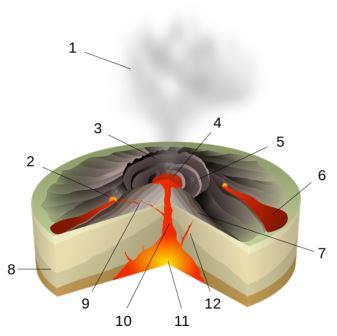
Keys:
1. Ash plume 2. Lava fountain 3. Crater 4. Lava lake
5. Fumaroles 6. Lava flow 7. Layers of lava and ash 8. Stratum
9. Sill 10. Magma conduit 11. Magma chamber 12. Dike
In a Hawaiian Eruption, fluid basaltic lava is thrown into the air in jets
from a vent or line of vents at the summit or on the flank of a volcano.
Strombolian Eruption
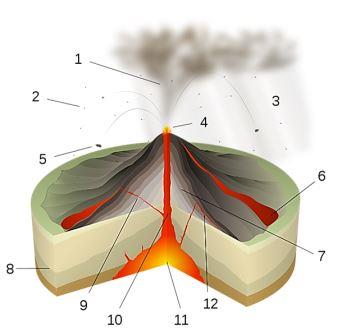
Keys:
1. Ash plume 2. Lapilli 3. Volcanic ash rain 4. Lava fountain
5. Volcanic bomb 6. Lava flow 7. Layers of lava and ash 8. Stratum
9. Dike 10. Magma conduit 11. Magma chamber 12. Sill
They are distinct bursts of fluid lava from the mouth of a magma-filled summit conduit.
The explosions usually occur every few minutes at regular or irregular intervals.
Vulcanian Eruption
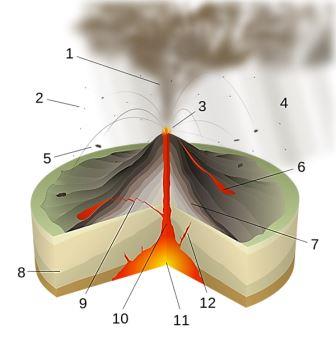
Keys:
1. Ash plume 2. Lapilli 3. Lava fountain 4. Volcanic ash rain
5. Volcanic bomb 6. Lava flow 7. Layers of lava and ash 8. Stratum
9. Sill 10. Magma conduit 11. Magma chamber 12. Dike
A short, violent, relatively small explosion of viscous magma. This type of eruption results from the
fragmentation and explosion of a plug of lava in a volcanic conduit, or from the rapture of a lava dome.
<<--->>
NEXT