
TO MY PIPE SMOKING PAGE
TO MY PIPE CABINET
Most pipe tobacco is made by carefully blending different kinds of tobaccos, sometimes accompanied by other substances to regulate moisture, make the tobacco burn better or add some taste or aroma. To have even the slightest chance at navigating this confusing sea of tins and pouches, one has to know some basics about tobacco. Let me start out with the most tedious bit, a mere mentioning of some primary tobaccos, used in blending.
1: basic bulk tobaccos, making the body of a blend:
Virginia
Sweet and rather sharp on the tongue, this is one of the most used bases for blending.
Burley (also: White Burley)
Little taste of its own, mostly added to blend to ad volume. This tobacco easily takes on taste from other tobacco's, it 'sinks into the blend'.
Maryland
Very light, smoky taste, used to fuse other tastes together and to enhance burning qualities of the tobacco. In the Netherlands a pure form is available as 'Vier Heren Baai'.
2: spice tobaccos, used to flavour a blend
Kentucky Burley
Produced in a different way then White Burley, this tobacco ads a smoky taste to a blend.
Latakia
A very distinctive smell and taste, smoky and rich. It is one of the basic components of a traditional English blend.
Perique
Sweet, very gentle on the tongue and with a high nicotine-contend, and a smell reminding of Port or old red wine. Used in small quantities, also one of the basic types of English blends.
Oriental and other tobaccos
There are several tobaccos for additional flavouring a blend, like Samsun and Drumm (these also used to flavour many cigarette tobaccos). Besides Orientals there are also Java and Brazilian tobaccos used for flavouring.
Cavendish is not a type of tobacco but a different way of treating tobacco; By moisturising, pressing and maturing, flavours are bonded with the tobacco. In a way, this is the oldest form of casing a tobacco.
Generally speaking there are two basic lines in tobacco for pipe smoking; cased tobaccos and uncased tobaccos.
The cased tobaccos are most available today. Even non-pipe-smoking people recognise these tobaccos and call them vanilla-tobaccos, flower-tobaccos or chocolate-tobaccos. Many of these tobaccos have added taste that has little to do with the basic taste of tobacco. These tobaccos usually have a strong and very distinctive taste, sometimes the flavours are easy recognisable as honey, or vanilla. Because they are carefully balanced and filled with additives to optimise them, they are usually easy to smoke, burning well and not to sharp on the tongue.
The biggest setback of these tobaccos is the tendency to smoke wet. Often it is quite impossible to finish a pipe to the last strand of tobacco; a lump of wet, unburnable tobacco is often left in the bottom of the pipe. This dottle is no new problem, nor is it specific for cased tobaccos. Sherlock Holmes used to collect a day's dottle, dry it on a corner of his mantelpiece, and use it for his first smoke on the next day. Anyone who ever tasted Dunhill's Early Morning Pipe and was surprised by its strong taste now understands why...
The second group, the uncased tobaccos is made up from different types of tobacco without additives. International, the old type English tobaccos are most familiar, flavoured with Latakia or Perique. Also known are the 'straight' Virginias, blends with very little or no added spice tobacco.
In the Netherlands there is a large group of tobaccos known as 'Baai' tobaccos, very fine cut and mainly made up of Virginias and Maryland (Koopvaert, Herenbaai). Baai means Bay, and these tobaccos are named after Chesapeake-Bay. In The Netherlands, these baai tobaccos go back a long time, and for me it's fun to be able to buy the same 'Rode Ster' (red star) my grandfather bought.
All these uncased tobaccos seem rather less accessible then the cased types. They can be sharp, or give some trouble to keep lit. On the other hand, they are more complex and subtle in taste, and tend to give more of a 'smoking-sensation'.Straight Virginias and the Dutch Baai-tobaccos are less pronounced in taste, and it's not a bad idea to reserve one or more pipes especially for these tobaccos.
Tins and pouches give little if any direct information on the type of tobacco -cased or not- or the types of tobaccos used in a blend. Virginia is used in most tobaccos, so here's little to learn from a phrase like 'best old Virginias'. But if Latakia or Perique is mentioned, one can be almost sure it's an uncased tobacco. A reference to 'English type' will nowadays not exclude casing absolutely, but it will mean the casing is not overpowering or prominent. And finally, mentioning fruit -apple, pineapple, berries-, flowers or food flavours will almost certainly mean it's a cased tobacco with all of it's merits and drawbacks.
From here on down, I give an impression of tobaccos I smoke on a regular base. They are not the best or most expensive tobaccos, they are sometimes only available in the Netherlands, and over all this selection means nothing, but these are tobaccos I return to every time. In general I have 3 or 4 tobaccos in use at any given time; a Baai, a cased tobacco and one or two uncased tobaccos. (technically speaking the descriptions above and below are not completely correct; Baai is not a separate kind of tobacco, it is an uncased tobacco, and some tobaccos I describe as uncased contain in fact Cavendish. But hey, this is MY page, MY taste and you can all go and boil your heads).
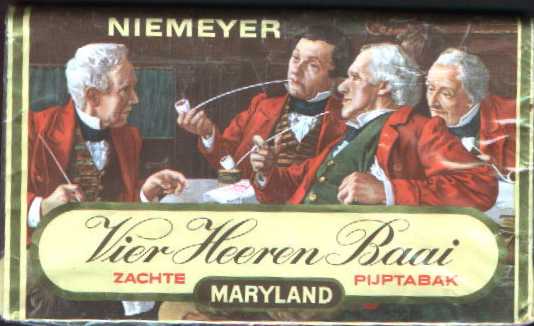
Pouche van 50 gram Fl.7,90 in 1998
Information on pouche: Gentle Maryland tobacco.
Appearance: bold curly tobacco, a little bigger in cut than most Baai tobaccos. A mixture of Yellowish-brown and a little red-brown tobacco.
Smoking: Burns good and rather cool. In the beginning a little tongue bite but while smoking the tobacco seems to get more gentle. Along with the 'gentling' down, the taste seems to grow more full. Tends to smoke a little wet. A little more taste and a little more sweetness than most Baai tobaccos.
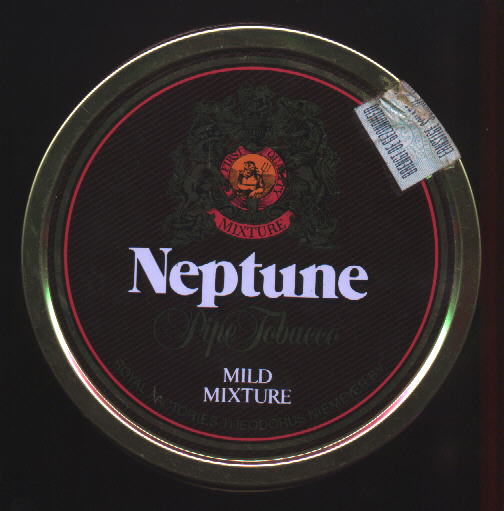
Pouche 50 gram Fl.8,10 in 1998
Information on pouche: nothing...
Appearance: Crumbly, short cut tobacco, a mixture of light and dark brown, with some black tobacco.
Smoking: A strong smell and taste, sweet and full. Burns well, smokes dry and leaves little or no dottle. The strong taste lingers on after smoking.
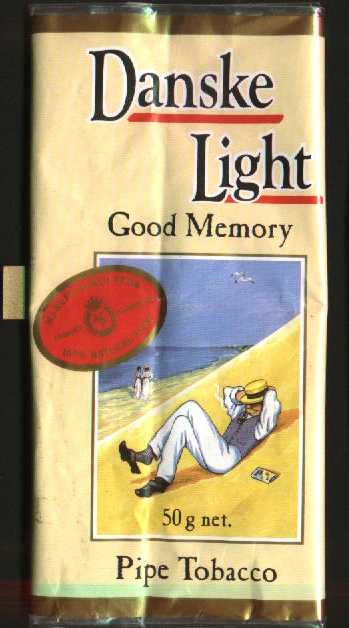
Pouche 50 gram Fl.7,60 in 1998
Information on pouche: Virginia and light Burley, an extreme mild Cavandish blend...
Appearance: A rubbed out flake, almost even reddish-brown, with slight variations in lighter and darker tobacco.
Smoking: Needs a firm hand in packing the pipe and a little extra attention on lighting. Sweet smell, gentle taste, not overpowering like for example Neptune. Tends to be a bit sharp on tongue and in the nose.
Tin 50 gram Fl.11,95 in 1998
Information on the tin: a very small picture of a pineapple...
Appearance: Flake tobacco, pressed into slices, rather dry. Middle-brown and dark-brown tobacco with little yellow-brown specks.
Smoking: This tobacco needs a little experience while packing: it needs to be packed tightly, but because the tobacco tends to become a little more wet while smoking, it can turn out to be to tightly packed after a few minutes of puffing... The tobacco has a very distinctive taste, and when smoked from a certain pipe, this pipe will carry the taste for quite a few smokes afterwards. Maybe a bit sharp on the tongue, but a good strong tobacco for the afternoon.
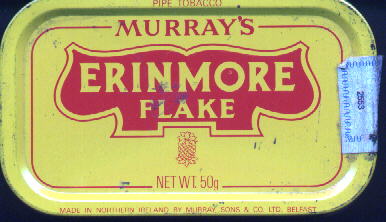
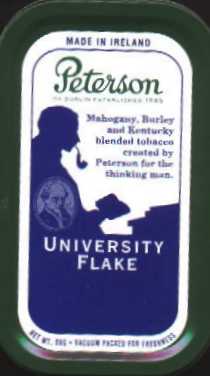
Tin 50 gram Fl.14,95 in 1998
Information on the tin: Mahoganny (?!?), Burley, Kentucky
Appearance: Flake tobacco, pressed into slices. The tobacco remains rather coarse even after rubbing out. Dark-brown, with al little light-brown and a little black tobacco, and a very little bit of yellowish tobacco.
Smoking: Needs a firm hand while packing, doesn't need to be tamped as often as other tobaccos while smoking. A little difficult in lighting, and also a little sharp during the first few puffs, but this diminishes fast. Full, heavy taste, but not overpowering. This is some serious tobacco, burning very slowly and with a huge nicotine contend. A smoke with this takes about 50 % more time then with a regular tobacco. Now here's a tobacco for doing your Robinson Crusoe-thing.
Tin 50 gram Fl.13,85 in 1999
Information on the tin: Latakia, Virginia en Oriental tobacco.
Appearance: Rather wide cut, brown with black-brown and a little yellowish-brown tobacco. When opening the tin, a strong, slightly sour smell emits.
Smoking: Needs a firm hand in packing and a little extra attention on lighting. While smoking, needs a lot of careful tamping. Strong, 'pickled' taste, after getting used to it very pleasant. Hard to finish the last bit, no dottle but some hard pits remain.
Remarkable: It seems this tobacco mellows in taste if it is taken from the tin and stored loosely in a larger container.
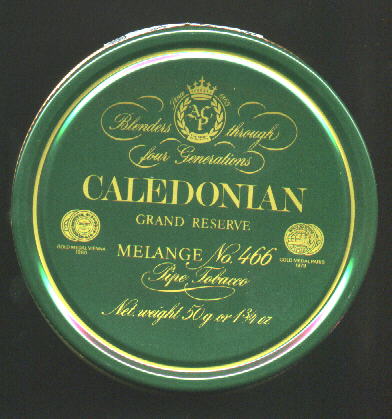
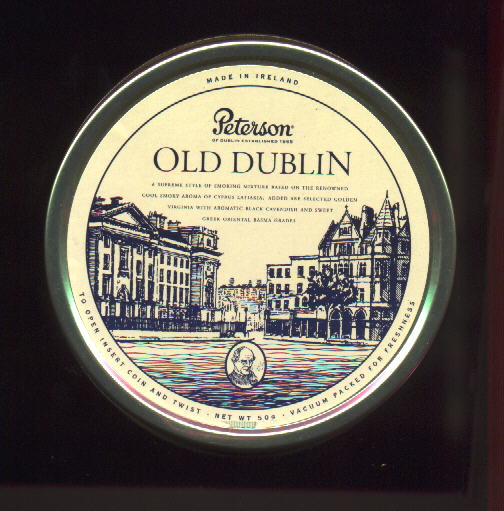
Blikje 50 gram Fl.14,95 in 1999
Information on tin: Cyprus Latakia with Virginias and greek-oriental Basma.
Appearance: Black, dark-brown and a little less yellowish-brown tobacco.
Smoking: Typical Latakiata blend, full-bodied, something sour and smoky about it.
I LIKE THIS ONE A LOT!
TO MY PIPE SMOKING PAGE
TO MY PIPE CABINET
