
TO MY PIPE SMOKING PAGE
TO MY TOBACCO JAR
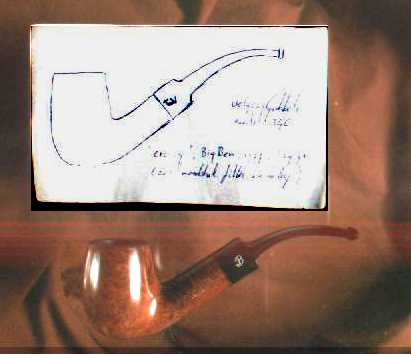
Now here's the pipe that illustrates the bond between a pipe smoker and his pipes. It's the replacement of the lost pipe I wrote about on the general pipe page. The first pipe of this model I bought in 1977 for Fl. 29,95. It was nothing special, a rather smallish pipe with no great grain or design. Just a good, if short smoke, very easy to smoke hands free, holding it with my teeth for the entire duration of the smoke. And after 16 years of trusted duty I lost it, forgetting it in a train. Gone. I tried to take it like a man, I really tried. Buying the same model again wouldn't replace emotional bond I had with the old one, now would it? And after all I had plenty of pipes, didn't I? But it kept on gnawing me, slowly nibbling away at the darker corners of my mind. O yes, sure, I was happy every once and a while, I loved women, I ate well. But every now and then I would reach for a pipe, no longer there. After 5 years of yearning I couldn't stand it any longer. I made a drawing, just from memory, and send it to Gubbels & Zn, the factory that made my lost pipe. Much to my surprise, a couple of day's later they actually called me. The model was still made, its shape number was 340 and I could order it from any tobacconist. So I did. For a mere Fl 50,00 the replacement was mine. And thus I learned I had been wrong for 5 years. It DID replace the lost pipe. It smokes as good as the lost pipe. The emotional bond with the lost pipe is continued in this pipe. It really filled the gap, left by the lost pipe.
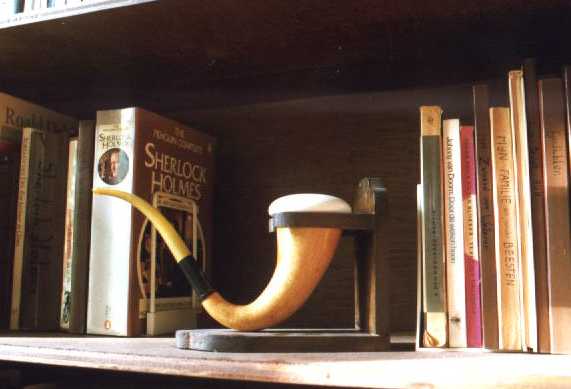
For those who never saw a pipe like this: this is a calabash-pipe. The orange/brown part is made of a gourd, forced into this particular shape while growing. The white part is made of meerschaum, a soft, plaster-like mineral that makes great pipes (queen of pipes it used to be called). And the yellow mouthpiece used to be made from amber, though this is just amber-like plastic. The pipe is clearly a design from the past, most popular in the 19th century, but they are still made. This pipe is a walking dino among pipes, and there's a reason for that. If it's well made, from real block-meerschaum, it's a great smoke, but that's not the main reason they're still around. This, lady's and gentlemen, is it:
The one and only real Sherlock Holmes pipe! Seen in many movies and on even more book covers, the ultimate symbol of the private consulting detective.
And here's the twist: Sherlock Holmes didn't smoke a calabash pipe. In all the stories Conan Doyle wrote on the sleuth, there's no mention of a calabash pipe. Holmes owned an oily black stone pipe, and old and trusted rosewood pipe, a cherrywood pipe he always smoked while being in an argumental mood, but not a syllable on a calabash. The icon of this man with cape, deerhunter-cap and a saxophone dangling from his mouth is of a later date. Since the character of Holmes was so popular, by the end of the 19th century Sherlock Holmes-plays were staged. And one of the more successful interpreters of Holmes, a certain Mr. Gilett, was a dedicated pipe smoker. And it's this Mr. Gilett who added the huge and particular pipe to the gestalt of Sherlock Holmes.
And is it a good smoke? I must say, it's not the disappointment I expected it to be. I really thought this was an object for showing off, not for pleasurable smoking, but is a rather good smoke.
First let me point out 2 setbacks. The pipe has some taste nuances I didn't like. There was a real fruity taste to it. In retrospect to be expected, but I wasn't prepared for it. And also there's a hint of wax-taste in it. Both nuances are diminishing over time, but they were both not really what I hoped for when I bought the pipe.
Another surprise -not especially negative, but very unexpected to me-: for a huge pipe like this, it has a small tobacco chamber. Not really small, but one expects to lose half a tin of tobacco without a trace in a large pipe like this, not the average amount one uses in a standard size 4 bruyere pipe. Add the very cool and dry smoke this type of pipe naturally gives into the equation, and it becomes clear that one is intended to smoke this pipe much to fast. My first blaze took about 20 minutes, where it should have lasted for about 1 hour...
The third advantage is most amazing and gratifying. Due to some unexplained phenomenon this pipes stays lit a lot better then most pipes. That makes it the ideal companion for a relaxed evening with a couple of good friend, sipping the odd whisky & s, solving the world's problems and discussing female physique all in one go. That Gilett-bloke knew his pipes when he choose this one for a stage performance...
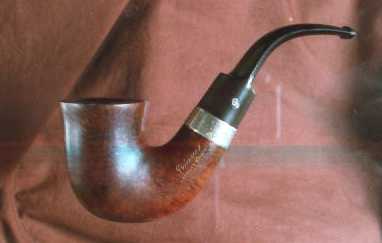
The old Irish firm Peterson launched a series of 7 pipes in 1987. These pipes were named after persons, streets and objects from the Sherlock Holmes stories. In my view a brilliant move. To me, Petersons have always excelled at somewhat old fashioned pipes, a little more crude, less refined then most modern pipemakers. With this collection they really went for the old look, and I love them for it. This is the 'first' pipe of the series, the 'original'. This specific pipe isn't the most original, by the way, because this one lacks the distinctive Peterson-bit. Peterson has an special design bit, half round at the end, with the smoke hole on top. This one has the more regular 'fishtail-bit' that I prefer above the Peterson-bit.
It is a big pipe, offers room for a bundle of tobacco and after lighting it one is silenced for an hour and a half.
I have to admit that this pipe has a little drawback; it tends to be a wet smoke. Moisture, always produced in the combustion of tobacco, accumulates at the pipes lowest point, and like all bends, it is not possible to run a pipe-cleaner through the pipe without disassembling it. And since disassembling a hot pipe is a big no-no, so there's no escape. One has to smoke very carefully or endure the gentle gurgling sounds of a child finishing his lemonade with a straw. However, I love the big and rather crude design of this pipe.
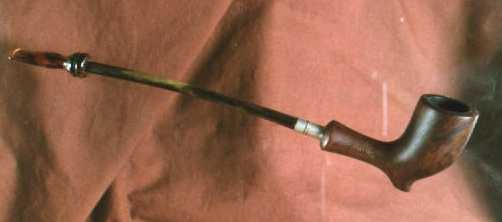
This is supposed to be a 'ladies-pipe'. Now I know rules are to be broken, and I'm sure somewhere there's a lovely lady smoking a pipe with grace, enjoying it to the fullest. Good for her. But I prefer to think of pipes as a manly attribute. Along with the urinoire and the necktie, pipe smoking is one of the last stands a man has left in this world.
HOLD YOUR GROUND, FELLOWS OF THE BRUYERE, OR ALL WILL BE LOST!
But then again, the 'ladylike' of this pipe lies in it's fragile design. As long as fashion-morons design these things specially for ladies, we needn't worry about any thing. Small, thin walled pipes are hard to smoke and need experience. Pipes like these will hold ladies off for indefinite time.
I like this pipe for it's reminiscence of old pipes. The bruyere head is a copy of old stone pipes, with heel and all. The thin stem looks like a temperate fix, made by someone who broke his pipe and was not in position to acquire a new one right away. Somehow it looks to me like a handover from Robinson Crusoe's estate.
The blackish stem was white when I bought the pipe, and at first I was saddened when it started to discolour. But now it gives the pipe a certain patina I really enjoy.
The basic design -if not in this ladylike anorexic form- is the oldest Butz Choquin design, according to several books it dates back to 1858. The stem used to be albatross-bone.
It is a light and nice smoker, al be it hot to hold if smoked carelessly.
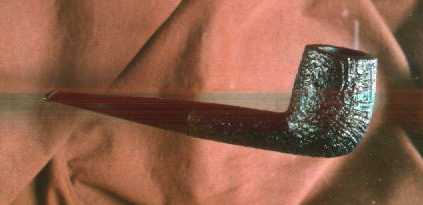
In the old day's almost every tobacconist kept a small basked on his counter, filled with pipes. Rising above the pipes was a little piece of cardboard telling us: "one for a fiver, three for a tenner". Or words to that effect. This basked was definite rock bottom in the pipe business, there was nothing below a basked pipe. Every pipe smoker would at least once try a pipe from this basked. And almost every pipe from this basked smelled like smouldering varnish, tasted like a wood-fire, and left the unlucky patient with holes in his tongue (could this be tongue-piercing avant la letre?).
What never ended to amaze me was that many pipes in these baskets looked alike, were recognisable as basked pipes. All good pipes in a regular shop were smooth or sandblast, and all good pipes were brown. In the basked most pipes were rusticated in the cruellest way, and most pipes were black. Why not at last TRY to look like a decent pipe? It took me years to figure out they actually were trying to look like decent pipes. My problem was that tobacconists I used to frequent didn't sell these decent pipes because they were a bit over-decent; to expensive actually. These black, butchered pieces of wood tried to look like Dunhill's. Dunhill doesn't limit itself to overprized Leather-goods and lighters, they also produce pipes...
Dunhill has produced pipes since 1911, and one way or the other, this manufacturer has grown into the non plus ultra in pipes. Why? I'll grant you they produce nice, classic pipes. They are certainly particular about the quality of the wood, their pipes are flawless and well made. Light-weight, good taste, all in all excellent pipes. But the best? Alright, so they're made in good old England. And due to a well planned system of nomenclature every pipe can be dated to a specific year of production, which makes Dunhills a nice object for collectors. But the best pipes of all? Are they really worth the price?
This pipe is a basic billiard shape. I also own a billiard made by Big Ben. The Big Ben costs Fl 50,-. The Dunhill costs Fl 560,-, over 10 times the Big Ben...
It doesn't taste 10 times as good. The grain isn't 10 times as beautiful. Alright, the black finish is kind of special; this stain can't get any darker, in 20 years this pipe will look exactly the same as when I bought it. And the sandblast shows a detailed and crisp 'sunburst'-grain, really nice. The bit is certainly the best among all my 60 pipes, perfect fitting between my teeth, absolutely flush with the wood of the pipe head. Due to a special treatment of the wood called 'oil-curing' the pipe has a distinctive taste that really brings out the best in uncased tobaccos.
I am in doubt. It is possible my judgement is clouded by knowing the price I paid for this pipe. It's also possible that this is just the best pipe I have. It certainly my favourite pipe: "If you were stranded on a deserted island, what"... Yes, this one.
Is it worth it's huge price-tag? I don't know for sure, but I think it is. It is not the pipe that has rendered all my other pipes unsmokable. I have bought several other brand pipes since I bought this Dunhill, and expect to continue buying other brands. I also expect to buy another Dunhill one day.
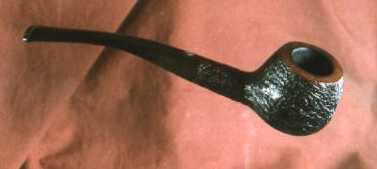
This 'prince' shape is an old English classic. This pipe is rather small, a nice pipe for a breakfast-smoke. I also own a 'rhodesian' and a 'Liverpool' shape. They all are perfect smokers, and I am buying my way into a set of 7. Next will be 3 more Danish designs, and I'm not sure what shape number 7 will be. All are 'briar bark' finish, a reddish-black sandblast, close to Dunhill's 'Shel-l' finish (except for the polished rim on the Parkers).
Parker is a name still associated with Dunhill by many. For years in the past they were a 'second' brand for Dunhill, selling pipes produced by Dunhill but not up to Dun-hill standards. Nowadays Dunhill buys pre-produced pipe heads, thus limiting their rejects to a minimum, and Parker is, once again, a brand of its own. They obvious learned a lot in those Dunhill days, because in my view they produce excellent pipes for a modest price. My Parkers cost Fl 150,- each.
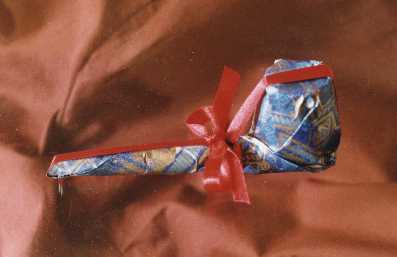
All of a sudden this neatly packed object appeared in my pipe cabinet. One of my friends thought it to be an old fashioned musical record. I have my doubts about that.
TO MY PIPE SMOKING PAGE
TO MY TOBACCO JAR
