


There are some theoretical bounds on the size of the failure database our
system can create.
'X' has nine choices for play on his first move, 'O' has eight choices
for play on his first move on a board that already has one 'X' placed in
one of the nine squares, etc.
Now assume that for the game of tic-tac-toe there exists a ratio
![$r \in [0.0, 1.0]$](img2.png) , where r is a ratio or percentage of moves available
either to 'X' or to 'O' on any given turn in any given game that lead to
failure. If such a ratio
, where r is a ratio or percentage of moves available
either to 'X' or to 'O' on any given turn in any given game that lead to
failure. If such a ratio  exists, then we know, at least theoretically,
the size of the failure database. Assume
exists, then we know, at least theoretically,
the size of the failure database. Assume  is the theoretical size of our
failure database.
is the theoretical size of our
failure database.


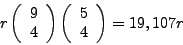
The maximum value of occurs when  . Call this maximum value
 . Obviously,
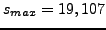 . In practice, and in our
implementation, we know the experimental value of , called
. In practice, and in our
implementation, we know the experimental value of , called  ,
, and we can solve the above equation for the experimental value of ,
,
, and we can solve the above equation for the experimental value of ,
 .
.

Our experimental results are reported later, including the experimental
values of . From these experimental results, we compute a value
for for the game of tic-tac-toe, assuming the ratio exists.
So, theoretically, in the worst case, for the game of tic-tac-toe, the failure
database will be no larger than  .
In this worst case, all possible moves for either 'X' or 'O' on any given
turn in any given game lead to failure.
This is a logical impossibility, since in any single completed game of
tic-tac-toe, 'X' and 'O' can't both lose in the same game.
Just think of
as an upper-bound on the size of our failure database, , in the game
of tic-tac-toe.
The actual size of the failure database is less than half its maximum size,
and we report these results later.
.
In this worst case, all possible moves for either 'X' or 'O' on any given
turn in any given game lead to failure.
This is a logical impossibility, since in any single completed game of
tic-tac-toe, 'X' and 'O' can't both lose in the same game.
Just think of
as an upper-bound on the size of our failure database, , in the game
of tic-tac-toe.
The actual size of the failure database is less than half its maximum size,
and we report these results later.