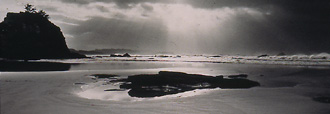
The world of Brighton and its coast was thus central
to Baxter, the place where the twenty-
five year old poet imagined he would wish to be buried...
. . . Know I loved most when alive
A certain bare coast open to the South
Where ocean and continual gales do strive
In hoarse green breakers by a river mouth.
It was the place that formed his poetic consciousness:
There is no coast I can compare to this.
Here is the ampitheatre of my dreams
Where once, a lonely child, I made
My own mythology of weeds and shells
And grew acquainted with the moods of Death
Till we were friends, old friends.
His Brighton environment gave him the material for a
full symbolic world, both a fallen Eden and a world in which natural images
body forth the basic powers and patterns of life. As Vincent O'Sullivan
has said, 'The Otago coast and hinterland - the only landscape, he said,
he ever really loved - provides precisely adequate detail for most moods,
and for their mythical embodiment'. Brighton and the coastline
from Taieri Mouth to Long Beach are thus at the centre of his poetic world,
but they are flanked by two other important aspects of his symbolic universe,
the City, represented by Dunedin, and the Wilderness, represented by Central
Otago. The City to Baxter is the human domain, an imperfect emdodiment
of the dream of the Just City, 'a City of a kind', one which is 'finite,
exact, and reasonable, designed for the fulfilment of limited aims'.
The crucial symbolic elements in the city townscape (except for the pubs)
are all there in a prose passage in which the middle-aged Baxter confronts
the site of his youthful rebellion and wonders 'What happened to that stupid
sad young man?. . . Who killed cock robin with his drumming heart
and his head full of feathers?':
|
|