|
JAMES K. BAXTER'S OTAGO WORLDS Lawrence Jones
|
Page 26
|

|
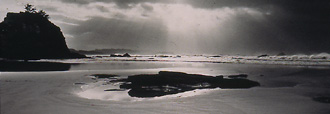
Twenty years later the poet returns to the same beach. If twenty years before,'Venus came over the sea' to the lovers, 'Lying (as so many do) / In one another's arms', she had left them 'Like shards of a dish the spade jars on'. This time what the poet sees is the cliff above the beach: 'a high stone Rhadamanthus / Washed by the black froth of the sea'. As the notebook drafts make more explicit than does the final version of the poem, Baxter wishes us to recall not so much that Rhadamanthus was king of the Isles of the Blessed, where the lovers may temporarily have beached, but rather that he was judge of souls in the underworld, where the lovers will end, their moments of bliss long ago lost. Thus in the version entitled 'The Tunnel' the poet makes explicit that he had not seen the cliff as a young man, 'made / Blind by Venus', but now he sees it as 'the myth / Of judgement when love dies'. If the beach can sometimes be the place of ambiguous revelation associated with Venus and the sexual experience, it is more often a less exalted 'arena for sexual adventure'. As such it is seldom positive in its implications, for it is associated with 'the wars of Venus, the bitterest of all, to lose', which the forty-year-old poet claims to be relieved to be beyond, leaving him 'a little nearer to that community of the living and the dead which I have looked for all my life'. The sexual adventure is associated with a complex of recurring images involving lupin, sandhills, the Brighton bathing sheds, the Brighton boathouse, summer, Venus personified in girls in bathing suits, frustrated or exploitive sexuality, condoms, and masturbation. The poet remembers the older boys with the 'big girls': 'Under the lupins, whispering in the dirt, / They imitated dogs'. Or, later, he sees himself as 'savage empty boy / Haunting the bathing sheds', drawn to and afraid of the older girls, 'furiously inventing a unicorn / Who hated the metal of Venus'. He remembers youth and 'the same sweet lie the lupin teaches' as it drops its 'gay pollen' on the frock and the bare leg and shoulder of the girl. The depressed and hungover Horse looks out in the morning on 'the treeless Domain' with a few 'early cars from town' already there, and thinks that later 'A few young men would take their girls into the lupins that grew along the sandhills, to lay down their overcoats and bang them in peace, absorbing the healing influences of the sea and soil.' In middle age, the poet walks the beach, 'Beyond the high-banked green domain / Where boy and girl lying in lupin mazes / Pluck the dragon's apple'. He remembers that 'From Black Head to the bar of Taieri Mouth' his father's uncle 'scattered lupin seed', and he thinks of the lovers who find cover there, leaving 'pale condoms' under the bushes with their 'bright female bloom' and their 'pollen blown over the wide stretch-marked belly of the sea'. The boathouse across the road from the river mouth and Domain he also associates with youthful sexuality. He remembers the 'lifted frock' and 'the boathouse spree and the hayloft bed', 'white legs among the cords and rowlocks', and his attempts 'to learn the tricks of water / From the boathouse keeper's daughter'. A married man in middle-age, he is still haunted by 'The floating feather / Of adolescent love' that he associates with the boathouse, and it is one of the icons of Brighton that he 'left behind in going to the city'. But it is the lupin that comes to mind most frequently. He imagines the 'rumbustious bad young man' (with echoes of Fairburn) persuading the young girl to 'make the two-backed beast' 'under the yellow lupin', and then leaving her. He depicts the young man at the dance persuading the girl to come with him into the dunes at the mouth of the creek to defy the morality of her great grand-uncles 'In tartan plaid and moleskin cloth'. At the bonfire on the beach, he imagines how the young lovers later in the evening 'two by two will vanish / Into the dunes', their 'widening flesh' possessed by the spirits of the Maori who made a midden of shells on the beach. In his more Dylan Thomas- ish moods, he stands on the 'Low lovers' dune', hears Parson's Rock 'preaching to . . . the lupin-sheeted / Bed of the sway backed sinners', while he 'alive must grieve / For the true flesh time wounded. . .' , or he climbs 'to Barney's pulpit rock' and imagines the lovers: Among night dunes the moony lovers In lupin shade far and near Twined under Venus' carnal star Mock the power of the prince of air. Their doomed flesh answers an undying summer. |
 |
 |