| W |
ML - Wireless Markup Language |
| | |
|
Building Mobile Applications using WAP & Wireless Programming
|
|
|
Java The future of the wireless Web
When Sun Microsystems introduced Java software for computers in the mid-1990s,
static Web pages sprang to life with clever animation, embedded software programs and sprightly interactive features.
A similarly momentous change is coming to the way U.S. consumers connect to the Internet � by using a mobile
phone instead of a computer to access moving pictures, scrolling stock quotes and a variety of news, games and sports results.
Liken its significance, if you will, to the impact on Hollywood in the 1920s of the first sound cartoon �
Walt Disney's Steamboat Willy, featuring Mickey Mouse.
Java promises to bring the best of the Net � the ability to display real-time news, for example �
to your telephone handset. It's a big improvement over the Wireless Application Protocol (WAP) technology,
the current form of phone access to the Web.
With a tiny Java program on a mobile phone, stock quotes roll across the small screen,
or the most recent photograph of Yasser Arafat pops into a top news story about turmoil in the Middle East.
Industry players and analysts see Java as one way for U.S. Consumers to finally discover the mobile Internet.
"I don't see any competition to Java," says James White, wireless practice manager at Fourth Generation,
a consulting firm in St. Paul, Minnesota.
Only the Java program can run on a range of mobile devices, bringing a variety of services to phones,
whether they are directly connected to a network or merely being used as off-line devices, he said.
Existing technology has been criticized as slow and cumbersome, forcing the average user to make some
20 handset key "clicks" to reach the limited number of Web sites designed to work with WAP browsers.
To date, the mobile Web has been anything but exciting � unless you happen to live in Japan,
which has a two-year head start on the rest of the world.
In Japan, people on the go use color-screen Java phones to play games, place bets, send e-mail,
or even tend to the "care and feeding" of virtual pets. More than 10 million Japanese own
Java-based mobile phones that let them play real-time backgammon against distant
opponents, or check train timetables.
Phones worth watching
Enter Java software innovators such as Mediabricks, a two-year-old start-up from Sweden.
It developed a tiny Java application that is a compact 30,000 bits of data in size.
When you run a copy of MediaBricks' program on your phone, Web pages refresh themselves.
If you're a sports fan, you can track professional basketball or Major League Baseball
scores as they happen. In Europe, phone-connected fans can keep track of English premiership
rugby action and German Bundesliga soccer scores on Saturday afternoons, receiving updates
replete with a message, picture and, in a few years' time, a video clip.
Everything is neatly integrated, and the user never loses sight of the menu �
which could be a problem with the WAP.
"Showing a picture, a news story and a scrolling stock ticker, all running independently
from each other, can only be done with Java," said Christer Simren, Mediabricks' chief executive.
Mediabricks is not alone in taking advantage of Java's improved features.
Already, HillCast, of Austin, Texas, streams stock quotes to Motorola's
Java-phones on the Nextel network, and Seattle-based Mobliss works with Alltel to bring
up-to-the-minute sports scores to Java handsets.
The catch? Only the more expensive handsets come with the necessary technology,
so-called Java virtual machine software.
But this is about to change.
Fear of Java software fragmentation
In North America, Nextel is aggressively pushing Java handsets, selling 1.3 million so far.
Motorola says all its new handsets will have Java.
"At the end of this year, we will even have an entry-level Java phone,"
said Motorola's European mobile phone president Fernando Gomez, referring to lower-cost, mass-market phone models.
Finland's Nokia, the world's largest mobile-phone maker, will put Java in a quarter of all new models.
Vodafone, the world's second-largest wireless operator, is also keen to improve on its
WAP offerings and is gearing up for Java.
For Java to truly succeed, however, Sun, the original developer, needs to ensure that its "write once,
run everywhere" promise is fulfilled. In other words, for Java software to become as widespread on
phones as Microsoft's Windows is on personal computers, Java must remain a coherent single system.
Yet demands by many network operators and handset makers for specialized Java software programming
hooks that run only on a few of their own devices, are threatening to fragment the potential mass
market for Java-based games or other programs that can run on all phones.
Already, there are some 15 to 20 Java dialects for mobile devices.
In Japan, for instance, NTT DoCoMo and J-Phone extended their Java software in order to
create their own three-dimensional visual and audio features.
It's up to software companies like Britain's Tao, Sweden's Mediabricks and Japan's K-Laboratory to
add their patented technology to interpret standard Java applications and make them smarter and faster.
Tao has Japanese electronics giants rallying around its Java technology as a standard for
new mobile phones. The privately held company is backed by Japanese consumer electronics companies like Sony,
Sharp, NEC, and Mitsubishi, as well as U.S. equipment supplier Motorola, the world's second-largest handset maker.
This new generation of Java mobile-phone software, due out next year, will solve this Babelesque confusion,
said Gerardo Dada, marketing manager at Austin, Texas-based Metroworks,
which sells software programming tools for mobile phones.
"It will be a powerful consolidator and reduce fragmentation," Dada said.
Chapter Introduction
In This Chapter we will focus upon
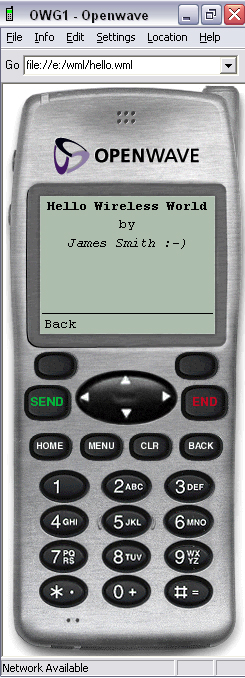
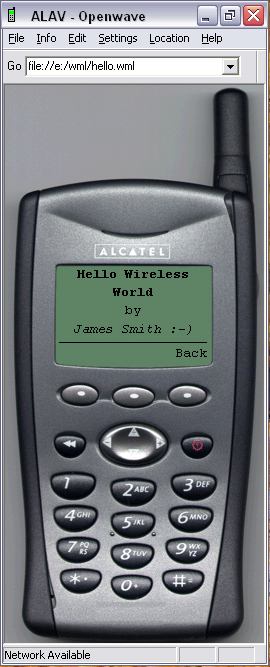
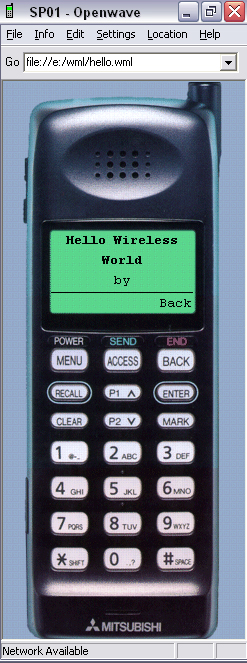
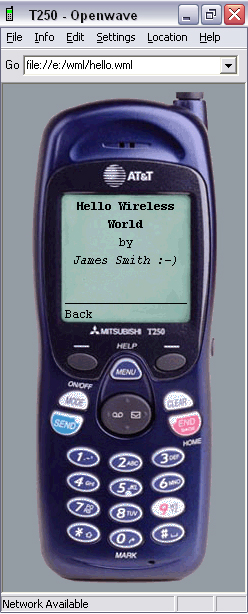
WML Scripts and How to Run them using WAP Simulator UPSDK which is developed by the
Developer community of OpenWave.Com , If u are interested in joining then developer community
the log on to http://developer.openwave.com
Wireless Programming got its importance as the need came in for
constantly mobile users to access a centralised database both trought their laptops and mobile
phone sets...., thats how WAP, PALM, Push Technology, SMS etc.. came into picture
|
|
|




 If you like this article and/or code
