Home
About Bulldog
Tips
Gallery 1
Gallery 2
About Us
|
history |
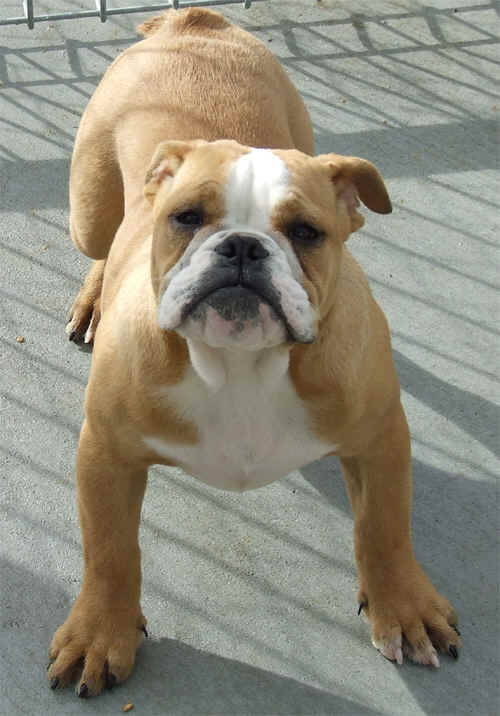 Looking
at this photo, it is easy to see why the Bulldog is affectionately
called the "sourmug". Looking
at this photo, it is easy to see why the Bulldog is affectionately
called the "sourmug".
|
|
|
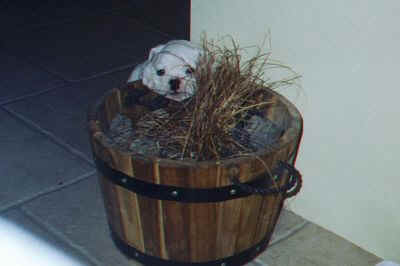 Of
the countless breeds of dogs there is no one more distinctive in
appearance than today's Bulldog. Of
the countless breeds of dogs there is no one more distinctive in
appearance than today's Bulldog.
|
 |
|
|
The Bulldog is thought to be descended from ancient
Mastiffs of asiatic blood, combat dogs that were introduced in Great
Britain by early phoenician navigators. Its name reflects its
original purpose; the Bulldog was used for bull-baiting.
Organized dog fights were also the rule of the day. In 1835,
the cruel practice of bull-baiting was outlawed in England. In
1875, the first Bulldog standard was published. Selective
breeding since that time has turned the Bulldog into a loving family
pet.
|
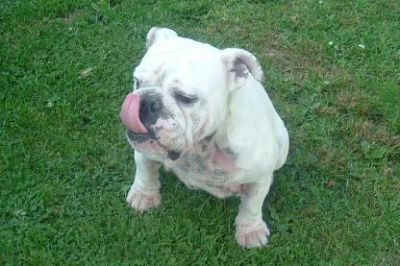 The
Bulldog's undershot jaw was so designed to enable him to clamp onto
a bull's nose with a vice-like grip. The Bulldog's wrinkles
had the specific function of keeping blood of a bull out of the
dog's nose and eyes. The
Bulldog's undershot jaw was so designed to enable him to clamp onto
a bull's nose with a vice-like grip. The Bulldog's wrinkles
had the specific function of keeping blood of a bull out of the
dog's nose and eyes.
|
|
|
characteristics
|
|
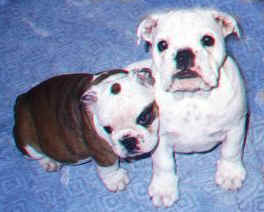
| If
you are unsure about purchasing a Bulldog do not look at Bulldog
puppies because you will not be able to go home without one. |
|
|
|
|
|
|
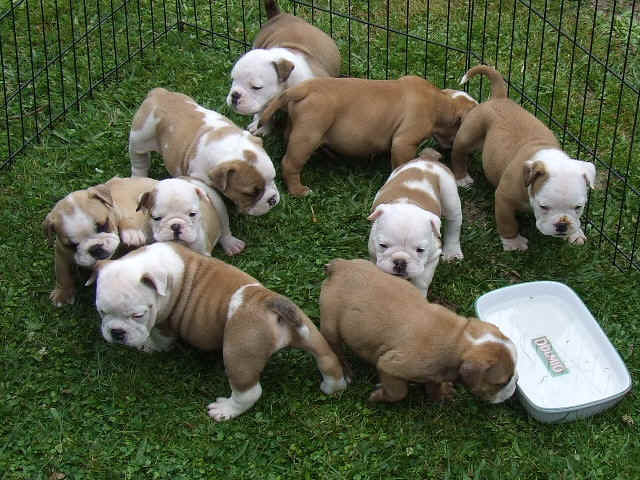
It is for this very reason
the person anticipating owning a Bulldog should give serious thought
to the decision. Puppies are the material for millions of
picture-postcards and greeting cards each year. Bulldog
puppies are particularly used in this respect. There is nothing more
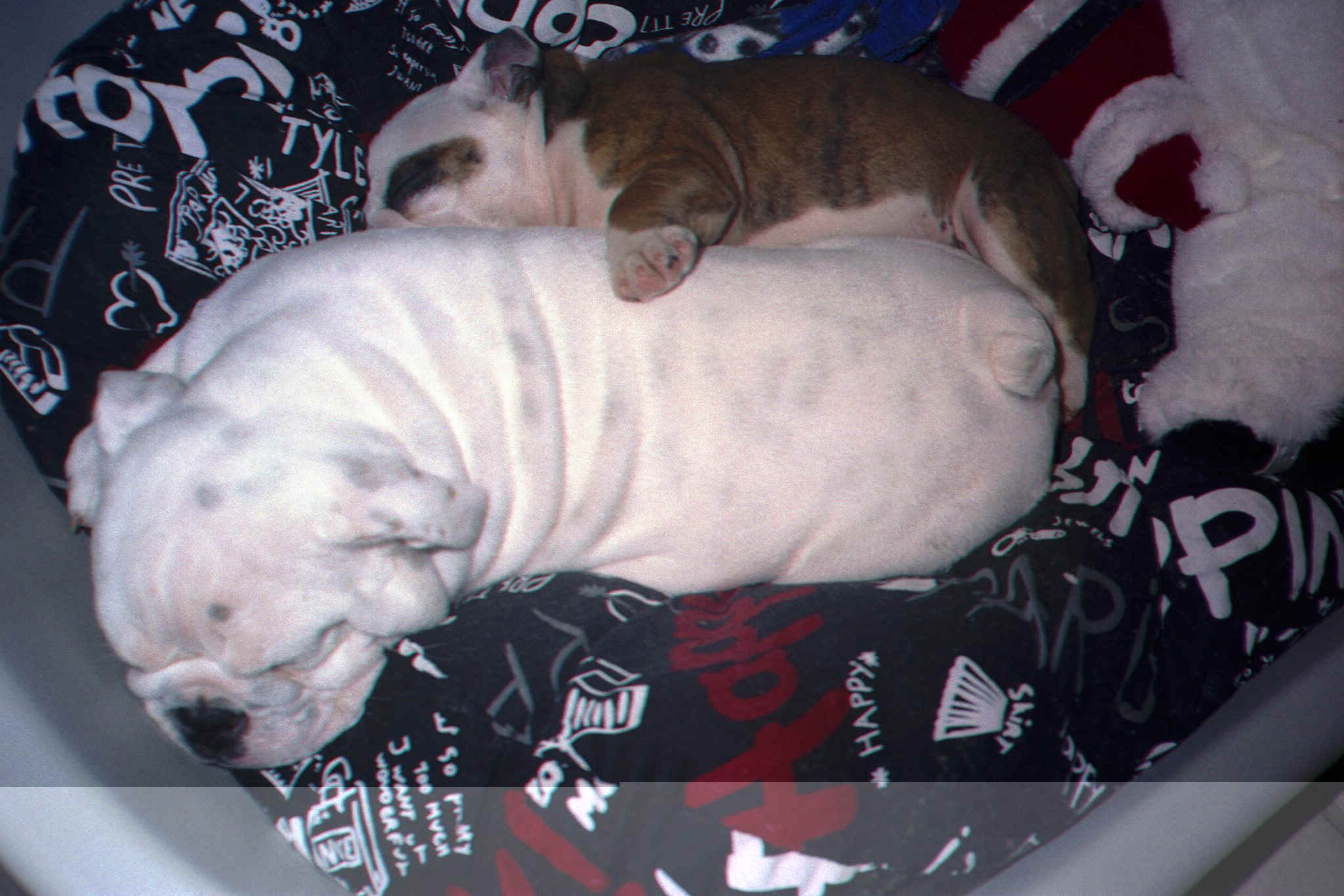
seductive than a pile of Bulldog puppies, nestled together sound
asleep, one on top of the other, or playing together. But there are
lots of things that is needed some serious thoughts and
consideration.
Here are some of special requirements for
anyone who wishes to buy a Bulldog:
1. The dog must be a house dog 100% of the
time: First and foremost the Bulldog is a people dog. The
Bulldog must be a "house dog!". He is not a breed
that is able to cope easily with temperature and humidity
fluctuations. Nor is the breed able to endure being isolated from
the people he loves.
2. Yards must be completely
fenced: Bulldogs are often
described as being loyal and although our egos would have us believe
that our dogs would pine away if they were not with us, this is
hardly the truth. A Bulldog would be just as happy anywhere as long
as he was fed, loved, petted and had a couch or chair to sleep on.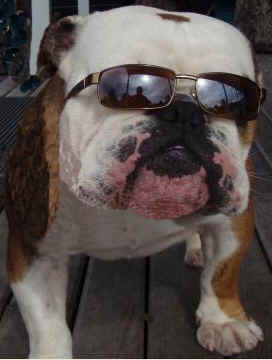
3. No
home where a "macho" or aggressive dog is wanted:
A home that encourages aggressive behavior is not the home for a
Bulldog. A Bulldog in a fight is something you never want to
see! They become totally involved, their eyes glaze over and they
are intent on doing great harm to whatever animal they are fighting
with. Further, it is extremely dangerous for anyone, including the
owner, to try and intervene as the Bulldog's complete and total
concentration is on the fight and he has no sense of what he is
biting!
4. No
home where we haven't met everyone in the household:
We want to meet everyone that our Bulldogs will be living with
because it is important to see how each member will interact with
the dog.
5. No
home where only one of the adults is enthused about getting a
Bulldog: Owning a Bulldog takes the
cooperation of everyone in the household and Bulldogs have very
special and often very limited appeal. No
Bulldog is safe in
an environment that it is not entirely receptive.
6. No
home where children are responsible for the dog's care:
Be very careful when we place a dog into a family with children.
Make sure that the children will not be abusive to the dog since the
dogs are very stoic and will take almost any abuse from a child. At
the same time, while the best of children can love and care for
their dogs they are not always capable of understanding or
remembering the very special care Bulldog ownership entails.
7. No
home where they "want to get into breeding:"
Breeding Bulldogs is extremely difficult on both dog and
owner. It is not something to be attempted by most people. It
takes a long time to understand what kind of stock is even suitable
for breeding and an even longer time to learn the intricacies of
breeding, whelping and rearing a litter of Bulldogs.
|
|
|
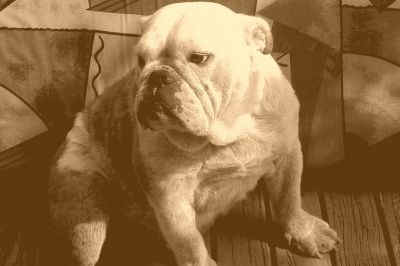 The Bulldog is a docile, affectionate companion and yet will be
playful and active (for short periods) if you want him to be.
The breed is absolutely wonderful with children and the
elderly. Their special talent in life is
"companionship". A Bulldog may not give two hoots about
guarding a missile site, but watch him take care of a toddler as the
two amble along with the child holding steadfastly to the loose skin
on the dog's throat.
The Bulldog is a docile, affectionate companion and yet will be
playful and active (for short periods) if you want him to be.
The breed is absolutely wonderful with children and the
elderly. Their special talent in life is
"companionship". A Bulldog may not give two hoots about
guarding a missile site, but watch him take care of a toddler as the
two amble along with the child holding steadfastly to the loose skin
on the dog's throat.
|
|
|
|
While Bulldogs can be tough with other dogs, their humans are their
lives. They are clowns and will do things just to make you
laugh. They are also very sensitive to your moods and will sympathize
with you, rejoice with you and be still or grieve with you.
Bulldogs are gentle and dignified. Part of their charm is that they
look so touch but they aren't at all. Their inner beauty will
steal your heart. When it comes to their humans, Bulldogs are
totally forgiving and totally loving. They are true companions
in every sense of the word.
|
|
|
Standard
|
|
|
General Appearance
Medium size and smooth coat; with heavy, thickset, low-swung
body, massive short-faced head, wide shoulders and sturdy limbs.
The general appearance and attitude should suggest great stability,
vigor and strength. The disposition should be equable and kind,
resolute and courageous.
Size
The size for mature dogs is about 50
lbs. for mature bitches about 40 lbs.
Proportion
The circumference of the skull in
front of the ears should measure at least the height of the dog at the
shoulders.
Symmetry
The "points" should be well
distributed and bear good relation one to the other, no feature being
in such prominence from either excess or lack of quality that the
animal appears deformed or ill-proportioned.
 Head-Eyes
and Eyelids- Head-Eyes
and Eyelids-
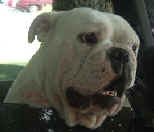
The eyes, seen from the front, should be situated low down in the
skull, as far from the ears as possible, and their corners should be
in a straight line at right angles with the stop. They should be
quite in front of the head, as wide apart as possible, provided their
outer corners are within the outline of the cheeks when viewed from
the front. They should be quite round in from, of moderate size,
neither sunken nor bulging, and in color should be very dark. The lids
should cover the white of the eyeball, when the dog is looking
directly forward, and the lid should show no "haw".
Ears
The ears should be set high in the
head, the front inner edge of each ear joining the outline of the
skull at the top back corner of skull, so as to place them as wide
apart, and as high, and as far from the eyes as possible. In size they
should be small and thin. The shape termed "rose ear" is the
most desirable. The rose ear folds inward at its back lower edge, the
upper front edge curving over, outward and backward, showing part of
the inside of the burr.
Skull
|The skull should be very large, and
in circumference, in front of the ears, should measure at least the
height of the dog at the shoulders. Viewed from the front, it should
appear very high from the corner of the lower jaw to the apex of the
skull, and also very broad and square. Viewed at the side, the head
should appear very high, and very short from the point of the nose to
occiput. The forehead should be flat, neither too prominent nor
overhanging the face.
Cheeks
The cheeks should be well rounded,
protruding sideways and outward beyond the eyes.
Stop
The temples or frontal bones should
be very well defined, broad, square and high, causing a hollow or
groove between the eyes. Stop should be both broad and deep and extend
up the middle of the forehead, dividing the head vertically, being
traceable to the top of the skull.
Face and Muzzle
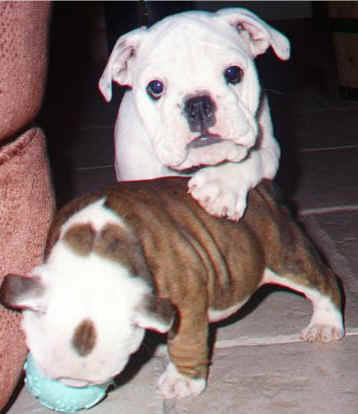
The face, measured from the front of
the cheekbone to the tip of the nose, should be extremely short, the
muzzle being very short, broad, turned upward and very deep from the
corner of the eye to the corner of the mouth.
Nose
Should be large, broad and black, its
tip set back deeply between the eyes. The distance from bottom of
stop, between the eyes, to the tip of nose should be as short as
possible and not exceed the length from the tip of nose to the edge of
underlip. The nostrils should be wide, large and black, with a
well-defined line between them.
Bite-Jaws
The jaws should be massive, very
broad, square and "undershot", the lower jaw projecting
considerably in front of the upper jaw and tuning up.
Teeth
The teeth should be large and strong,
with the canine teeth or tusks wide apart, and the six small teeth
infront, between the canines, in an even, level row.
|
|
|
Neck
The neck should be short, very thick,
deep and strong and well arched at the back.
Topline
There should be a slight fall in the
back, close behind the shoulders (its lowest part), whence the spine
should rise to the loins, thence curving again more suddenly to the
tail, forming an arch.
Body
The brisket and body should very
capacious, with full sides, well-rounded ribs and very deep from the
shoulders down to its lowest part where it joins the chest.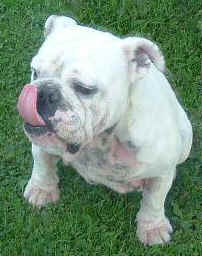
Chest
Should be very broad, deep and full.
Underline
The body should be well ribbed up behind with the belly tucked up and
not rotund.
Back and
Loin
The back should be short and strong, very broad at the shoulders and
comparatively narrow at the loins.
Tail
May be either straight or "screwed", and in any case must be
short, hung low, with decided downward carriage, thick root and fine
tip. If straight, the tail should be cylindrical and of uniform taper.
If "screwed", the bends or kinks should be well defined, and
they may be abrupt and even knotty, but no portion of the member
should be elevated above the base or root.
|
|
|
 Forequarters
|
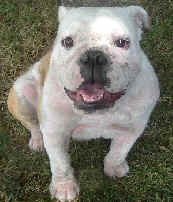
Shoulder
Should be muscular, very heavy,
widespread and slanting outward, giving stability and great power.
Forelegs
Should be short, very stout, straight and muscular, set wide apart,
with well developed calves, presenting a bowed outline, but the bones
of the legs should not be curved or bandy, nor the feet brought too
close together.
Elbows
Should be low and stand well out and loose from the body.
Feet
Should be moderate in size, compact and firmly set. Toes compact, well
split up, with high knuckles and very short stubby nails. The
front feet may be straight or slightly out turned.
|
|
|
|
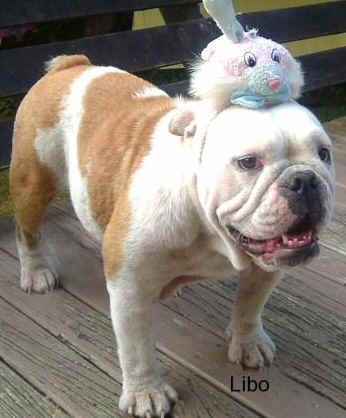
Legs
The hind legs should be strong and muscular and longer than the
forelegs, so as to elevate the loins above the shoulders. Hocks should
be slightly bent and well let down, so as to give length and strength
from the loins to hock. The lower leg should be short, straight and
strong, with the stifles turned slightly outward and away from the
body.
Feet
Should be moderate in size, compact and firmly set. Toes compact, well
split up, with high knuckles and short stubby nails. The hind feet
should be pointed well outward.
|
Hindquarters
|
Coat and Skin |
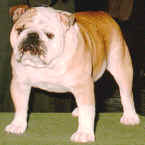
Coat
Should be Straight, short, flat,
close, of fine texture, smooth and glossy.
Skin
Should be soft and loose, especially at the head, neck and shoulders.
Wrinkles and Dewlap
The head and face should be covered with heavy wrinkles, and at the
throat, from jaw to chest, there should be two loose pendulous folds,
forming the dewlap.
|
|
|
|
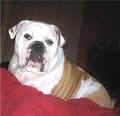
Color of coat- The color of coat
should be uniform, pure of its kind and brilliant. The various colors
found in the breed are to be preferred in the following order:
(1) red brindle
(2) all other brindles
(3) solid white
(4) solid red
(5) piebald
(6) inferior qualities of all the foregoing
The brindles to be perfect should have a fine, even and equal
distribution of the composite colors. In brindles and solid colors a
small white patch on the chest is not co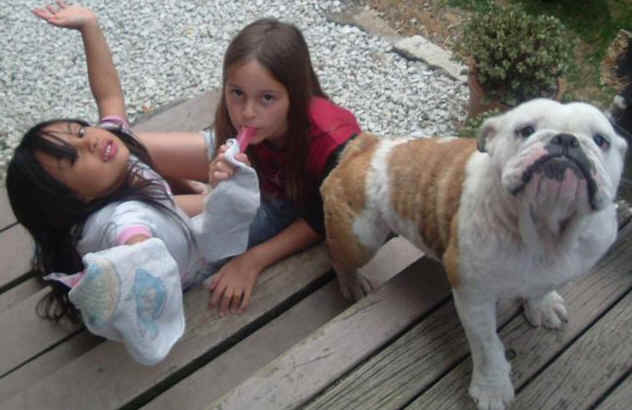 nsidered
detrimental. nsidered
detrimental.
Gait
The style and carriage are peculiar, his gate being a loose-jointed,
shuffling, sidewise motion, giving the characteristic
"roll." The action must, be unrestrained, free and vigorous.
Temperament
The disposition should be equable and kind, resolute and courageous
(not vicious or aggressive), and demeanor should be pacific and
dignified. These attributes should be countenanced by the
expression and behavior.
|
|
|
|
AN OVERVIEW OF THE BULLDOG
STANDARD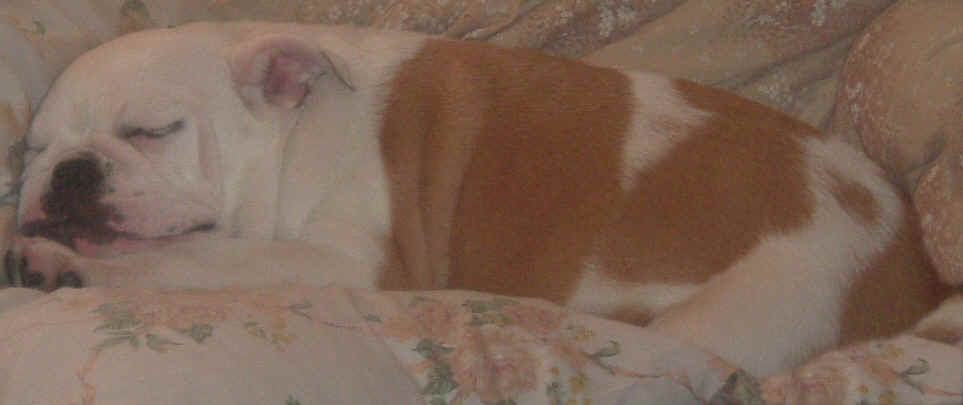
The look of the Bulldog both in
body and expression underscores its character-kind, courageous and
dignified. That is the essence of the Bulldog temperament.
While the standard takes great pains to describe in detail all that is
desirable in the breed, in the end the reader should come away with
the picture of a dog that owns the ground it stands upon; sound of
both limb and mind. Never too small, nor too big. It is a medium-sized
dog and the opposite ends of the size spectrum do not conjure up a dog
that is at once both strong and vigorous.
|
|
|