JAINPUSHP
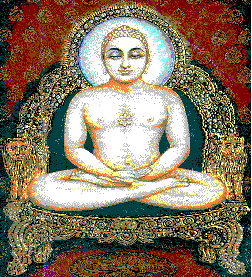
Jai Mahavir ji
An exclusive web site dedicated to Jainism.
One source for information related to universal message of Jainism and Jain philosophy.
Gunasthãn
 Home
Home
Mandir
Jee
News
and views
Jainism
Fundamentals
Make
Donations
Kid's
world
Jain
Groups
Jain's
Web Sites
Contact
Us
Stages of spiritual Development
*There are fourteen stages of spiritual development,
called gunasthãn as given below:-
(i) Mithyãtva
(i i) Sasadan
(iii) Misra
(iv) Avirat Samyaktva
(v) Deshvirat
(vi) Pramatta Sanyat
(vii) Apramatta Sanyat
(viii) Apuravakaran
(ix) Anivritti Karan
(x) Sukshama Sampraya
(xi) Upshant Kashay
(xii) Kshina Kashay
(xiii) SayogKevali
(xiv)AyogKevali
The deluded, ignorant, word-engrossed soul is in the first stage. This delusion cum ignorance ( mithyãtva) is the principal cause of the soul's samsãra and
is its chief enemy. When such a soul happens to subdue and suppress for a time
its mithyãtva, owing to various internal and external factors, it rises to the fourth stage, which is that of samyãktva or clear vision, the antithesis of mithyãtva. The suppressed mithyãtva soon rises to the surface again and causes the downfall of the soul to the first, or any of the intervening second and third stages.
It may also succeed in destroying mithyãtva , partially or wholly. In the case of first it can abide in the fourth stage for considerable time, after which it falls down, but again rises till it is able to destroy the enemy completely. In that case there is no possibility of a further downfall, but sooner or later it rises to the highest stage. Thus the fourth stage is the veritable entrance to liberation.
When in the fourth stage a soul feels disposed to and launches upon a course of regular self-discipline, even if partial, it rises to the fifth stage Deshvirat . The disciplined and religion-practicing Srãvakas and Srãvikas, respectively the laymen and lay-women, belong to this stage.
By renouncing the world and taking the vows of an ascetic, the individual sets out upon a course of full discipline, and thus enters the sixth stage called Pramatta Sanyat . When the ascetic for a time withdraws himself from outward activities and practices, and succeeds in occupying himself in concentrated spiritual meditation, which he always tries and occasionally is able to do, he enters the seventh stage Apramatta Sanyat. Generally, he soon reverts to the sixth stage, but if he can stick in the seventh stage for sufficient time, he begins to rise spiritually upwards to the higher stages up to the twelfth Kshina Kashay stage, loosening in the process the bond of karma and dissociating it from the soul at a very highly accelerated pace. The passional states of the soul are reduced to the minimum in intensity, quality, number of forms till they are totally eradicated in the twelfth stage when all the four ghati karmas are also completely got rid of .
At this point of time the soul enters the thirteenth stage, become an omniscient Arhat-kevalin (Sayog Kevali) , a Jina. All the Tirthankararas, after attaining enlightement, the supreme vision or Kaivalya, belong to this stage, and then alone they commence preaching the Dharma for the good of all living beings.
The fourteenth stage is of very short duration, in which all vibrations and activities stop and the four aghati karmas also drop off. The soul is now fully and wholly liberated, leaves the samsãra for good, becomes sidha and floats up to the top of the universe ( Loka ), to abide there for ever in perfect purity and bliss.
"The end"
Note:- The contents of this article are the extract from the book 'Religion and culture of the jains' written by Dr Jyoti prasad Jain
The words shown in Italic are from Prakrit Language.
" Truth is an experience not a substance"
" Every soul is capable of achieving Godhood."
'
Back to Jainism
Contact JainPushp:
Email: [email protected]
copyright
All rights reserved