“ O my Lord, Make myself such that I may always for
all living beings, pleasure in the company of the virtuous, sympathy for
the afflicted and tolerance for those perversely inclined.”
The
fact as to how zealously the slogan of disarmament is shouted today
in the U.N.O. by experimenting the unparallel weapon of non-violence
is the gift of Jainism alone. The blood stained slogans and misdeed
pushed the Indian culture absolutely towards violence by declaring,
for example, at the time performing worship old Vedas, violence in sacrifice
in the yajnas is not violence. It was merely Jainism, which established
non-violence in the form of guardian of inner purity and spiritual soundness.
The jain Saints told the Indians- The Indian religion and faith
established by the lord is very minute, So, the theories and customs
that there is nothing wrong in the violence for the sake of religion can
never be true religion.
Killing the violent, troubled and suffering creature is nothing but
violence. The violent feeling in the form of mind, speech and body
resulted in violence merely by presenting such a rational subject.
Jainism saved and protected various kinds of creatures against being
burnt in ‘yajnas’ forever. The utterances of the holy books by the
holy saints, for example,
“live and let live”, became dear to every peace loving human being.
Jainism said- Non- violence is the root of the personal asceticism
of purification of the inner soul, the method of salvation and desire of
establishing world peace. Non- violence really means, the equalitarian
view towards each other and every creature. It is the opinion of the
Jain saints that all the living beings possess the same inner strength
from those possessing one sense to the others that possess five senses
better than the conscience strength of the soul. So all are brethren
together; killing any creature is like killing of kith and kin, in other
words, it is the involvement of sin. The non- violent person
automatically becomes drawn towards the vegetarian way.
The very first principle of Jains religion is
Ahimsa, i.e. non-injury to living beings, which must be observed very
scrupulously and thoroughly. One should behave towards all living beings
with proper restraint and control. There has been a very detailed and
minute description of Himsa-Ahimsa in Jain philosophy. In Tatvartha
Sutra one of the scares scripture of Jains
written by Uma Swami about one thousand years before has defined
Himsa as thus:- Any life killed through carelessness is Himsa. Killing
any creature directly or indirectly is Himsa. Even the thought of
killing in the mind is also Himsa. Thus first the mind and then speech
and body come into action in Himsa.
Violence in any form to any living being small or big is not
permitted in Jainism. Violence with intention and through care-less ness
is strictly prohibited e.g. while removing any object, it should not be
dragged but carefully lifted and put at another place after seeing that
there is no creature under-neath and likewise while walking one should
be so careful to avoid harm to any creature.
Jain view of Ahimsa enjoins not only compassion towards human or
sub-human beings, but also abandoning even the thought of causing
injury. If you have evil thought to cause harm to others, it amounts to
have committed the offence of violence spiritually, no matter the idea
may not have been translated into action physically. The basic spirit of
this humane way of life is " To live and to let live," that is to live a life of understanding,
tolerance, sympathetic co-operation, and peaceful co-existence, nay, the
still fuller and nobler co-realization.
Lord Mahavira has summed up the Ahimsa in one word-Restraint. He
states that he alone is non-violent who keeps restraint on his hands,
feet, speech and senses ie restraint is Ahimsa and it materializes by
self-dedication.
Father of the nation Mahatma Gandhi was a great devotee of Ahimsa.
The 1st President of India Dr. Rajendra Pd. Also
states-‘Ahimsa is a unique possession of Jainism.’ In the words of
sardar Patel- ‘Non-violence is the religion of brave.’ India
succumbed to slavery not due to Ahimsa; rather she won freedom through
non-violence.
According to Jainism absence of the feelings of attachment or ill
will (malice) is Ahimsa, and their presence is Himsa. Only the monks and
ascetics, who are adorned with forgiveness; who have renounced the world
and who feel no sorrow even when tortured, can observe non-violence in
letter and spirite. But the mundane souls should also shun violence as
far as possible keeping in view that they have to attain this ideal.
Violence (Hinsa) is of four types: -
1.Intentional Violence-
i.e. Violence committed intentionally and knowingly for meat eating, to
perform violent yajnas in the name of religion, or hunting of animals
for procuring their skin/bones and dead bodies for display.
2. Vocational or Occupational Violence-
i.e. Army or Police Violence committed to keep law and order in the
country and defense of the nation, Violence committed in agriculture,
trade and industry etc.
3. Accidental Violence-
i.e. Violence committed in digging, pounding, cooking and such other
activities essential to daily living.
4. Protective Violence-
i.e. Violence caused in the safety of personal or other’s life,
property and religion etc. from a beast or brute.
The central of Jainic Ahimsa is that you should try well to
discharge your duties of warrior, artisan, merchant, ruler etc. You
should discharge your duty honestly and honorably with a humane heart.
Intentional injury in any form must be avoided. The Jain masters have
ordained that intentional injury to the living must be abandoned at any
cost.
From the historical point of view this message of Ahimsa was in fact
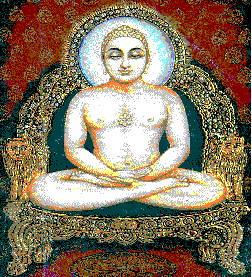
taught to the world by the 1st Jain Tirthankara- Lord
Rishabhdev later on lord Mahavira, the 24th Tirthankara
further advanced it and translated it into action.
The Jain concept of Ahimsa is quite positive, and it is useful for
the social development. From individual point of view, it is a social
virtue as well as individual one so that there would be peace in
society. In today’s context of world tension, fear of war, hatred
towards each other, Ahimsa as understood by Jainas is an essential
factor to bring about peace and sane social order in the world.
To sum up this principle of Ahimsa, non-violence or nom-injury to
life, is one of the extreme importance and universal application. And,
it pervades the entire length and breadth of Jaina code of Right
conduct, the path. The chief criterion with which to judge the rightness
and goodness of a thought, word or deed of Ahimsa. If an action, on the
conduct of a person, is Ahimsite, it is good and right; but if it
involves himsa, especially avoidable himsa, it is bad and wrong, the
degree of badness depending on the character and extent of the himsa
involved.
In short, Ahimsa is equated with ‘dharma,’ the nature of the
soul. It is essential, intrinsic and inherent nature of pure soul. No
wonder that the ancient Jaina sages have described Ahimsa as ‘Param
Brahma’, the very God. Indeed, Ahimsa is a basic necessity for a good
life for individual, community, nation and world. Without it, there can
be neither contentment nor prosperity, nor peace.
The End.
Back to fundamentals
 Home
Home