Gulistan
in my mind…
(Part Three)
By A.H. Jaffor Ullah
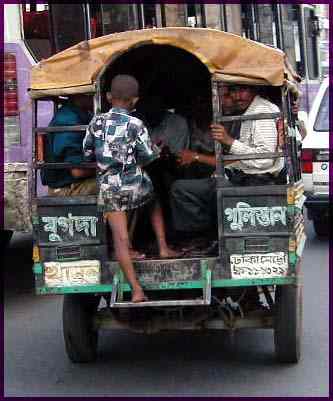
Gulistan
in my mind…
(Part Three)
By A.H. Jaffor Ullah
In any South Asian nation if you
want to start a new community to grow even in a wilderness, all you have
to do is open a new cinema hall. The cinema hall will be like an
attractant - the way bugs are attracted to open flame, cinema hall attracts
our people. For ages, the Bangalees, Biharis, Orrissans, Punjabis,
Maharashtrians, Sindhis, and rest of our subcontinental folks had been
attracted to cinema hall. First, the moviegoers will come by droves;
then, a few tea stalls will open up and before long a barbershop, a tailor,
a magazinewallah, and then myriad business people will open near
the cinema hall. It won’t take an eon before a ricksha stand here
and a babytaxi stand over there will show up. Believe it or not,
a community grows that way in our part of the world.
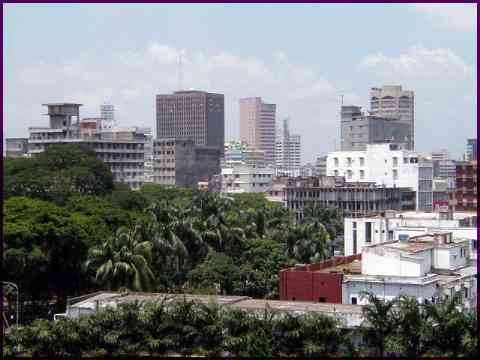
This photo was taken from Nagar
Bhavan looking at the new
Central Business District near
Gulistan
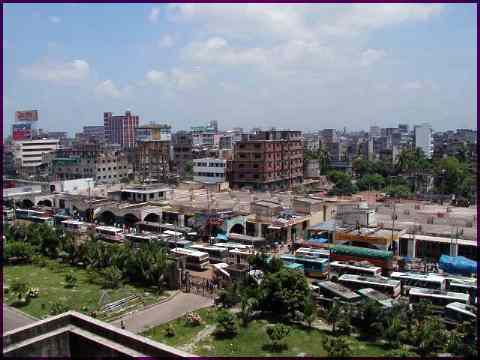
This photo was also taken
from the nagar Bhavan.
Here one can see the Puran Dhaka
(towards Nawabpur)
The Gulistan cinema just did that
in the late 1940s. The folks from Wari and Bangshall had no reason
to cross the Nawabpur railway crossing. Whatever they needed, they
could find it in Puran (Old) Dhaka. Besides, the northern
side of Nawabpur railway crossing was no man’s land anyway. In the
olden days, the big field north of the railway crossing was meant for Paltan’s
(platoons) exercises. For all practical purposes, to the Dhakaites
of late nineteenth century, the city ended at Fulbaria Railway Station
(railway cars came to Dhaka much later than 1854 when the first rail ran
from Howrah to Pundooah in West Bengal). However, that changed in
the early 1900 when some brave folks moved into the suburb of Segun Bagan
(Bagicha), Dilkhusa, Motijheel area. A thriving community of mostly
Hindu intellectuals moved to Segun Bagan (Bagicha) area. By then,
the old Dacca College, which was established in 1886, had moved from Puran
Dhaka to Curzon Hall area; thus, it became a center of higher education
for entire of Dhaka. Thus, when the High Court and Curzon hall were
built in the aftermath of division of Bengal in 1905, the northern suburb
of Segun Bagicha became a very desirable place to live. Please read
Buddhadeb Bose’s short stories to get some ideas about life in idyllic
Segun Bagan in 1920s and 30s. I learned some of these from my high
school teacher Parimal Chandra Sengupta who had attended Dhaka College
at the same time Mr. Bose was attending the same college for his intermediate
degree. Parimal Sir was a close friend of Mr. Bose both then attending
the Dacca College in 1930s.
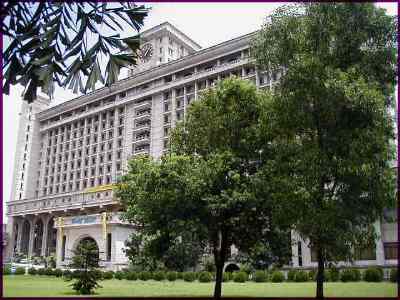
Dhaka's very modern Nagar Bhavan.
The municipality's headquarter was
locared in Old Dhaka before
this building was erected in recent times
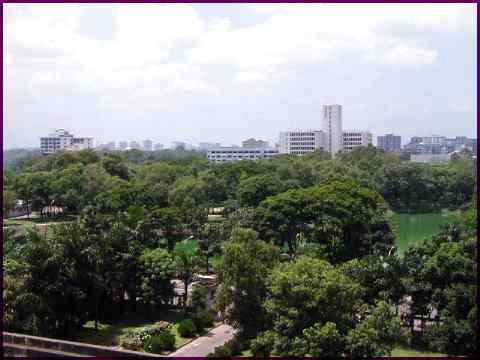
Osmany Uddyan opposite the Nagar
Bhavan. The newly constructed skyscrapers
are all in the easterly direction
in Segun Bagicha and Purana Paltan areas
Let me now make the leap from 1930s to 1950s when commercial activities centering Gulistan building were in the offing. The old Jinnah Avenue was a stretch of road about a mile or so starting from the beginning of Gulistan building from its southern end. Only the western side of Jinnah Avenue could have buildings because the eastern side had the entrance to the Governor’s House, the outer stadium (Paltan Maidan), and the main stadium. Therefore, commercial enterprises started setting up shops, display center, restaurants, and dispensaries on the western side of Jinnah Avenue. The British radio giant Murphy had a show room at the southern end of the Gulistan building. Then come some stores and after which come the entrances to Naz and Gulistan cinemas. After going into the next block, one could see a series of drugstore starting with the Bham Building. Most people from different parts of Dhaka used to come to this block for buying prescription medicines. There were some doctors and dentists’ office in the Bham Building. There were some very classy restaurants in this block too. Come to think of it, La Sani and Shangri-La restaurants were located somewhere there. According to our elders, these classy restaurants used to serve alcoholic beverages. Also, rumor had it then that illegal gambling used to run in these facilities. In those days, Dhaka’s affluent used to visit these restaurants. There will be other clothing stores in Jinnah Avenue. On the backside of Gulistan there used to be one large stationery shop whose name I cannot remember now. However, I remember a departmental store – a very European-looking with Mannequins -- by the name Ahmed’s (or was it calledd Karim’s?) used to be there at the far end of Jinnah Avenue. On the western side of the Gulistan Building there used to be a restaurant and bakery shop by the name Rex. Dhaka’s movie producers, actors, news reporters, used to routinely come to Rex for pastries and tea. I also remember seeing a two-storied government Dak Bungalow behind Gulistan Building. Visiting government high officials from West Pakistan used to find temporary housing in this large house. On the western side of Bham Building opposite to Rex was the famous Baby Ice-cream parlor, where we used to go very rarely because of the exorbitant price. That was the first fully air-conditioned parlor that I could remember opened for business in the late 1950s.
The Gulistan area used to be the
hub of many businesses and newspaper office. Behind the Bham Building
was located The Morning News office. This Karachi-based newspaper
had a branch office in Dhaka.
The Morning News used to publish
simultaneously one from Karachi and the other from Dhaka. This paper
was popular because they used to run a word finding game call “Get-A-Word.”
On every other Friday, scores of people, mostly middle class and educated
ones, used to come to The Morning News Office to buy coupons to
play the game. As a university student, I also tried my luck to win
the prize but without much success.
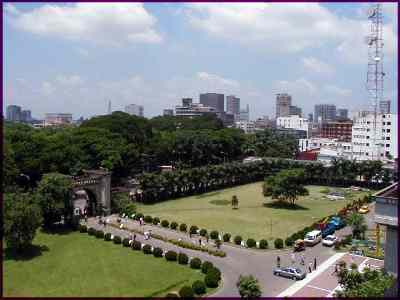
A view of the Motijheel downtown's
skyscrapers from Nagar Bhavan
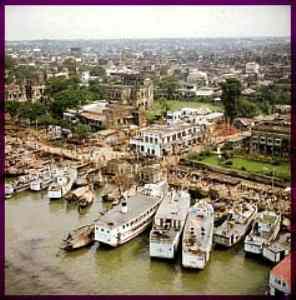
Boat moored at Buriganaga
in Sadarghat (1963 photo)
The Jinnah Avenue area rapidly developed
in the 1950s to become the most sought after real estate property in "New"
Dhaka. Any place that is located north of Nawabpur railway crossing
is considered in those days to be the Naya (New) Dhaka. The
importance of Gulistan area cannot be overemphasized because every place
that you can think about was located nearby. First, there was this
Fulbaria Railway Station that was located just to the southwest of Gulistan
only walking distance from the cinema hall. Second, the secretariat
was nearby located about one-third mile to the northwest. Third,
the Dhaka University and High Court were also nearby, barely a mile from
there in the northwesterly direction. Fourth, even though the Motijheel
Commercial Area was not developed then in the early 1950s; however, it
grew in the 1960s. Fifth, the stadium was only at a stone’s throw
distance from it. Considering all these places of importance that
are near by from Gulistan, the area grew very fast during 1950 through
1960. This place was equivalent to Calcutta’s Chowrongi Business
District. In the entire Dhaka, the Jinnah Avenue was the only
four-lane road, two going in each direction. The neon lights located
in the center island used to light up the road in the evening. Add
to that all the neon signboards that were just making entry to Dhaka for
the first time. All these had added pizzazz to this place.
In fact, Gulistan area ushered in the modernity to Dhaka as early as in
late 1950s. Other commercial places such as Nawabpur and Sadarghat
used to look pale and dingy as compared to glitzy Gulistan-Stadium area.
There was nothing snazzy about Gulistan area. All the stores were
decorated with a touch of class. If anyone wanted to see garishly
decorated store, he or she had to go to Patuatuli or Islampur area in the
southern most section of Old Dhaka by the river. Gulistan area stores
were chic and elegant with modernity written all over them.
The construction of a government planned New Market next to Nilkhet and
Azimpur only was started in the early fifties; and the first time I visited
that shopping center probably in 1955-56. I also remember seeing
some Banks’ branch offices located in Jinnah Avenue. The insurance
companies also had their provincial head offices in the same area.
All in all, this strip of about one mile was indeed the center of attraction
in Dhaka. In today's parlance Gulistan area could be dubbed as Central
Business District or CBD of Dhaka. There was one more thing that
I almost forgot to mention here about Gulistan’s one more attraction from
culinary standpoint. Behind Gulistan cinema was a small makeshift
mosque; next to it one could have seen few pushcart vendors selling very
spicy snacks such as chatpati, foochka, etc. Moviegoers
used to jam this place after the show was over. A visit to these
roadside eateries was a must in those days. The name and fame of
Gulistan as a place to visit spread all over erstwhile East Pakistan so
much so that folks visiting Dhaka from rural areas used to visit this area
to see those 5-storied buildings that would line up for the entire three-fourth
mile starting from the southern edge of Gulistan building and ending in
close to GPO building, which was located on the other side of the Jinnah
Avenue.
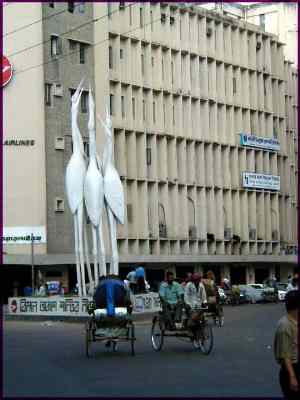
The sculpted cranes near Biman
Building in Motijheel.
This structure was non-existent
in the 1960s.
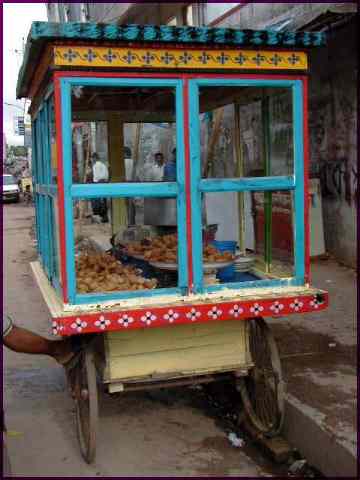
Fuchkawalla keeps the age-old
tradition of Gulistan
Gulistan’s importance as a communication hub of Dhaka cannot be neglected either. First, the railway station as I have mentioned earlier was only walking distance from the building. The bus from different parts of the suburb used to disembark its passenger next to Nawabpur railway crossing. That bus depot used to be very crowded all the time as I remember now. A flurry of activity could be seen at this bus depot. In fact, a bazaar grew up there in no time. I remember seeing many roadside restaurants and itinerant cameramen taking photos with outrageous background. Street vendors used to have all sorts of merchandise to sell. One could get a glass of sugarcane juice pressed right before their eyes as the passengers wait for the arrival of the buses from other parts of the city. This crowded bus depot was not the only one to grace the Gulistan area. The bus depot for Mahakhali line (Route 6) used to start from the southern edge of Gulistan Building, whereas, the bus for Kurmitola and Tongi used to line up behind the Gulistan Building on the west side. Also, bus services to Old Dhaka (Route 2) used to stop at the corner of Jinnah Avenue and the road coming from east (Tikatuli) bringing folks from Motijheel area. Even in the mid 1950s, this place used to be very congested. People had hard time crossing the wide Jinnah Avenue. This was the place many accidents used to happen because many rural folks coming to Jinnah Avenue area for the very first time used to get confused while crossing the wide four-lane road.
(End of part 3)
------------------------
A.H. Jaffor Ullah writes from New
Orleans, USA. His e-mail address is - [email protected]
To go to part four of Gulistan in my mind...
To go to the Index
Page of Jaffor Ullah's Illustrated articles