Gulistan
in my mind…
(Part Four)
By A.H. Jaffor Ullah
Gulistan
in my mind…
(Part Four)
By A.H. Jaffor Ullah
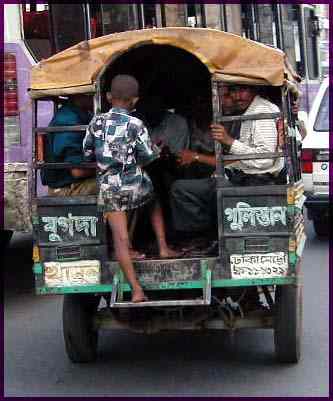
The main mode of transportation
in Dhaka in 1950s used to be by rickshas. In Old Dhaka though, the
hackney carriage (Ghora’r Gari) used to run everywhere. In
fact, when our family first disembarked onto Fulbaria railway station in
1950, we were taken to our temporary place of stay at Juginagar in Wari
by a horse carriage. Most coachmen used to be Dhakaia Kutti
(the local half Bangal-half Urdu spoken folks of old Dhaka). Their
tongue was acerbic, their language caustic, lively, and witty. In
those days, many jokes abound centering the conversation between the
kutti
coachman and the bhadralok (educated) shawari (passenger).
In mid 1950s, we first started to see the coming of Italian made Vespa
babytaxis. Welcome to the world of pollution. They used to
make the body near Dolia Khal in Old Dhaka. Before those babitaxis
came to Dhaka, we had much cleaner air, though. Incidentally, the
Gulistan area was the main hang around place for the baytaxiwallahs. The
babytaxi stand stood next to the Gulistan building. That was the
largest stand for the babytaxis in the entire Dhaka. It was costly
though to hire a babytaxi to go from Gulistan to Farmgate. The bus
would cost only 2 anna (12 naya paisa), a ricksha would charge 8-10 annas
(50-65 naya paisa); however, the babytaxi would charge anywhere from one
to one and a quarter rupee (Taka). In those days, middle class folks
would hardly make 175 to 300 rupees per month. Thus, comparatively
speaking, the babytaxi fare was beyond the reach of most ordinary people
who had great difficulty to make both ends meet with this paltry sum of
money. At the time, however no one was abashed to take a bus ride.
It is now a different situation altogether.
 |
 |
I fondly remember two things one
happening in 1959 and the other one in 1960. I was in my 8th grade
attending the Tejgaon Polytechnic High School. In 1959, my two elder
brothers and I went to Gulistan Cinema to attend the Press Show
of the third movie of East Pakistan – Akash aar Mati. Mr.
Fateh Lohani directed this movie. My second brother and I acted in
this movie. The shooting was done in late 1957. As a child,
I got to meet all the actors of the movie. I had no idea what the
press show meant. There was a great deal of feasting at the movie
theater. Gulistan Cinema wore a festive look on that afternoon.
I felt as if somebody because we were ushered into a special seat only
reserved for the actors. My schoolteacher Mr. Nani Basak knew that
I had acted in Akash aar Mati movie. A year later in 1960 one day
he asked me to come to his house located om Modonmohon Basak Road in Wari,
Old Dhaka. I went there dutifully to find that he was anxiously waiting
for me with his daughter who was in my same age group. She was very
pretty young girl with big eyes and she was soft-spoken too. Nani
Basak sir told me that Jharna has a screen test at one place in Jinnah
Avenue. We took a babytaxi from old town Dhaka to reach Jinnah Avenue
pronto. We climbed up couple of stairs in one of the building right
in the middle of the avenue not too far from Gulistan. Some Urdu-speaking
folks were waiting there in the room. They had a makeup man there
at the site. Jharna was gone for only few minutes. She returned
to the room looking even prettier than before. The cameraman took
several shots of her. The entire thing took less than half an hour.
While we left the place, Nani Basak Sir told me that these are moviemakers
from Lahore. And they wanted to make an offer to her for acting as
a dancing girl for a movie. A month or so later a happy-faced Nani
Basak Sir told me in the school that the movie producer liked Jharn’s photogenic
face. One of the film directors probably (Mr. Ehtesham or his brother)
picked a screen name for Miss Jharna Basak. Shabnam was the name
of this teen actor. The rest was history. Shabnam became a
box office hit actress in the mid 1960s at this tender age. I have
my doubts though whether she remembers that eventful day when we all went
to that building in Jinnah Avenue for her screen test.
 |
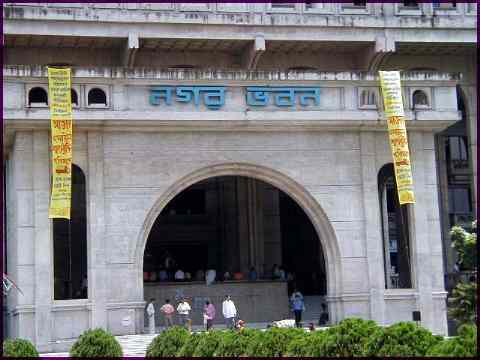 |
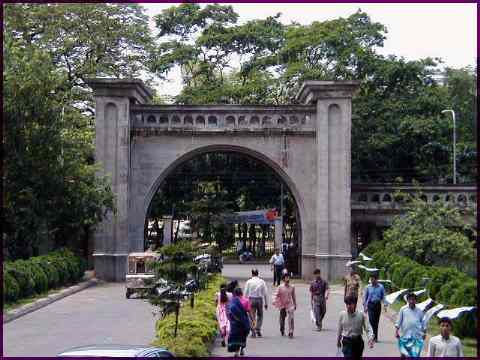
Allow me to move into a less glamorous area of describing the concrete buildings in the Gulistan area. The DIT Building was modeled after certain British architecture in London, which was erected in the 1950s. This building was located very near to Gulistan building; its location was on the eastern side of the stadium. Later in the mid 1960s, Dhaka’s only TV station had its studios located in this building. In late 1950s, the Adamjee group of Industries built a very modern office complex in close proximity to the DIT building. The US government rented some space here where they housed their consular office. In 1969 when I was getting ready to come to the US for my graduate studies, I stopped by at this place to receive my student visa. Therefore, from a personal perspective, I have many fond memories of Gulistan and the nearby places. Furthermore, in the 1960s, I used to come in the winter months to watch the test matches played between the Pakistani team and visiting teams. Thus, I consider myself being very fortunate to watch MCC, Australia, and West Indies. However, only in 1950s (circa1955-56) Indian team captained by Vinu Mankad came only once to play in Dhaka. To my knowledge, India never sent any national team to Dhaka since then (I can only speak up to 1970).
Soccer used to be a very favorite sport among Bangalees. In 1950s, there were only two leagues; one -- A League with the best teams and the other one was B League with lesser-known teams. Most A-Teams had their clubhouses located in the outer stadium area. The most prominent teams were The Wanders (or was it Wanderers?), The Mohammedan, The Azad Sporting, and The Victoria Sporting Club. Our own Tejgaon Friends’ Union was also a lesser-known team belonging to A- Teams. Another team from Tejgaon was called B.G. Press (Bengal Government Press). Our high school’s teacher Mr. Dinesh Chandra, popularly known in Tejgaon as Dinesh Sir, was the general secretary of this team. It was poorly funded team. Nevertheless, the local boys who used to make the bulk of the roster, once in while would beat the champion team such as Azad Sporting or Victoria Sporting Club.
The soccer teams of Dhaka used to
do their fund raising by hosting the game of “Housie.” The clubhouses
in those days were made of wooden structure and they were scattered all
over the Paltan Maidan on the eastern side. In 1960-61, I have visited
these clubhouses just out of sheer curiosity. Before that, the Aga
Khan Gold Cup tournament was established in the late 1950s. My teacher
Mr. Nani Basak used to serve as the referee’s assistant (Line’s man).
Therefore, I used to attend these games gratis. Calcutta’s Mohammed
Sporting Club also took part in this game in one year and so did some Burmese
or Indonesia’s team whose name I forgot by now. The sports events
made the importance of Gulistan Area even more.
 |
 |
The other important places near Gulistan Building were the two cultural and library that were very popular among the students of Dhaka’s colleges and university. The British Information Service used to have their office in a wooden structure in Purana Paltan in the early 1950s. In November 1956 when the news of The Suez - Sinai War came to Dhaka, the angry mob stormed the wooden building that housed the British Information service. In that Middle East war between Egypt and Israel, the British sided with the Israelis. Thus, people were very angry in Dhaka and they did burn down the place. Even though I was a little kid then, I still remember our elders talked about the burning down of this library run by the British. The USIS facility was located opposite to Dhaka’s Press Club in Segun Bagicha near the Secretariat building. Both the old British Information Service and USIS were located not too far from the Gulistan building.
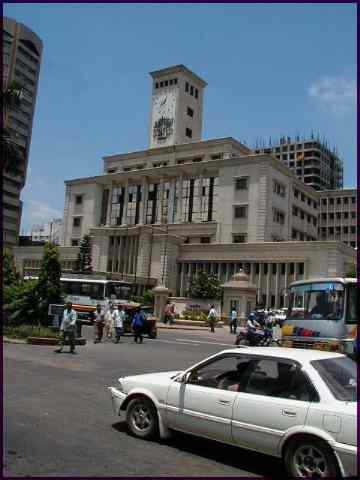
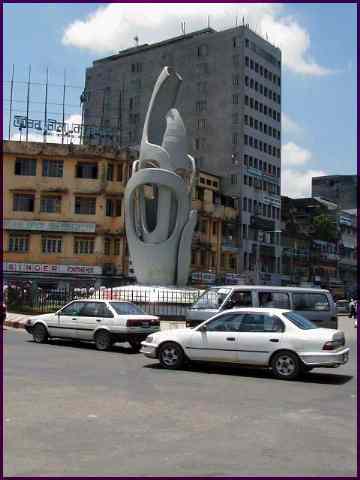
In the late 1950s, the government decided to construct the first ever traffic light (signal) in front of Gulistan Cinema. The traffic signal used to be manned by a traffic policeman who would sit in a small box in the intersection of the road. In addition, I remember that the municipality brought the famous cannon of Mir Zumla and puts it at the intersection of the road coming from DIT building and meeting the Jinnah Avenue. Folks used to come and take their photos standing next to the cannon that had a new paint job then. As a child, we used to climb up the barrel of the cannon. In 2001 when I visited the Gulistan area, I could not find the traces of Mir Zumla’s cannon right at the spot where it was placed some 40 years ago. A young traffic police whom I could find there said he does not remember seeing any cannon at this spot ever. I was saddened by the policeman’s reply. A historical object had gone into oblivion quite unnecessarily.
Although my visit to Gulistan in
July 2001 brought a lot of memory and emotion in me, I was quite shaken
by the sordid look of this place. Yes, in the last thirty plus years
I have been living outside Bangladesh. Yes, I have seen many marvels
of man’s creation including some fine specimens of architecture and building
including IM Pei’s famous architecture of
Pyramid at the Louvre
in Paris, which was constructed in the 1980s. Therefore, it won’t
be out of place if I make comments about the ordinariness of the architecture
of Gulistan
building.
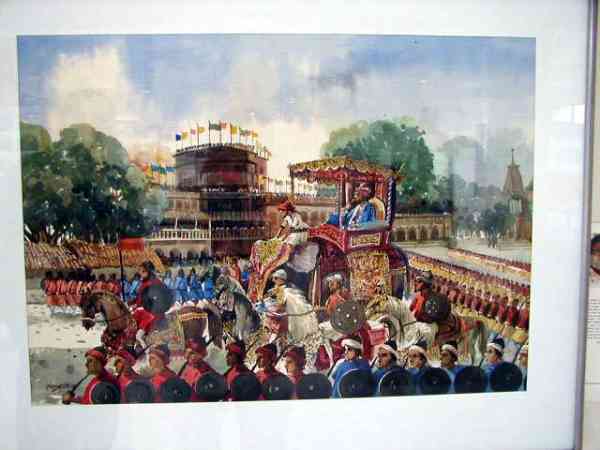
This painting shown in the Museum
at Nagar Bhavan depicts a celebration of some
sort taking place in Dhaka in
which a nobleman participates with full regalia.
Yes, this is the place that I thought had some pizzazz in my early life. However, the sad thing is that these properties were never upgraded or even taken cared properly. The humidity and the heat from tropical sun did these buildings in. These structures were built by the financing of non-Bengalis in the early 1950s but after 1971, the Bangalee owners never cared for these buildings. These derelict structures are now sitting in the most prized land. Therefore, there is a renewed interest in these building. However, the interest lies only in the demolition to retrieve the precious land. Right before flying to Dhaka in June 2001, I read in Dhaka’s newspaper that Gulistan Cinema building will be demolished and in its place a big hotel will be erected. The much talked about demolition took place perhaps in the May 2001. Therefore, when I arrived in Dhaka the building’s facade was already gone. In July 2001, when I visited the place, I took some photographs of the demolished building and the nearby places. It was a depressing sight, undoubtedly. The crumbling walls wore a pallid look. It looks like a ghost building. I can’t even imagine that tens of thousands of people flocked to this building for entertainment. They paid a decent sum of money to spend 3 hours of their time to enjoy a movie sitting in the air-conditioned cinema hall. All these memories are gone now. In just few years, a new plush building will stand in this place. Perhaps it will be an air-conditioned hotel or an office building. In 10-20 years time no one will even remember that a gorgeous cinema hall – the best in Dhaka city – used to stand hear for half a century. Consequently, all the living history and the memory of it will go into the black hole of Dhakaites’ memory. I guess this is what is call life in the Third World.
(The End)
---------------------------
A.H. Jaffor Ullah writes from New
Orleans. His e-mail address is - [email protected]
All the photos in this article
was taken by the author using a digital olympus camera fitted with a optical
zoom lense.
To go to the
Index page of Jaffor Ullah's Illustrated articles