Gulistan in my mind!
(Part Two)
By A.H.
Jaffor Ullah
Gulistan in my mind!
(Part Two)
By A.H.
Jaffor Ullah
The movie theater Gulistan used to screen mostly the hit movies from India, Lahore or even from western nations; however, its companion theater -- the Naz -- used to show only English movies. The Pakistani government was lenient about importing hit Bombay and Calcutta movies from India. That liberal policy of the government did not last long, though. The military government of Ayub Khan finally put an end to this liberal policy of occasional screening of both Bengali and Hindi movies from India. That irked the liberal folks of Dhaka, to say the least.
The capacity of the Naz cinema hall
was very small as compared to the Gulistan. Therefore, it made sense
for Naz cinema to screen only foreign films for Dhaka’s discriminating
moviegoers. Our hearts and minds used to be with the Naz Theater.
In every Friday’s issue of the English newspaper the first thing we would
do was to search the movie guide hoping some good flick was coming to Naz
theater. As was the case, we saw many English movies in this theater
throughout the 1960s. I still have fond memory of watching Elvis’s
‘Blue Hawaii’ in this theater. Gulistan cinema also brought some
exciting flicks; come to think of it, I enjoyed viewing David Lean’s fine
movie “Bridge Over the River Kwai" (1957) starring such luminaries
as William Holden and Alec Guinness in Gulistan. The other good one
I viewed there in Gulistan was Hollywood’s blockbuster movie “Ben Hur”
(1959) starring Charlton Heston and Stephen Boyd. Come to think of
it, both the Gulistan and Naz Cinema used to be a denizen of Dhaka's Teddy
Boys of the sixties who must have tturned fifties by now.
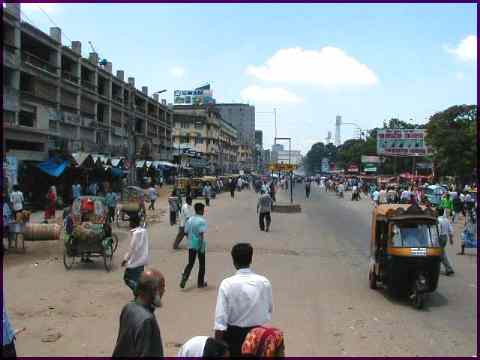
From a traffic police's control
point I took four photos.
This one looks at northerly
direction from Nawabpur side towards bait-ul Muqarram
Watching movies occasionally used
to be the only mode of entertainment in Dhaka until television came to
town in a very limited way in late 1960s. Before that, we used to
go to industrial exhibition in the winter days in Ramna Park. In
those days, the park used to be empty; not many trees were there, therefore
it was an ideal spot for hosting an exhibition or Shilpo Mela even
though there weren’t much Shilpo (industries) to talk about.
Nevertheless, the Mela (Fair) used to draw a large number of crowds.
There was another event I must make mention of here because it deals in
high technology and entertainment both at the same time. As far as
I could remember now, in 1963, the U.S. government brought a new technology
in the domain of entertainment to Dhaka. They erected a humongous
temporary movie, which was circular in design in the outer stadium (Paltan
Maidan) opposite to Gulistan Cinema. This was called Circarama,
which is essentially a three-hundred-and-sixty-degrees projection cinema.
The event was free; therefore, a crowd thronged to watch this unique movie
presentation. The short documentary movie essentially glorified all
the good thing America has to offer to humankind in the 1960s.
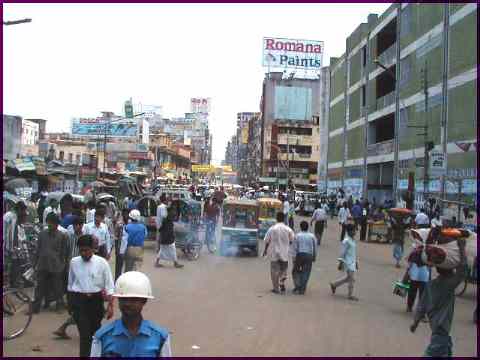
This photo looks at the
southerly direction from the same traffic police's control point
towards Nawabpur side.
Look at the traffic congestion and emission from a babytaxi!
By early 1960s, Gulistan area was fast becoming a business park because of its unique location. It was bridging both the old and new Dhaka. For example, a business center rapidly grew in Gulistan-Stadium area as early as in the late 1950s. The stadium market, which it was called, became a popular spot for shopping for the upper middle class. In those days, the battery operated radio used to be the most sought after item and guess where one could find this item in Dhaka. A trip to stadium market was the best thing one could do to find a good radio to buy. The first transistor radio came to Dhaka in the early 1960s and one could buy this item for rupee 500-600 in the stadium market. Besides electronic items, sari stores were springing up everywhere in the stadium market. I still can recall a sari emporium by the name ‘Pabna Sari House’ located in this place. So were the eateries. Many good quality restaurants found good home in the stadium market.
Dhaka stadium has a colorful history
like many other things in this Mughal originated town. It may sound
funny but the fact is the stadium used to be a wooden one in the forties.
It was essentially meant for local soccer games. The Bengalis in
those days hardly played any cricket. Thus, there was no good cricket
field in Dhaka or anywhere else in East Pakistan. In January 1955,
a red-hot Pakistani team came to Dhaka to play a test cricket match against
India after they defeated the MCC team in Oval, England, hardly 6-7 months
ago. The team was captained by a talented cricketeer by the name
Abdul Hafiz Kardar. None other than the Indian cricket legend Vinu
Mankad captained the Indian team. The neighborhood kids all went
to see the practice session of both the Indian and Pakistani team practicing
in two corners of Dhaka stadium. I remember meeting Fazal Mahmood,
a handsome cricketeer who earned a good reputation of being a medium pace
bowler; his powerful bowling had devastated the England’s MCC in Oval test
match in July 1954. We also met a few other Pakistani cricket players
at the time including Khan Mohammad (a fast bowler) and Shujauddin who
was both an all-rounder batsman and a slow spin bowler. The fun part
visiting the players on that day was to get the autographs from these players.
I was only 7 years old then; therefore, I had to accompany some elder kids
of our neighborhood. The Pakistani players were kidding with us as
we gather their autographs. The fast bowler of Pakistani team Khan
Mohammad lifted me over his had and held me in the air for few seconds.
It caused a roll of laughter among the crowds. I felt embarrassed
but other kids thought I was a lucky fellow to be lifted by none other
Khan Mohammad. Well, that was the talk of the schoolyard for the
next few days. The budding batsman Hanif Mohammad who was our hero
was only in his lare teens in those days. Therefore, we probably
missed him thinking that he was much older. The Indian team played
well and it was a draw match. After the match, the government decided
to demolish the wooden stadium, which was worn out by then, and replace
it with a concrete one. In the mid 1960s, the stadium was made two-storied
because of the growing demand for seats. I remember watching Pakistan-West
Indies cricket match in mid 1960s in which WI’s captain Gary Sobers participated
in the game but only to experience a humiliating defeat in hands of Pakistani
team. In mid 1960s, a powerful Australian team came to Dhaka. This
is the only game in which the Pakistani team was defeated by the visiting
team in Dhaka field. In late 1960s, the MCC came to play the Pakistani
team in Dhaka. All in all, there were 6-7 test matches being played
in this stadium if I recall correctly.
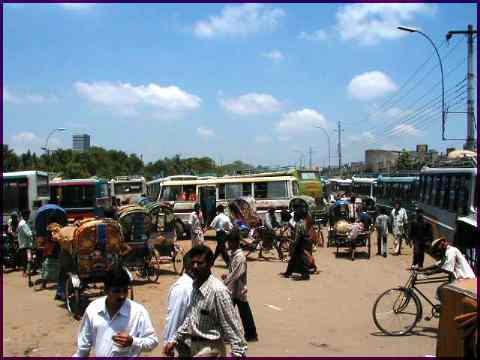
To the southeast of Gulistan
towards the old Governor's
House we see another bus depot
In the late 1950s there used to
be another big field next to the stadium reserved for both sports and politics.
It was then called the Paltan Maidan. Later the part of Paltan Maidan
closer to the stadium was dubbed the ‘Outer Stadium.’ The Inter-school
football competition used to be played here. So, this was a well-known
territory for us - all the school kids of Dhaka. We used to come
to root for our school team regularly. These games would invariably
end up with petty violence in the sideline. A lot of bad blood had
developed between the rival schools. For example, our Tejgaon Polytechnic
High School couldn’t stand the players of the Nabakumar Institute.
Thus, there would be fistfight among bigger kids. Being little, we
used to stay out of the harm’s away.
All the photos were taken from one point where Gulistan meets Nawabpur Road, looking north in Baitul Mokarram's direction (upper left), south in Nawabpur's direction (upper right), east (Tikatuli's direction) and west ( Fulbaria's old railway station or Bangabazar's direction.
Since I am describing in some detail
what it was like nearby Gulistan building, I would mention about the hawkers’
market, which was next to a mosque standing in Paltan Maidan. God
only knows when this hawkers’ market was started in the far side of the
‘Outer Stadium.’ There were plenty of empty spaces on the northern
side of the railway line that connected Dhaka to Narayanganj. Most
likely, the squatters came in from nowhere and opened stalls to sell lungi,
sari, chaddar, etc., to the crowds which Gulistan area had many.
In winter months, this place of ‘Outer Stadium’ would host a variety of
programs such as drama, jatra, mela, and myriad other outdoor activities.
In a way, this place was just an oasis for Dhakaites in those days.
Since many people would hang around near Paltan Maidan area, there was
obviously a need for outdoor entertainment. Besides, there was hardly
any empty space in the crowded
Puran
(Old) Dhaka. This could
explain the popularity of Paltan Maidan becoming an oasis for the folks
living across the Nawabpur railway crossing in the southerly direction.
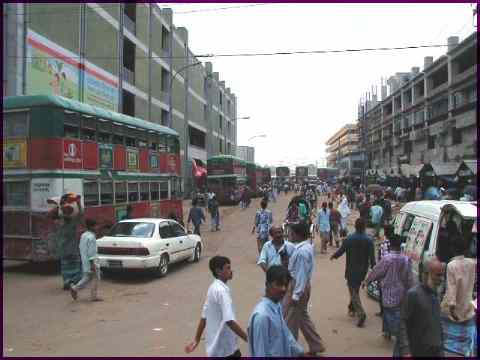
Passengers and pedestrians mill
around the bus depot to the
southwest of Gulistan near Old
Fulbaria Railway Station
The main road hugging the Gulistan Cinema was named after Mr. Muhammad Ali Jinnah to honor the man who gave a separate homeland to Muslims of East Bengal and northwestern provinces of British India. Now that is a befitting honor one could bestow the principal leader of Pakistan. I think this naming of the widest boulevard in Dhaka was done posthumously in 1949-1950. Mr. Jinnah was not there to hear that the Bangalees have honored him by naming the widest avenue in the city in his name. In 1972, after Bangladesh became independent Jinnah’s name became an unpopular one overnight. And so did the name of our favorite esplanade. The name of Jinnah Avenue was changed to Banga Bandhu Avenue to the dismay of many Muslim Leaguers.
The old Jinnah Avenue is a north-south road. It started from the end of Nawabpur rail crossing and it headed straight north. The road was supposed to go straight into Purana Paltan area. From there, the road would have gone in northerly direction still to head towards Maghbazar. But if one sees the old Jinnah Avenue one will see that when the road comes near the main gate of the stadium, it made an abrupt left turn (ninety-degrees turn) and then it again made an abrupt right turn, again a ninety-degree turn after few hundred yards or so. This strange wiggling of the main road was due to the work of a few unscrupulous Bangalees of Purana Paltan. We heard from our schoolteachers and elders that some influential folks of Purana Paltan influenced the DIT (Dhaka Improvement Trust) staffers to change the course of the road. In 1962, a mosque was erected on the north side of first bend where Jinnah Avenue makes the first abrupt ninety-degree turn near the foreign post office. Can you guess the name of that mosque?
(End of part 2)
---------------------------
A.H. Jaffor Ullah writes
from New Orleans. His e-mail: [email protected]
To read the next chapter of Gulistan in my mind click here
Return to the Index Page of Jaffor Ullah's Illustrated article