Gulistan
in my mind…
(Part One)
By A.H. Jaffor Ullah
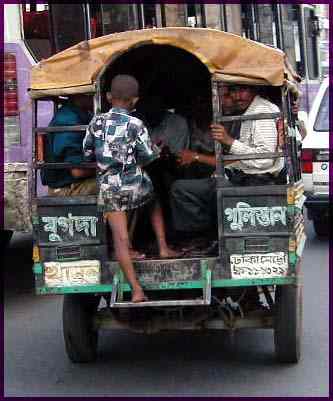
Gulistan
in my mind…
(Part One)
By A.H. Jaffor Ullah
This article is a curtain call for fifties and sixties Dhaka. Yes, I will narrate some personal reflection from the pages of my life. They say that teenage years of a person have the maximum impact on one’s life. And this is very true. How often do we find ourselves humming a tune from the bygone days of our youth? Many a time.
Kids of my generation who grew up to be teenagers in Bengal in the fifties and sixties fondly remember the tune of Hemanta Mukhopadhyay, Sandha Mukhopadhyay, Shemol Mitra, Satinath Mukhopadhyay, Manna Dey, Manabendra Mukhopadhyay, and many more artists like them. From ‘Silver Screen’ we still remember the faces of Uttam Kumar, Suchitra Sen, Sharmila Thakur, Chhabi Biswas, Bikash Roy, to name a few. Some boys of my generation were so much enamored with the acting and beauty of Suchitra Sen that she became the femme fatale of many a kid. Therefore, the impression of one’s halcyon days of youth leaves an indelible mark, which is rather difficult to efface no matter how hard one tries.
The neighborhood in which one grows up also leaves a distinct impression on one’s mind. No wonder Nobel laureate Amartya Sen’s mind is haunted by the fleeting images of his childhood at Larmini Street in Wari, Old Dhaka. Whenever Prof. Sen gets an opportunity to visit South Asia, he makes sure to visit Dhaka. However, does he visit the posh area of Baridhara or Gulshan? Not quite so. Instead, he heads towards Wari, the olden section of Dhaka. To him, the neighborhoods in and around Nawabpur Road and Victoria Park would be more interesting to visit rather than strolling through Gulshan Lake or having a shopping spree in Kemal Ataturk Road’s fancy stores. Even the nightlife in Gulshan with all its fancy eateries would not provoke a slightest interest in him.
The Cambridge don is renowned for roaming the streets of Wari and other parts of Old Dhaka in search of his lost family history. This attachment to our past is the force that dictates one to visit the old places. Even though the images of the old places that are transfixed in our mind quite do not match the present-day look of the same old places, but this trip down the memory lane brings a lot of emotion in many folks. I can empathize with Prof. Sen for his ardor to go back to the places where he roamed in his adolescent days. I know there is some people who for whatever reasons would rather not visit the places where they grew up. Nonetheless, some persons among us would not mind taking the nostalgic trip to yesteryears.
For me, visiting the places that I encountered in the past most certainly brings a sense of personal history. We all have a humble beginning. It hardly matters what we are today. However, to go to a place where we grew up, it mostly brings up the memory of bygone days when our needs and aspirations were not that big. We were more than happy with our little achievements in those days. Those accolades may seem trivial today, but decades ago we were very proud to have them. Nonetheless, forgetting one’s past is quite normal for some censorious folks. However, for me, it will be an outright anathema. I am very defensive about protecting my past. There is nothing in my past that I want to forget. No unpleasantness whatsoever. Mind you, life was not all that placid in the fifties and in turbulent 1960s. Nonetheless, I don’t cringe for the fear that my past is going to reveal some horrible stuff. No, I was not a Razakar; nor was I an Ayub (Gen. Ayub Khan) lover, which we had plenty in Dhaka. I was a plain Bangalee who always dreamt about living under the sky without having to say 'yes sir' to the Pakistani militaries or the politicians. However, I know many a kid who grew up in those days dreaming about joining Pakistani army [as many famous men had done so in the 1950s], air force, navy, or civilian administration. For them, serving the masters meant more than serving mother Bangla. This is one of the reason the yesteryear of my life is downright alluring to me. Not many kids of my generation however could say that with certitude and in a firm tone.
When my parents first brought us
to Dhaka in 1950, we stayed in a brick house in Juginagar located deep
inside Wari. I have a vague recollection of that place. My
mother talked about this place later when I was growing up in the verdure
of Tejgaon. Her description of the place may have gone inside my
head. And I think I know that place for sure. However, in reality
I have a hazy recollection of that place. All I could remember was
monkeys, which we had plenty in old Dhaka in the fifties. In 1951,
we were leading an itinerant lifestyle; from Wari we first moved to Khejurbagan’s
staff quarters for government agricultural officers. We stayed there
for few months and then again it was a moving time. We stayed at
our maternal uncle’s house ‘Bari Villa’ closer to Tejgaon railway station
for hardly 2-3 months. From there, we finally moved to Tejkunipara
(near Farmgate area) permanently. There, our house was an one-stored
brick home, which was a Baganbari (rest house) of a zamindar
from Idilpur, a place whose location is still unknown to me. The
original owner of this place, i.e., the zamindar was a Hindu person because
there was this Mandir next to our house, a small one though. The
zamindar
named
this Baganbari the 'Idilpur Probash.' When he would come to
Dhaka for whatever reason, he would stay in this place. There was
an acre or so land around the house with many exotic plants and fruit trees.
In late 1950s, Prof. Saidur Rahman, father of Shafique Rehman of Din
Din Jai bought this property
illegally by paying scanty sum
of money to a man in Calcutta in late fifties even though a law was passed
by then which would have barred anyone from buying properties from Hindus
who have already moved to India. The property was then distributed
among 4-5 people. Our family also received a tiny part of the land
while professor Rahman gobbled up the lion share. I will write in
thorough details in my future articles exposing the mindset of Muslim Bangalees
who were educated during the British Raj and who were absolutely greedy
when it comes to possessing land especially the one that belonged to the
Hindus who had left East Bengal for West Bengal in the wake of Desh
Bivag (partition). Enough of this excursion. Let me now
go back to the main topic of my narrative.
 |
 |
In 1950s and 60s, the central business
district of Dhaka used to be the Nawabpur area. People would say
then that one could even buy tiger’s milk for a fair price in Nawabpur.
The Gulistan area was just developing in the late 1940s. For the
people of Old Dhaka, Gulistan area was the northern edge of the
city. With contemptuous mirth, they were calling it Noya Dhaka.
Beyond Gulistan was sparsely populated land of Segun Bagan (Bagicha), which
was immortalized by Buddhadeb Bose’s writings. It used to be a suburb
where most educated Hindu lawyers, doctors, teachers, etc., used to live
in the thirties (as per Bose’s short stories). Tejgaon used to be
a no man’s land then. It makes sense why the zamindar of Idilpur
built his Baganbari in Tejgaon. The prime reason was being
the cheap price of land in Tejgaon area. The Northern part of Dhaka
had this humongous Kali Bari (Mandir for mother goddess Kali) in Ramna
area that also housed an Ashram by the name Anandamoyi Ashram. By
traveling to farther north, one could have encountered Shahbag where Dhaka’s
Nawab used to have a Baganbari. Then one would find Maghbazar.
I don’t know whether any of the Magh people used to live one time or another
in this place. Then one would have run into Kumarpara. This
is the place where Hotel Sonarga stands now. Right now, this is the
center of Dhaka city. In Kumarpara, they used to sell earthen pots.
I have some vague recollection of visiting the Kumarpara with our servant.
There stood a roadside shoshan (crematory) next to the Kumarpara
as I recall the place. Next to the crematory were few Palmyra Palm
trees known in Bangla as Tal Gach
and some Khejur Gach (date
palm). In monsoon days, water used to fill the low-lying areas next
to Kumarpara and Karwan Bazar because of the deluge. Small
boats carrying succulent Tal Shash (immature fruits) and fuel woods
would moor their country boats to this place. In those days, the
locals could hardly pronounce Karwan Bazaar accurately. They used
to say Kawran Bazar. The word Karwan may have derived from the word
caravan.
 |
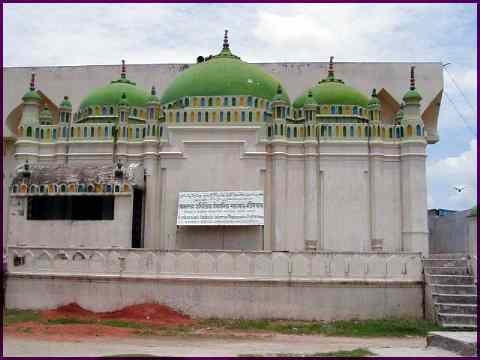 |
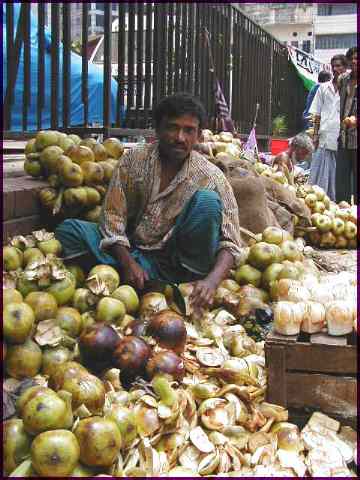
In the 1950s, Karwan Bazar was the main shopping place for us as far as groceries were concerned. It was then located one mile to the South from our house. To go to the main bazar, we would cut across the Christian Missionary’s big open field, which the nuns never appreciated. They used to abhor our trespassing of their ‘scared’ land. Then we would cross Tejgaon Polytechnic High School yard, from there, we would cut across Tejtari Bazaar, and that would bring us right into the heart of Karwan Bazar where one would find an enormous tamarind (tetul) tree. Behind the tamarind tree was a small mosque, which is still intact and one could see the green clored minarets of this mosque next to the building that houses ofices of the two newspapers of Dhaka. This meandering trip from our house to Karwan Bazar through Christian orphanage, Old Polytechnic High school, and Tejtori Bazar would save us about one-third of a mile or so. However, in the 1960s, a new road was built when in 1961 Queen Elizabeth came for the very first time to visit East Pakistan. This road is now aptly called the VIP Road.
Commuting from Tejgaon to Gulistan
was a cinch then. A bus service used to run from Old Tejgaon Airport
to Gulistan even as early as in the 1950s. Later, the route was extended
to Mahakhali to the northeast in the mid 1950s. This used to
be known as Number Six Route. The other bus that would take us from
Farmgate to Gulistan would come from Kurmitola Cantonment. On the
way to Gulistan this bus would cross Shahbag, Ramna Racecourse, Public
Library, Chankha’r Pool, and then passing the Asiatic Society's building
, Pakistan Air Force's Recruitment Office where one could see an old fighter
plane parked in front of the building, Old Jadughar, and TB hospital, railway
head office, and Siddique Bazar, the bus would finally reach behind the
Gulistan Cinema. It used to cost us two-annas, which was equivalent
to 12-naya paisas. In 1961, Pakistan moved to decimal (metric) system
from the antiquated anna system (16 annas equivalent to one rupees or Taka).
In those days, a college professor in a government institute used to earn
Rupees 250 to 300. Therefore, two annas were not next to nothing.
A middle-class family used to spend Rs. 2 to 3 for daily kutcha
bazaar. A cinema ticket in Gulistan used to cost a horrendous some
of Rs. 1.25 in middle stall (rear stall was even more expensive something
like one rupees twelve annas or 1.75 rupees!).
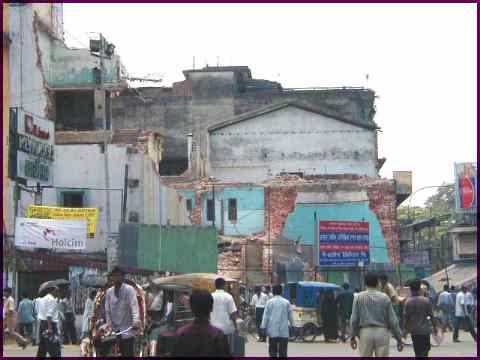
A demolished Gulistan looks like a war zone
now!
The movie theater Gulistan used to be the place where our heart belonged in the 1960s. Our elders told us that there was a rundown cinema hall where Gulistan was located. The theater, New Britannia, which was quite appropriately named during the colonial time, was there to screen movies for the army who would live 6-7 miles to the north in Kurmitola. After the partition, the old theater was demolished [or it may have burned down] and in its place, a brand new theater was erected. An Urdu/Farsi name ‘Gulistan’ (Flower Garden) was given to this new theater. It was the only centrally air-conditioned cinema hall in entire East Pakistan. Therefore, the ticket was used to be a bit pricey here. Later in the 60s, they built another movie theater on the third floor of the same building next to Gulistan movie house. It was named Naz (another Urdu/Farsi name). The owner of these two movie theaters was Urdu speaking people with ties to West Pakistan. One of the owners had the family name Dosani. I noticed that the guardsmen in the movie theater were all Urdu speaking people. One time, I asked a guard to tell me where the owner was from. I remember him saying that the Malik (owner) was non-Bengali. I asked the same question to Bangalee movie director Mr. Salahuddin in 1978 who had a film distribution office in the adjacent Bham Building. He also told me that most buildings adjacent to Gulistan were owned by Urdu speaking folks mosst likely from Karachi. Therefore, it appears that the moneymaking Gulistan Cinema was not the one owned by a Bangalee person or any corporation from East Bengal and that is a fact. It seems as if the colonization of East Pakistan began a long time ago in the aftermath of 1947 partition. This partition no doubt gave us a separate homeland. However, it also created a massive opportunity for certain Karachiwallahs to make some easy money in Dhaka.