
 |
Cochlear implants work, however, it takes a lot of work to be successful. If you know of anyone whom the implant did not work for, there are usually environmental reasons over mechanical ones. The person may have not been a good candidate to start with (cochlear implant centers are the best evaluators for candidacy), or they may have not utilized the equipment properly (wearing it all of the time is a must), or maybe they did not follow through on therapy. Even stories where a mechanical failure occurred, the device is usually reimplanted.
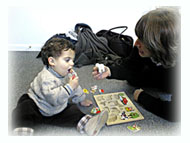
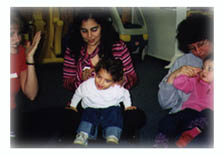
At Home Jacob's therapy is a twenty-four hour seven day a week endeavor. We use an auditory-verbal aproach. In addition to formal speech therapy, which I will get into in a bit, we constantly bathe Jacob in language. For example, instead of just getting him some milk, we will say "You want milk? Okay - Mommy's getting the cup. I'm opening the cup. The cup is blue. I'm opening the fridge. I'm taking out the milk. I'm pouring the milk. The milk is cold! I'm putting the lid back on. Here you go. Is that good? Mmmm." So you see, it can be tiring. We also create what we call "experience books". These are little books with pictures of Jacob and various activities. Books titled "People I Know", "Places I Go", "Jacob Goes on a Trip", "Jacob Takes a Bath", "Jacob Goes to School", etc. This is a way of reinforcing language. Jacob loves his little books and will pick one out of the book shelf before he will take a regular book! Another thing we have is posters up in our kitchen and family room. We continue what we learn from our therapists at home. We constantly play listening games with Jacob, asking him where things are in books or on the posters, and we follow through on the therapists suggestions for activities. We use almost every opportunity as a spring board for language. Speech Therapy Jacob attends speech therapy 3 to 4 hours a week. Not all children need so many hours, but we felt for Jacob that the consistency pushed him on. Also, some of our sessions are not as productive as others due to Jacob's age. Sometimes he falls asleep before therapy and then just won't want to wake up, and sometimes it's just typical behavioral issues associated with his age. His formal speech therapy consists of Lois Heyman, (his speech therapist) doing things with Jacob, then explaining to me exactly what she is doing so I can continue therapy when I'm home with Jacob. She also works on any oral motor problems Jacob may have. Furthermore, we are trying to pick a word a week for Jacob to learn, and bombarding him with that word. So far, he has gotten it every week. Socialization Socialization is very important for a hearing impaired child, and should be part of the therapy routine. They need to learn how to talk and listen in a group setting with their peers. Some centers offer child groups. However, with Jacob, I make sure he has at least 2 playdates a week, and we are in a Mommy and me nursery class, where I make sure Jacob is listening and talking to the other children. I can't stress enough how much early socialization and techniques for peer groups can help avoid social difficulties once they start school. Jacob is going to start a 2's toddler program next year 2 mornings a week by himself (without Mommy present). Teacher of the Deaf We have a Teacher of the Deaf work with Jacob once a week. This is very important, and many of our home activities are inspired by her. She works on concepts and comprehension, as well as a bit of speech. This is important because Jacob missed a lot of these concepts his first year, and also may continue to miss them if they are not fed into him properly. Finally, it's a great pre-teaching of pre-school concepts, and will ready him to be mainstreamed in pre-school. Other Issues Jacob is also in physical therapy twice a week to help him with his balance. Jacob has balance problems that may be associated with his hearing loss (vestibular abnormalities). Jacob Last but certainly not least, we try to remember that Jacob is a child first and foremost. We try to make everything fun for him and not seem like too much work. We don't want to frustrate him, because for a child who is going to be doing therapy for years and years, he has to love it. And so far he does. |
|||||||
 |
||||||||
 |
||||||||
 |
 |
 |
||||||
 |
 |
 |
||||||