Click sobre la bandera para cambiar a español


Jose Luis Ibarra Martínez

"Experience is the name which we use for our mistakes"
  
Oscar Wilde 1854-1900

"Time passes quickly here. Enough to do during the day, and a fair amount of free time."
   The Ghost Road  of
Pat Barker 1943-


The idea of this page is to give some help and useful stuff to those people who shared the same hobbies than me. The core of the page is about the job which I did for the last three years as MPhil Student in the Chemistry Department in the University of Manchester. There is also a link to other page with different routes to bike around the mountains in Sierra Nevada and the Sierra de Huétor, both allocated in Granada, Spain. The routes are in Spanish, so if someone wants to bike over here, just send me  an e-mail and I´ll be very happy in biking together showing those great mountains. And finally, nowadays, I´m involve in learning C++ and Visual Basic, so, shortly, I´ll make a new linked  page from here with programming stuff and projects with C++, Visual Basic and LabView as well.


This is the logo of the Molecular Beam Scattering group in the Chemistry Department of the University of Manchester.


 University of Manchester
 
Chemistry Department
 
Physical Chemistry Department
 
Molecular Beam Group


During my first year in the University of Manchester, 2000, I had to extend my knowledges about rotational, vibrational and electronic motions of the molecules, and also the transition between the energy levels. The experimental part included the knowledge, understanding and the usage of techniques and instrumentation: molecular beam scattering, LIF (Laser-Induced Fluorescence), Time-Of-Flight (TOF) Mass Spectroscopy besides UHV (Ultra High Vacuum systems). In the pdf report which you can link below there is a chapter about UHV systems. In addition to the practical knowledge, I had to learn the theoretical stuff, of course. Below, you can also download the final first year report.
At the second year I continued widing the knowledge of the first year and I started a new job: to make with LabView, G language, a computer program, TOFSys, to simulate virtually an electronical device called "TOF interface". This virtual instrument will be used to communicate a PC-Win, a 486-PC and the TOF Timing unit, which sets the parameters for the experiments in conjunction with all the equipment in the laboratory. The virtual instrument, TOFSys, also gets and analizes the collected data from the TOF quadrupole mass espectroscopy.
And at the last year I finished the TOFSys program and the documentation for it. When I finished developing TOFSys I started to write the MPhil Thesis, which I submited on October. Below, there is a link to download the TOFSys and the documentation with the pdf extension. TOFSys only can run if you have the LabView of National iInstruments properly installed in your computer.                        By clicking here you can see what else we do in the laboratory, mostly if you are interested in the chemical-physics of surface dynamics and the techniques used for these studies.


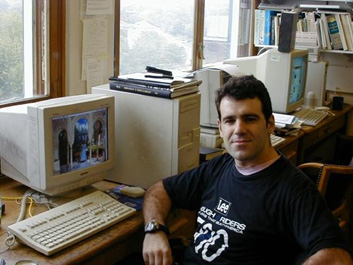
As part of my job I developed a computer program called TOFSys with LabView. The PC has been the most important tool in my learnig. This one in the picture is a PoweMac, a little bit old...


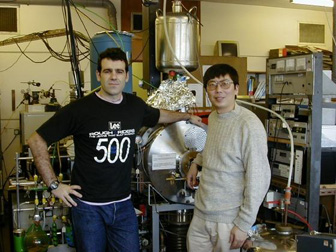
My mate Weijie and me. Behind us the main chamber where we make the experiments. The chamber is connected to a UHV System of diffusion pumps and it achieves a pressure of 10-12 mbar, almost vacuum.


Below these lines it is possible to download some tutorials, posters and the TOFSys software with the documentation.The tutorials are: rotational motion of molecules with an introduction of spectroscopy, vibrational motion, Franck-Condon principle, LIF (laser-inducer fluorescence) with a small introduction to LASER and the fluorescency phenomena. There is also an experiment made in the laboratory over a GaAs(100) optic semiconductor surface using TOF Quadrupole Mass Spectroscopy and Inelastic Molecular Beam Scattering. A basical description of the apparatus used in the laboratory is also reported in two parts being the second one deeper in details: laser, diffusion pumps for UHV Systems(Ultra High Vacuum), fotomultiplier, ionisers, and maybe one of the most amazing devices, the pulsed molecular beam source, which we´ve just made one of the smallest in the world; all of this in addition with an introduction of QMS (Quadrupole mass spectrometer).
I also have included two posters, one of them was presented by the molecular beam group in the annual meeting of Chemica-Physics, University of Leicester, ANUMOCP 2002, titled: A new miniature pulsed supersonic molecular beam source. The other one presents schematically the idea about what we do in the laboratory.


LabView software:

  • TOFSys for LabView plus documentation

Tutorials and posteres:

First year final report:


PUBLICATIONS

  • “Trapping Desorption and Inelastic Scattering of Br2 on GaAs(100)”.   MPhil tésis. 2004. Universidad de Manchester.

  • “Supersonic molecular beam study of the direct-inelastic scattering and the trapping-desorption of Br2 on GaAs(100)”. Weijie Jia, Jose L. Ibarra, J. C. Whitehead, Peter A. Gorry. 2003. To be published.


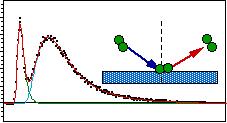
Direct-Inelastic Scattering

Trapping-Desorption

These two phenomena are studied in the Lab using a semiconductor optical surfaces like GaAs(100).


Routes in mountain bike around Sierra Nevada and Sierra de Huétor, Granada, Spain


"And in that silence where a thousand echoes still ring, I see how her transparent body is gradually filling with the golden opacity of the rest..."
Au temps du fleuve Amour of Andrei Makine 1957-


Send me anything what you want. I´ll reply you as soon as I can.

Jose L. Ibarra M. [email protected]


Hosted by www.Geocities.ws

1