
Foreign Policy
Welcome to the Foreign Policy page! This page is designed for people who are willing to do the research that is required in order to really understand international politics. This site is going to provide visitors with the vast amount of resources required for this. For people that don't have the time or the will to do their own research, I will provide my own interpretation of just what the hell is going on the world. I will try to keep it as dummy friendly as possible.

For those you that don't believe you need to know anything about foreign policy guess what: - -we live one of the most democratic societies in history. The U.S. is also the most internationally active nation in history. Therefore, there is either tremendous burden on U.S. citizens, or the citizens can put the burden on to a few individuals who will adopt whatever policies they see fit. The problem here is that ordinary Americans will always be held accountable and responsible for whatever the government does internationally.

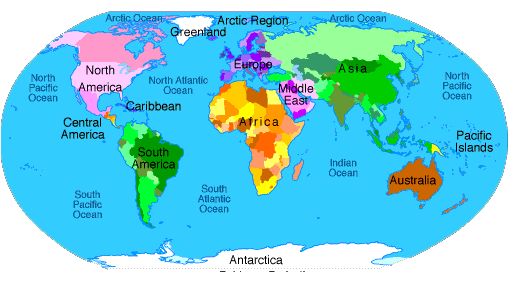
Click on a region to get an analysis of U.S. involvement in that region...

...Or browse below to get info. pertaining to U.S. foreign policy in general.

Links to sites with info relating to US foreign policy:
Country Indicators for Foreign Policy Yale Avalon Project: US Foreign Relations
Columbia International Affairs Online FPIF: Who's who in the Bush Admin.
Institute for Foreign Policy Analysis Yale Avalon Project: American Diplomacy 1778 to present
The RAND Corporation Foreign Policy Association
Intl. Society of Political Psychology Federation of American Scientists
Council on Foreign Relations US State Dept.: Military Training and DoD Engagement Activities of interest
Powell's Books: US Foreign Policy CS Monitor: Neoconservatives and their Blueprint for US Power
UMich Doc Center: US Foreign Plcy National Archives and Records Adm.
Use of US Forces: 1798-1993 Znet: Foreign Policy Watch
US State Department: Foreign Relations Volumes 1861 to date  
 
US State Department: Foreign Relations Volumes available online
United States foreign policy in general:
Countries with the most significant US involvement:
Iraq - US wants to control oil prices and Islamic extremism, also wants to help out Israel. Also good location for world trade. See Bahrain.
Afghanistan - US wants to control Islamic extremism and possibly other motives. Needs more investigation. Possibly strategic military location (Russia, Asia, Middle East)
Venezuela - attempting to overthrow Chavez. US wants to control oil prices. Also strategic location between Caribbean and South America.
Haiti - attempting to overthrow Aristide, former Catholic priest. Aristide doesn't believe that Haiti can depend on US corporations. He believes that US businesses will leave if they find cheaper labor in other countries. He is trying to set up Haiti's economy so that it is not too dependent on American corporations. Since American businesses want the cheap labor in Haiti (for an unspecified amount of time), they are working with the CIA to overthrow Aristide's government.
Pakistan - trying to contain Pakistan's nuclear technology, prevent war between India and Pakistan. Also very important ally in war against Islamic extremism. Problem: Musharref is self appointed ruler, there is no elected government. The people of Pakistan could forseably elect leaders that are anti-American. Since there is a history of western countries supporting monarchs in Islamic countries, the people of Pakistan don't trust Musharref. This can be dangerous.
United Kingdom - strong US ally since world war I. Part of an alliance of former British colonies (South Africa, Australia, Canada) that are united out of mutual benefit. US and UK try to back each other up militarily whenever they can. Together, with the help of the former British colonies, they monitor communications around the world between both individuals and organizations. (Echelon)

            In order to understand U.S. foreign policy, one needs to first understand international politics in general.  In order to understand international politics, one needs to understand people.  Therefore, in order to understand U.S. foreign policy, one needs to understand people.  The study of politics is the study of people.

            What are the fundamental aspects of people that need to be understood in order to understand foreign policy?  I believe they are as follows: 


1)      People tend to form into groups.

2)      These groups tend to expand as far as they can until they are contained.

3)      There are numerous amounts of groups.  Sometimes they come into contact with each other and interact.  The types of interaction are:

a.       Cooperation – mutual survival and prosperity (trade)

b.      Conflilct – competition for survival and prosperity (war)

4)      The main goals of the groups are to survive first, prosper second.

a.       survive means simply to stay alive.

b.      Prosper means to expand, obtain “wealth”, pleasure, happiness, increase strength, increase survival ability

c.       Both a and b tend to be pursued mercilessly at any cost.  These are the priorities. (Most of the time)

 
Hosted by www.Geocities.ws

1