


Key areas of Swarm Intelligence include:
1. Self-Organization: activities are decentralized and unsupervised, but yet coordinated
2. Adaptiveness: the system can respond and adapt to dynamically changing environment
3. Robustness: the objectives of the group can still be achieved even when some members of the group are not successful.
The above properties have been suggested to be effective in distributed optimization problems in areas such as telecommunication and manufacturing (Bonabeau et al., 1999; Bonabeau & Meyer, 2001; Cicirello & Smith, 2001).
The Bee Colony Algorithm for JSSP is also inspired by the work done by Nakrani & Tovey (2003), where a novel honey bee algorithm is used to solve the problem of dynamic allocation of internet servers.
The remainder of this page shall discuss some key characteristics of natural honey bees.
A honey bee has amazing senses superior to that of a human. For instance, it can see more colors and smell more scents than a human can. It can also see and understand the polarization pattern in the sky, and this capability helps them to navigate even at night (Alcoz, 2007).
In addition to the above features, a honey bee can also calculate distances and directions accurately. It can then communicate this information to other bees to indicate sources of food, and influence them to follow its path (Kimball, 2005).
In order for a honey bee to convey information about a food source to other bees, it needs to tell them about:
1. The scent of the nectar
2. The direction of the source from the hive
3. The distance of the source from the hive
(Kimball, 2005)
A honey conveys these messages by 2 types of dances, namely, the Round Dance and the Tail-wagging Dance (Waggle Dance).
The Round Dance indicates that the food source is within 50 m of the hive. The figure below shows the Round Dance.
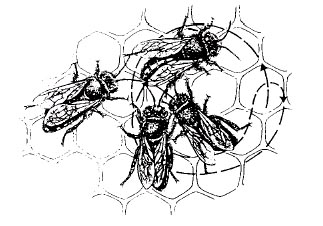
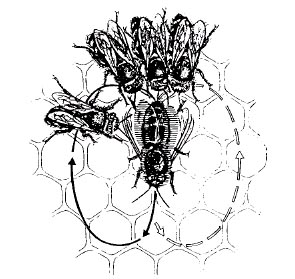
Hence, honey bees are able to communicate information about food sources effectively and accurately.
The following is a brief description of how honey bees forage for food.
When a honey bee discovers a food source, it flies back to the hive and informs other bees by either the Round Dance or the Waggle Dance. The profitability of the food source considering the distance and sweetness is indicated in the dances, on top of the direction of the source.
Other bees in the hive, after seeing the dance, may decide to follow the path of the dancing bee and visit the same food source. Naturally, the more profitable the path, the larger the number of bees will follow it.
In this way, a bee colony works on a self-organizing strategy that gathers food in an efficient and effective manner.