


A feasible solution in a Job Shop Scheduling Problem is a complete schedule of operations specified in the problem. We can think of each solution as a path from the hive to the food source. The figure below illustrates such an analogy
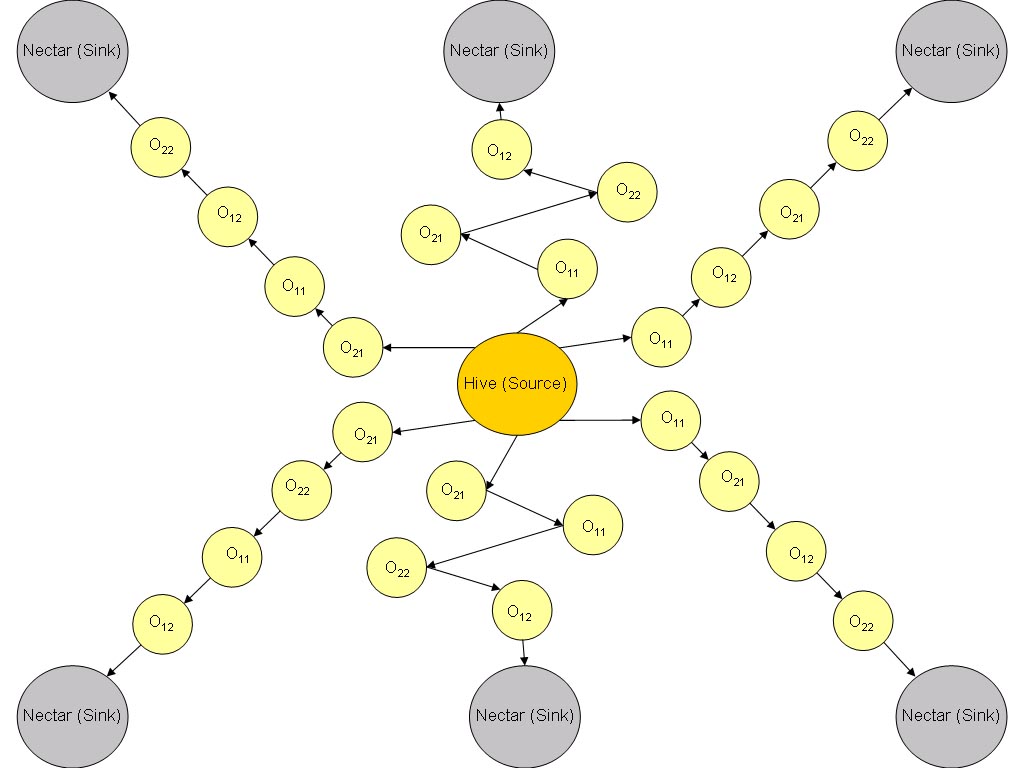
We can thus maintain a colony of bees, where each bee will traverse a potential solution path. Once a feasible solution is found, each bee will return to the hive to perform a Waggle Dance. The Waggle Dance will be represented by a list of Elite Solutions, from which other bees can choose to follow another bee's path. Bees with a better makespan will have a higher probability of adding its path to the list of Elite Solutions, promoting a convergence to an optimal solution.
Using the above scheme, the natural honey bee's self organizing foraging strategy can be applied to the Job Shop Scheduling Problem.