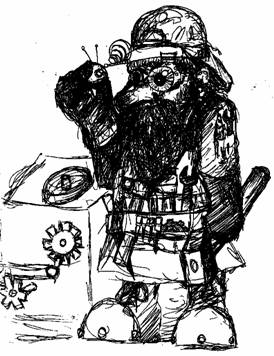
Lyle Masterforge, dwarf scientist
Scientist
The scientist is the most exciting new class
available to the players, as it finally puts some high technology on the side of
the heroes. The scientist uses skills based on science, Natural Law, and
mechanical or chemical crafts to build technological devices powered by steam or
clockwork. Most adventuring scientists are gnomes and dwarves, because those races are
extremely given towards engineering, construction, and general tinkering.
Naturally, humans and half-orcs also make excellent scientists, and in Færith
they have taken to new scientific advancements as if they were a religion unto
themselves.
Abilities: Intelligence is the most important ability to the scientist, since it grants him bonuses to important scientific skills. Dexterity is useful because great hand-eye coordination is needed for delicate repairs, and Constitution helps because frankly, you never know when something is going to unexpectedly explode.
Hit Die: d4
Starting Cash: 6d4 × 100ƒ
Class Skills
The scientist’s class skills (and the key ability for each skill) are Drive (Dex),
Craft (Int), Concentration (Con), Decipher Script (Int), Diplomacy (Cha),
Disable Device (Int), Demolitions (Int), Gather Information (Cha), Heal (Wis),
Intimidate (Cha), Investigate (Int), Knowledge (all skills, taken individually)
(Int), Listen (Wis), Open Lock (Dex), Pilot (Dex), Profession (Wis), Repair (Int),
Research (Int), Search (Int), Spot (Wis), and Use Rope (Dex).
Skill Points at 1st Level: (10 + Int modifier) × 4.
Skill Points at Each Additional Level: 10 + Int modifier.
|
Table 3-2: The Scientist |
|||||||||
|
Level |
Base Attack Bonus |
AC Bonus |
Fort Save |
Ref Save |
Will Save |
Scientist Special Abilities |
Maximum Discovery Level |
Bonus Craft Points |
Reserve Points |
|
1st |
±0 |
±0 |
±0 |
+1 |
+1 |
Craft inventions, sabotage |
0-lv |
500 |
50 |
|
2nd |
+1 |
±0 |
±0 |
+2 |
+2 |
Skill Focus |
1st |
1,000 |
100 |
|
3rd |
+1 |
±0 |
+1 |
+2 |
+2 |
Research |
— |
— |
150 |
|
4th |
+2 |
±0 |
+1 |
+2 |
+2 |
Instant mastery |
2nd |
2,000 |
200 |
|
5th |
+2 |
±0 |
+1 |
+3 |
+3 |
Bonus feat |
— |
— |
250 |
|
6th |
+3 |
±0 |
+2 |
+3 |
+3 |
Tech specialty |
3rd |
3,000 |
300 |
|
7th |
+3 |
+1 |
+2 |
+4 |
+4 |
— |
— |
— |
350 |
|
8th |
+4 |
+1 |
+2 |
+4 |
+4 |
Skill Focus |
4th |
4,000 |
400 |
|
9th |
+4 |
+1 |
+3 |
+4 |
+4 |
— |
— |
— |
450 |
|
10th |
+5 |
+1 |
+3 |
+5 |
+5 |
Bonus feat, instant mastery |
5th |
5,000 |
500 |
|
11th |
+5 |
+1 |
+3 |
+5 |
+5 |
Tech specialty |
— |
— |
550 |
|
12th |
+6/+1 |
+1 |
+4 |
+6 |
+6 |
— |
6th |
6,000 |
600 |
|
13th |
+6/+1 |
+1 |
+4 |
+6 |
+6 |
— |
— |
— |
650 |
|
14th |
+7/+2 |
+2 |
+4 |
+6 |
+6 |
Skill Focus |
7th |
7,000 |
700 |
|
15th |
+7/+2 |
+2 |
+5 |
+7 |
+7 |
Bonus feat |
— |
— |
750 |
|
16th |
+8/+3 |
+2 |
+5 |
+7 |
+7 |
Instant mastery |
8th |
8,000 |
800 |
|
17th |
+8/+3 |
+2 |
+5 |
+8 |
+8 |
— |
— |
— |
850 |
|
18th |
+9/+4 |
+2 |
+6 |
+8 |
+8 |
Tech specialty |
9th |
9,000 |
900 |
|
19th |
+9/+4 |
+2 |
+6 |
+8 |
+8 |
— |
— |
— |
950 |
|
20th |
+10/+5 |
+2 |
+6 |
+9 |
+9 |
Skill Focus, bonus feat |
— |
— |
1,000 |
All of the following are class features of
the scientist.
Starting Feats: A scientist begins with Simple Weapons Proficiency, Personal
Firearms Proficiency, Light Armor Proficiency, and Shield Proficiency.
Craft Inventions: Scientists can build and use a variety of technological
devices that other characters cannot. Anyone can use the Craft (chemical)
skill to make acid or explosives or use Craft (mechanical) to smith a musket --
but only scientists can make a machine gun or a box of firebomb grenades.
To craft an invention, the scientist must first meet all its prerequisites,
which usually means having access to the appropriate scientific discoveries.
Knowing a discovery requires that the scientist have an Intelligence of at least
10 + the discovery level. The scientist begins with a number of free 0-level discoveries ("findings") equal
to 1d6 + his Intelligence modifier, and upon reaching 2nd level, he gains 1d4 free
0-level or 1st-level discoveries. At every level thereafter, he makes 1
free discovery of any level that he can use. Otherwise, the scientist must
make new scientific discoveries using his own research and the research of other
scientists (the process is described fully in
Chapter 6).
Scientific discoveries are merely theories on paper, though. In order to use them, the scientist must work them into technological inventions. Making an invention isn't like crafting a normal item -- rather, it's more like making a magic item. To make an invention, the scientist must know the required discovery and meet any other prerequisites. He then pays for raw materials equal to half the item's base price, as well as experience points equal to 1/250th the base price in silver guilders (1/25th its price in gold doubloons) and craft points equal to 1/100th its base price in guilders (which is 1/10th its price in gold). The item is then completed the next day (no Craft check is required -- the experience points spent represent more care and attention placed into the crafting process than any take-10 or take-20), though for every additional 8-hour day spent on construction, the scientist can reduce the cost in craft points by 100 CPs. The scientist may also choose to attempt a Craft check in order to reduce the EXP cost for creating the item, but this carries with it a risk of failing to create the item and ruining some of the raw materials.
The crafting process and the various
categories of inventions are described in
Chapter 6, while the
scientific discoveries are listed in
Chapter 7.
Bonus Craft Points: Whenever the scientist attains access to a new discovery
level, he gains bonus craft points equal to that discovery level times 1,000.
These craft points can be applied to any crafting project the scientist takes
part in.
Reserve Points: At every level, the
scientist gains a number of reserve points equal to his level times 50.
These points may be spent in place of experience points to cover the EXP cost
for creating scientist items (but not for any other purpose). Reserve
points may be stored or spent from level to level as the scientist character sees
fit.
Lyle Masterforge,
dwarf scientist
Sabotage: Science is the art of observation; and many scientists are
perceptive enough to be able to observe even the most obscure details of a
feature of construction. The knowledge of how mechanical devices are put
together, or exactly how chemical compounds react, also gives any scientist an
acute understanding of how to make devices not work properly. Hence, scientists
are able to find and disarm mechanical traps (but not magical ones) with DCs
higher than 20, and they can use the Disable Device skill on extremely
complex machines with disable DCs higher than 20.
Skill Focus: At 2nd level and every 6th level thereafter, the scientist gains Skill Focus in either Craft (chemical, mechanical, pharmaceutical, or structural, Knowledge (natural sciences, physical sciences, or technology), or Research as a bonus feat.
Research: The scientist has a knack for finding information. At 3rd level,
provided the scientist has at least 8 ranks in the Research skill, the synergy
bonus to Knowledge checks made
while researching at a library or similar store of information increases from +2
to +5.
Instant Mastery: At levels 4, 10, and 16 the
scientist may choose a skill that is not on his class skill list to become a
scientist class skill. The
scientist immediately gains 4 free ranks in that skill.
Bonus Feats: At 5th, 10th, 15th,
and 20th level, the scientist earns a bonus feat taken from the following list:
Extend Invention, Improvise Invention, Simplify Invention, Miniaturize Invention, Mass-Produce
Invention, or
Talented Crafter.
Technological Specialty: At 6th level, the scientist chooses a category of
technological items (armaments, grenades, elixirs, gadgets, automata, surface
vehicles, aircraft, or artillery). When a scientist crafts an item
of that type, he receives a +2 bonus to all the Craft, Knowledge, and Research checks needed
to research and build it, and its cost in raw materials, experience, and craft
points is reduced by 10%. The scientist receives an additional technological specialty at
levels 12 and 18, and he may choose to specialize in new types of items, or to
take the same specialty multiple times and stack its effects. For example,
an 18th-level scientist who had specialized in armaments three times would
receive a +6 bonus to skill checks involved in making
technological weapons and armor, any such equipment he built would cost gil.,
EXPs, and CPs as if its base price were 30% less than normal.