
|
|
|
The Prayers
|
|
|
|
|
|
|
|
|
|
|
|
|
|
|
|
|
|
|
|
|
|
About Catholic Prayers
Praying
"The Catholic encyclopedia states that prayer is: "An act of the virtue of religion which consists in asking proper gifts or graces from God. In a more general sense it is the application of the mind to Divine things, not merely to acquire a knowledge of them but to make use of such knowledge as a means of union with God. This may be done by acts of praise and thanksgiving, but petition is the principal act of prayer.
Objects of Prayer:
"Like every act that makes for salvation, grace is required not only to dispose us to pray, but also to aid us in determining what to pray for. In this "the spirit helpeth our infirmity. For we know not what we should pray for as we ought; but the Spirit himself asketh for us with unspeakable groanings" (Rom., viii, 26). For certain objects we are always sure we should pray, such as our salvation and the general means to it, resistance to temptation, practice of virtue, final perseverance; but constantly we need light and the guidance of the Spirit to know the special means that will most help us in any particular need. That there may be no possibility of misjudgment on our part in such an essential obligation, Christ has taught us what we should ask for in prayer and also in what order we should ask it."
How to pray:
"In response to the request of His disciples to teach them how to pray, He repeated the prayer commonly spoken of as the Lord's Prayer, from which it appears that above all we are to pray that God may be glorified, and that for this purpose men may be worthy citizens of His kingdom, living in conformity with His will. Indeed, this conformity is implied in every prayer: we should ask for nothing unless it be strictly in accordance with Divine Providence in our regard. We are to ask also for temporal things, our daily bread, and all that it implies, health, strength, and other worldly or temporal goods, not material or corporal only, but mental and moral, every accomplishment that may be a means of serving God and our fellow- men. Finally, there are the evils which we should pray to escape, the penalty of our sins, the dangers of temptation, and every manner of physical or spiritual affliction, so far as these might impede us in God's service."
To whom may we pray:
"Although God the Father is mentioned in this prayer as the one to whom we are to pray, it is not out of place to address our prayers to the other Divine persons. The special appeal to one does not exclude the others."
Who can pray:
"As He has promised to intercede for us (John, xiv, 16), and is said to do so (Rom., viii, 34; Heb., vii, 25), we may ask His intercession, though this is not customary in public worship. He prays in virtue of His own merits; the saints intercede for us in virtue of His merits, not their own. Consequently when we pray to them, it is to ask for their intercession in our behalf, not to expect that they can bestow gifts on us of their own power, or obtain them in virtue of their own merit."
Effects of Prayer:
"In hearing our prayer God does not change His will or action in our regard, but simply puts into effect what He had eternally decreed in view of our prayer. This He may do directly without the intervention of any secondary cause as when He imparts to us some supernatural gift, such as actual grace, or indirectly, when He bestows some natural gift. "
The use or habit of prayer rebounds to our advantage in many ways. Besides obtaining the gifts and graces we need, the very process elevates our mind and heart to a knowledge and love of Divine things, greater confidence in God, and other precious sentiments. Indeed, so numerous and so helpful are these effects of prayer that they compensate us, even when the special object of our prayer is not granted."
The Promise of God: "Ask, and it shall be given you; seek, and you shall find: knock, and it shall be opened to you" (Matt., vii, 7); "Therefore I say unto you, all things whatsoever you ask when ye pray, believe that you shall receive" (Mark, xi, 24 -- see also Luke, xi, 11; John, xvi, 24, as well as innumerable assurances to this effect in the Old Testament)."
Mental Prayer: Mental prayer is also called meditation, and constitutes one of the most effective means toward sanctification. It can be practiced by the members of the laity as well as those of the clergy, and from it they can derive great spiritual profit. Many good Catholic lay-persons devote fifteen minutes or a half-hour to meditation daily, choosing particularly as the subject of their contemplations and prayer the life and teaching of Our Blessed Lord. Meditation is especially beneficial in the morning when we can look forward to the difficultiers of the day in a spirit of faith and humbly ask God for light and grace to His will in all things.
Vocal Prayers: Vocal prayers are also recommended by the Church, and many of them, such as the rosary and the litanies, are richly indulgenced. However, it would be a mistake to imagine that the more vocal prayers a person recites, the holier he is. It is better to say a few vocal prayers slowly and attentively than to recite a large mumber hurriedly and with little attention.
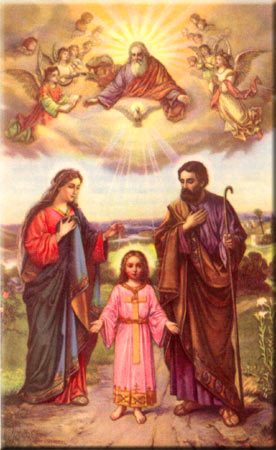

Glorious
Ames Hymn Collection
1 Timothy 2:1-4 Matthew 15:7-8 II Machabees 12:46 St. Matthew 11:25-26 Matthew 26:41 1 Peter 4:7 1 Thessalonians 5:16-18 Ecclesiasticus 6:37 Proverbs 28:9 Proverbs 1:28-30 We usually begin and end our prayers with the sign of the cross. Matthew 28:18-19 We make the sign of the cross to express two important mysteries of the Christian religion, the Blessed Trinity and the Redemption.
" I urge therefore, first of all, that supplications, prayers, intercessions and thanksgivings be made for all men; for kings, and for all in high positions, that we may lead a quiet and peaceful life in all piety and worthy behavior. This is good and agreeable in the sight of God our Savior, who wishes all men to be saved and come to the knowkedge of the truth"
"Hypocrites, well did Isaias prophesy of you, saying, 'This people honors me with their lips, but their heart is far from me.'"
"It is therefore a holy and wholesome thought to pray for the dead, that they may be loosed from sins"
"... I confess to thee, O Father, Lord of heaven and earth because thou hast hid these things from the wise and prudent and hast revealed them to little ones. Yea, Father: for so hath it seemed good in thy sight."
"Watch and pray, that you may not enter into temptation"
"Be prudent therefore and watchful in prayers"
"Rejoice always, Pray without ceasing. In all things give thanks; for this is the will of God in Christ Jesus regarding you all"
"Let thy thoughts be upon the precepts of god, and meditate continually on his commandments: and he will give thee a heart; and the desire of wisdom shall be given to thee"
"He that turneth away his ears from hearing the law, his prayers shall be an abomination.
"Then shall they call upon me, and I will not hear; they shall rise in the morning and shall not find me. Because they have hated instruction, and receivecd not the fear of the Lord, nor consented to my counsel, but despised all my reproof"
"And Jesus drew near and spoke to them saying,'All power in heaven and on earth has been given to me. Go, therefore, and make disciples of all nations, baptizing them in the name of the Father, and of the Son, and of the Holy Spirit'"
When we say "In the name," we express the truth that there is only one God; when we say "of the Father, and of the Son, and of the Holy Ghost," we express the truth that there are three distinct Persons in God; and when we make the form of the cross on ourselves, we express the truth that the Son of God, made man, redeemed us by His death on the cross.


