 |
 |
 |
 |
 |
 |
 |
 |
 |
 |
 |
|
Standart Shar Pei FCI-Standard N° 309 / 09. 08. 1999 / GB ORIGIN : China. PATRONAGE : F.C.I. DATE OF PUBLICATION OF THE ORIGINAL VALID STANDARD : 14.04.1999. UTILIZATION : Hunting- and watch-dog. CLASSIFICATION F.C.I. : Group 2 Pinscher and Schnauzer, Molossians and Swiss Mountain-and Cattledogs. Section 2.1 Molossian, Mastiff type. Without working trial. BRIEF HISTORICAL SUMMARY : This Chinese breed has existed for hundreds of years in the provinces bordering the South China Sea. The town of Dialak in the province of Kwun Tung is probably the place of origin.
BEHAVIOUR / TEMPERAMENT : Calm, independent, loyal, affectionate to his family.
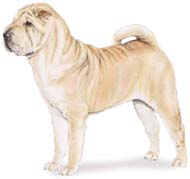
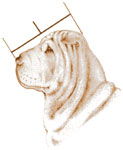
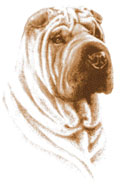
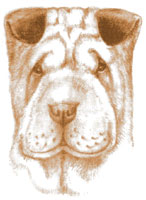
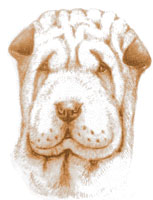
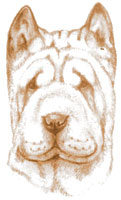
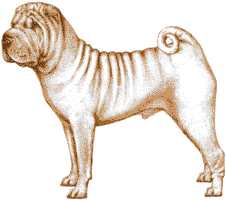
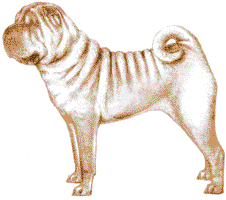
CRANIAL REGION : Skull : Flat, broad. Stop : Moderate. FACIAL REGION : Nose : Large and wide, preferably black, but any colour conforming to general coat colour permissible. Wide opened nostrils. Muzzle : A distinctive feature of the breed. Broad from root to tip of nose with no suggestion of tapering. Lips and top of muzzle well padded. Bulge at the base of the nose permissible. Mouth : Tongue, roof of mouth, gums and flews : bluish black is preferred. Pink spotted tongue permissible. Solid pink tongue highly undesirable. In dilute-coloured dogs the tongue is solid lavender. Jaws/Teeth : Jaws strong with a perfect scissor bite, i.e. the upper teeth closely overlapping the lower teeth and set square to the jaws. Padding of lower lip should not be so excessive as to interfere with the bite. Eyes : Dark, almond-shaped with a scowling expression. Lighter colour permissible in dilute-coloured dogs. Function of eyeball or lid in no way disturbed by surrounding skin, folds or hair. Any sign of irritation of eyeball, conjunctiva or eyelids highly undesirable. Free from entropion. Ears : Very small, rather thick, equilaterally triangular in shape, slightly rounded at tip and set high on the skull with tips pointing towards eyes; set well forward over eyes, wide apart and close to skull. Pricked ears highly undesirable
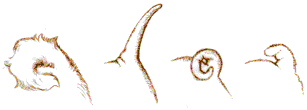
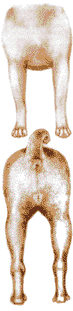
NECK : Medium length, strong, set well on shoulders. The loose skin under the neck should not be excessive. BODY : Folds of skin on body in mature dogs highly undesirable except on withers and base of tail, which show moderate wrinkling. Topline : Dips slightly behind withers; then it rises slightly over loin. Back : Short, strong. Loin : Short, broad, slightly arched. Croup : Rather flat. Chest : Broad and deep, brisket reaching the elbow. Underline : Rises slightly under the loin. TAIL : Thick and round at the root, tapering to a fine point. The tail is set very high, a characteristic feature of the breed. May be carried high and curved, carried in tight curl or curved over or to either side of the back. Lack of or incomplete tail highly undesirable.
FEET : Moderate size, compact, not splayed. Toes well knuckled. Hindfeet free from dewclaws. GAIT / MOVEMENT : The preferred gait is trot. The gait is free, balanced, active with good forward reach and strong drive from the hindquarters. The feet tend to converge to a center line when the speed increases. Stilted gait undesirable. COAT HAIR : A distinctive feature of the breed : short, harsh and bristly. The coat is straight and offstanding on the body, but generally flatter on the limbs. No undercoat. The coat may vary in length from 1 cm to 2,5 cm. Never trimmed.
COLOUR : All solid colours acceptable except white. Tail and rear part of thighs frequently of a lighter colour. Darker shading down the back and on the ears permissible. SIZE : Height : 44 - 51 cm at withers (17,5 - 20 ins). FAULTS : Any departure from the foregoing points should be considered a fault and the seriousness with which the fault should be regarded should be in exact proportion to its degree. SERIOUS FAULTS : • Deviation from a scissor bite (as a transitory measure, a very slightly overshot mouth is permissible). • Snipy muzzle. • Spotted tongue (except pink spotted tongue). • Large ears. • Low set tail. • Coat longer than 2,5 cm. ELIMINATING FAULTS : • Flat foreface with badly overshot bite; undershot bite. • Solid pink tongue. • Lower lip rolled in, interfering with the bite. • Round, bulging eye. Entropion, ectropion. • Skin, folds or hair disturbing the normal function of the eye. • Pricked ears. • Absence of tail; stumpy tail. • Heavy folds of skin on body (except withers and base of tail) and limbs. • Not a solid colour (albino, brindle, patches, spots, black and tan, saddled pattern). N.B. : Male animals should have two apparently normal testicles fully descended into the scrotum. REMARK : Any artificial physical alteration to the Shar Pei (in particular lips and eyelids) eliminates the dog from competition.
|
||||||||||||||



 |
 |

