9.28.2001
Wild Justice
Alxander Cockburn
The Price
It was bracing to see former Sen. Bob Kerrey, now president of the New School, joining CNN's Paula Zahn for commentary Monday morning. Zahn, whom I place only fractionally under Laura Bush in the pantheon of my affections, made reference to Kerrey's expertise in military affairs. This plunges us straight into the fierce debate about how much of an historical context one is permitted to give the Sept. 11 attacks.
Lest there be any doubt about this, by the way, maybe I should register my own view that these were crimes against humanity. But I also think it's very necessary to set them in a full historical perspective, not least because one hears, often enough, questions like, "What are we to tell our children?" or "Why does everyone hate us?" being answered in a carefully circumscribed fashion.
Take Nat Hentoff, in a recent column: "'How can I explain this horror to them?' Jessica asks. 'How can I explain how people can do this?' What I'd say to my grandchildren is that there are people everywhere in this world who identify themselves totally with a system of belief�whether political, religious, a poisonous fusion of both, or some other overwhelming transcendence that has become their very reason for being. These vigilantes of faith have unequivocally answered the question of Duke Ellington's song 'What Am I Here For?'
"Such people can be of any faith, color, and class. Palestinian suicide-bombers; the self-exhilarating murderous fringe of the Weather Underground here in the 'revolutionary' 1960s; John Brown, the abolitionist executioner; and the self-betraying pro-lifers who urge the killing of�and sometimes actually assassinate�doctors who perform abortions. How can our American government�and how can we protect ourselves against such 'holy' fanatics?"
Surely Hentoff's grandkids deserve a little more than sneers about the Weather People and the 60s, this by way of explanation of what prompted those Muslim kamikazes to their terrible deeds? After all, around the time the Weather folk blew themselves (and only themselves) up in that house on W. 11th St. in the Village, the United States government, in the name of freedom's war on evil, was incinerating Vietnamese peasants with napalm and shooting them in their huts or in ditches. In Kerrey's unit the techniques included throat-slitting as well as shooting.
Mention of Vietnam or any other of the United States' less alluring zones of engagement with the enemies of freedom makes Christopher Hitchens seethe with fury, at a level of moral reproof almost surpassing his venom against Clinton the molester of women and bombardier of Khartoum. In a Bomb the Bastards outburst in the latest Nation he takes a swipe at the "masochistic e-mail traffic that might start circulating from the Chomsky-Zinn-Finkelstein quarter" and decrees that "Loose talk about chickens coming home to roost is the moral equivalent of the hateful garbage emitted by Falwell and Robertson, and exhibits about the same intellectual content."
We can safely say that the word "loose" is a purely formal device, and what Hitchens means here is that any and all talk about homeward-bound chickens is out of bounds, part of all the things we are not allowed to talk about. In times of crisis, by the way, it's often liberals who are quickest to set rules about what we should say and how we should say it.
"This nation is now at war," proclaimed Peter Beinart, editor-in-chief of The New Republic, "and in such an environment, domestic political dissent is immoral without a prior statement of national solidarity, a choosing of sides." Well, obviously we're in total solidarity against the fanatic terror that doomed just short of 7000 ordinary people that Tuesday morning, and we're against the religious and political precepts of those who were reverently described only a few short years ago in our newspapers and in presidential proclamations as the Afghan or Saudi "freedom fighters."
But at what point is a fracture in national solidarity permitted by Commissar Beinart? When the B-52s lay waste to Afghans in some slum on the edge of Kandahar on the supposition that bin Laden was there? Or when Attorney General Ashcroft moves to end all inhibitions on electronic snooping or warrantless arrests?
The time when the Bill of Rights, or the providing of historical context or satire, is most precious and most necessary is always when it is being deprecated as too dangerous, irrelevant or inappropriate at the present time.
What moved those kamikaze Muslims to embark, some many months ago, on the training that they knew would culminate in their deaths as well of those (they must have hoped) of thousands upon thousands of innocent people? Was it the Koran plus a tape from Osama bin Laden? The dream of a world in which all men wear untrimmed beards and women have to stay at home or go outside only when enveloped in blue tents? I doubt it. If I had to cite what steeled their resolve, the list would surely include the exchange on CBS in 1996 between Madeleine Albright, then U.S. ambassador to the United Nations, and Lesley Stahl. Albright was maintaining that sanctions had yielded important concessions from Saddam Hussein. "We have heard that half a million children have died," Stahl said. "I mean, that's more children than died in Hiroshima. And you know, is the price worth it?"
"I think this is a very hard choice," Albright answered, "but the price�we think the price is worth it." They read that exchange in the Middle East. It was infamous all over the Arab world. I'll bet the Sept. 11 kamikazes knew it well enough, just as they could tell you the crimes wrought against the Palestinians. So would it be unfair today to take Madeleine Albright down to the ruins of the Trade Towers, remind her of that exchange and point out that the price turned out to include that awful mortuary as well? Was that price worth it too, Mrs. Albright?
Mere nitpicking among the ruins and the dust of the 6500? I don't think so. In many ways America has led a charmed life amid its wars on people. The wars mostly didn't come home and the press made as sure as it could that folks, including the ordinary workers in the Trade Towers, weren't really up to speed on what was being wrought in Freedom's name. In Freedom's name America made sure that any possibility of secular democratic reform in the Middle East was shut off. Mount a coup against Mossadegh in the mid-1950s, as the CIA did, and you end up with the Ayatollah Khomeni 25 years later. Mount a coup against Kassim in Iraq, as the CIA did, and you get the agency's man, Saddam Hussein.
What about Afghanistan? In April of 1978 a populist coup overthrew the government of Mohammed Daoud, who had formed an alliance with the man the U.S. had installed in Iran, Reza Pahlavi, aka the Shah. The new Afghan government was led by Noor Mohammed Taraki, and the Taraki administration embarked on land reform, hence an attack on the opium-growing feudal estates. Taraki went to the UN, where he managed to raise loans for crop substitution for the poppy fields.
Taraki also tried to bear down on opium production in the border areas held by fundamentalists, since the latter were using opium revenues to finance attacks on Afghanistan's central government, which they regarded as an unwholesome incarnation of modernity that allowed women to go to school and outlawed arranged marriages and the bride price. Accounts began to appear in the Western press along the lines of this from The Washington Post, to the effect that the mujahideen liked to "torture victims by first cutting off their noses, ears and genitals, then removing one slice of skin after another."
At that time the mujahideen were not only getting money from the CIA but from Libya's Muammar Qaddafi, who sent them $250,000. In the summer of 1979 the U.S. State Dept. produced a memo making it clear how the U.S. government saw the stakes, no matter how modern-minded Taraki might be or how feudal the muj. It's another passage Hentoff might read to the grandkids: "The United States' larger interest...would be served by the demise of the Taraki-Amin regime, despite whatever set backs this might mean for future social and economic reforms in Afghanistan. The overthrow of the DRA [Democratic Republic of Afghanistan] would show the rest of the world, particularly the Third World, that the Soviets' view of the socialist course of history being inevitable is not accurate."
Taraki was killed by Afghan army officers in September 1979. Hafizullah Amin, educated in the U.S., took over and began meeting regularly with U.S. embassy officials at a time when the U.S. was arming Islamic rebels in Pakistan. Fearing a fundamentalist, U.S.-backed regime in Afghanistan, the Soviets invaded in force in December 1979. The stage was set for Dan Rather to array himself in flowing burnoose and head for the Hindu Kush to proclaim the glories of the muj in their fight against the Soviet jackboot. Maybe I missed it, but has Dan offered any reflections on that phase of his reportorial career?
Looking back at that period, Robert Fisk wrote in the Independent on Sunday, "I was working for The Times in 1980, and just south of Kabul I picked up a very disturbing story. A group of religious mujahedin fighters had attacked a school because the communist regime had forced girls to be educated alongside boys. So they had bombed the school, murdered the head teacher's wife and cut off her husband's head. It was all true. But when The Times ran the story, the Foreign Office complained to the foreign desk that my report gave support to the Russians. Of course. Because the Afghan fighters were the good guys. Because Osama bin Laden was a good guy. Charles Douglas-Home, then editor of The Times, would always insist that Afghan guerrillas were called 'freedom fighters' in the headline. There was nothing you couldn't do with words."
Well, the typists and messenger boys and back office staffs throughout the Trade Center didn't know that history. There's a lot of other relevant history they probably didn't know but which those men on the attack planes did. How could those people in the Towers have known, when U.S. political and journalistic culture is a conspiracy to perpetuate their ignorance? Those people in the Towers were innocent portions of the price that�Albright insisted�in just one of its applications was worth it. It would honor their memory to demand that in the future our press offers a better accounting of how America's wars for Freedom are fought, and what the actual price might include.
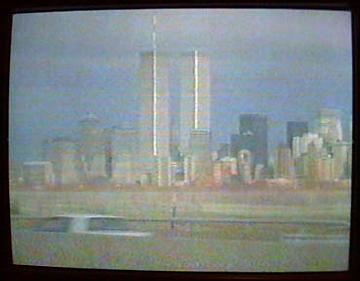
As a project to make myself feel useful, as well as perhaps to do something for other people, I am attempting to build a repository of sorts of images of the World Trade Towers from better times. But not just any pictures; rather, I was inspired, in rewatching "Being John Malkovitch" and seeing the towers from the Jersey side (attached), to try to assemble a collection of pictures/screenshots from DVDs/stills/what-have-you that have the WTC as a backdrop. For example, I would guess that "The Sopranos" has shown them from the Jersey side at least once, and I know I saw a Jeep ad last night on TV that did the same. Naturally, what I'm hoping for is to create something on the Web whereby others can at the same time remember what the twin towers really looked like (and just how they dwarfed their surroundings) and grapple with the magnitude of their destruction. There's no object lesson, no moral I'm imparting, just a possibility.
So if you know you have something in your collection -- but no news articles or anything that is in some way specifically referential to the attacks, please -- do send it along and I'll keep you posted as to what I create.
Scopophilically, Tk ([email protected])
9.25.2001
Here are the photos of my college roommate Johnny Liew's BMW. Parked it a block away from the WTC. This is something we are laughing about at this point. Actually, he told me that it took a couple of days for him to laugh about it but that I understand.


In partial response to Matt Xanderhod:
First, were these attacks acts of war? It is pretty clear to me that Osama bin Laden (or whoever planned the attacks) sees them as acts of war. [etc.]
A speculative point of clarification: I would suggest that the Responsible Parties see these as acts of a war that is already ongoing. Not to flog Clausewitz's horse, but what constitutes war is as much a matter of expediency as anything else. That said, I would agree with you that increased conflict is a desired goal of the perps. At the same time, and at the risk of being jingoistic, I think they may have underestimated just how stubborn Americans can be. We've grown soft and fat from too many years of prosperity and self-indulgence, but when God is on our side (as apparently it is, since W said so in his speech and he's got 90% approval ratings these days), we're fairly hard to lick. Trouble is, they've got God on their side also. (And I refuse to make the distinction between using the word God and Allah. That's a veiled bigotry that I can't stand.)
Second, should we now behave as if we're at war? I say no. This may sound strange, but I think that we should NOT treat the attacks as acts of war precisely because that's what the perpetrators want us to do. [etc]
A set of points, and one which bears acting on, but I would draw the distinction between what we should do and what of the actually possible options we should do. Since tit-for-tat is the ruling principle here, I would second your mention of covert teams. I have it on good authority (to wit, my father, a 22-year Marine Corps veteran) that people living in caves are highly unlikely to be "smoked out," as the detestable metaphor runs*, by conventional attacks. A missile can land within a stone's throw or closer to a cave and the inhabitants will be perhaps deafened and nervous, but they will not be otherwise harmed. The Marines managed to island-hop in the closing year of WWII, but only fairly slowly and by adapting techniques to the terrain and the enemy. Vietnam provides the clear contrast.
Further, I am skeptical of the conventional wisdom that holds that a headless al-Qaeda is no different from, and perhaps more dangerous than, a bin Laden-headed al-Qaeda. The metaphor chosen by J.P. Lederach (as reprinted in Ishbadiddle) is that of a virus. One flaw in this metaphor(since all metaphors have at least one) is that there is one identifiable source of this virus's growth and well-being, and that bottleneck is bin Laden. I'm no expert on him or al-Qaeda, but it seems to me as though even the experts are only referring to him. Not to lieutenants, not to similar organizations and their leaders, but to him. That would suggest that if we obtain him (and concomitantly cut off his funding), we will do significant damage, so as to set back his plans by many years. During that time, of course, I suggest we work on the other aspects of the problem, elucidated quite well by Messrs. Xanderhod and Lederach.
Ethically, [snip] I think we need to have SOME ethical standards like these or we risk lowering ourselves to the level of terrorists.
At the risk of being too world-weary, I proffer that we have long since lowered ourselves to the level of terrorists and state-sponsorship of terrorism. Perhaps is is worth desiring and working so that we begin to have some ethics, but denouncing terrorism in the name of God and then defending military action in the name of God seems to me highly lacking in ethics.
The other aspect of "waging war" that frightens me is the effects here in the US. Already, we are hearing calls for large scale-backs of privacy rights and, to a lesser extent, civil rights � some coming from John Ashcroft . . .
*This is where the asterisk above comes in. Though the discussion about the encoded nature of contemporary racism belongs to another day, I'd like to strongly second Matt's concern here. The dominant contrasts being made � in the Paper of Record as well as in the government's language � are unsettling, to say the least. Saying that this is a fight between the civilized and the uncivilized (I had someone actually say to me that 'these people' were worse than animals because 'at least animals care for their children'), between cowards and the brave, between a known 'God' and a strange 'Allah', all encourage the vilification of non-Jewish Semites and South/Central Asians despite the casual assurances to the contrary. Tigers not changing their stripes and all that.
With this last point in mind, I'd like to suggest that we all write our various national, state, and local representatives, asking that they make an unmistakable statement that there shall be no singling out of Arabs or South Asians for restrictive treatment, whether couched in terms of protection or of national security, during this conflict.
> with my own eyes I could begin to comprehend it. Of
> course, they're only letting residents down there,
> and I couldn't even begin to think of a credible
> reason why I needed to go below Canal.
Well, I had a credible reason last Thursday -- I needed to go to a Wall Street-based Verizon store to replace a dead cell phone -- and after I ran my errand, I decided to walk east and see how close I could get. Like Mike, I think I felt a compulsion to see the site with my own eyes after a week dominated by an all-encompassing, partially self-inflicted multimedia blitz.
To my surprise, Broadway had been reopened below City Hall -- unsurprisingly, only the east side of the street. When I crossed Cedar St., to the block bordered by Liberty St. and dominated by the HSBC building and the Big Orange Cube, and looked west, what I saw simply took my breath away.
Try to recall the experience of finally seeing a major landmark -- the Eiffel Tower, the Golden Gate Bridge, the "Hollywood" sign -- after years of small-scale familiarity through books and postcards. Filter that moment of epiphany through a prism of accelerated media saturation, as well as the profound grief of tragedy. The largeness of what I was experiencing was not just physical, although its sheer mass was central to its impact; it was an overpowering collage of everything that the terrorists destroyed nine days earlier: the Trade Center never felt more symbolic to me than it did after I viewed its remains.
The twisted 10-story hull of what once was Tower Two is now an unintentional postmodern monument to an age of naively massive architecture. The five-story pile of detritus at its base -- chaotic, variegated, like the world's largest mound of Pick-Up-Sticks -- would make a devastating motif if the building's remains really was just artwork. For your own sanity, you have to try to apprehend the mound as what it resembles from your surface vantage point: a giant pile of *stuff*, rather than an impromptu mass grave.
I can partially validate Mike's comment when I say that seeing the twisted, chaotic wreckage on television can't compare to the visceral impact of seeing the site, silent and still, in person. It was a rainy day Thursday, and so while people were already gathering to stare and take pictures, it was a relatively small bunch considering how many hundreds of New Yorkers had expressed their desire to get closer to the site the week before. It was a fairly quiet, reflective crowd, matching the somewhat muted rescue effort underway in the midst of the day's rain.
This transformed two-block radius had personal resonance for me, bringing back the daily walk I used to take when I lived in Jersey City. I would ride the PATH into the Trade Center concourse, exit via the southeast corner of Tower Two, join the mass of people crossing Church Street amid very aggressive traffic, and make a beeline through the small, one-block-square park as I approached Broadway. The park is gone now; perhaps you've seen some of the photos of the hurricane of paper and dust that had subsumed it on the morning of the 11th, all of which has been bulldozed -- trees, statuary and all -- to create a parking lot for emergency vehicles. And the corner I traversed every morning? It's unrecognizable; it's as if was barely ever a corner at all. I hadn't reflected on it much previously, beyond the obvious thank-God-I-was-no-longer-a-PATH-commuter thought, but seeing my little walk route transformed symbolized for me the many things we took for granted that aren't coming back, and the people I used to walk alongside who may have had much closer calls to the tragedy that morning.
Quiet, rain-soaked reflection was just what I needed that Thursday evening, but I was drawn back to the site on Saturday morning -- a clear day, and so the block was packed with tourists and New Yorkers alike. This time I brought my camera, and the pictures attached to this e-mail were taken that day. (In fairness to those with dialup modems, like me, I've greatly lowered the resolution and corresponding file size.)
Given the myriad of photos you've seen in recent days, these might not be terribly revelatory, but I wanted to share them as a document to a firsthand glimpse of the aftermath. I'm trying not to dwell too intently on it all, because -- to answer Mike's implied question -- I have now seen the wreckage, and I still can't come up with answers or fathom the magnitude of this horror. But somehow I guess I feel better having gone in person to -- if this is possible at such a public wake -- pay my last respects.
Love to you all,
Chris


9.24.2001
Noam Chomsky on Radio B92, Belgrade
Why do you think these attacks happened?
To answer the question we must first identify the perpetrators of the crimes. It is generally assumed, plausibly, that their origin is the Middle East region, and that the attacks probably trace back to the Osama Bin Laden network, a widespread and complex organization, doubtless inspired by Bin Laden but not necessarily acting under his control. Let us assume that this is true. Then to answer your question a sensible person would try to ascertain Bin Laden's views, and the sentiments of the large reservoir of supporters he has throughout the region. About all of this, we have a great deal of information. Bin Laden has been interviewed extensively over the years by highly reliable Middle East specialists, notably the most eminent correspondent in the region, Robert Fisk (London _Independent_), who has intimate knowledge of the entire region and direct experience over decades. A Saudi Arabian millionaire, Bin Laden became a militant Islamic leader in the war to drive the Russians out of Afghanistan. He was one of the many religious fundamentalist extremists recruited, armed, and financed by the CIA and their allies in Pakistani intelligence to cause maximal harm to the Russians -- quite possibly delaying their withdrawal, many analysts suspect -- though whether he personally happened to have direct contact with the CIA is unclear, and not particularly important. Not surprisingly, the CIA preferred the most fanatic and cruel fighters they could mobilize. The end result was to "destroy a moderate regime and create a fanatical one, from groups recklessly financed by the Americans" (_London Times_ correspondent Simon Jenkins, also a specialist on the region). These "Afghanis" as they are called (many, like Bin Laden, not from Afghanistan) carried out terror operations across the border in Russia, but they terminated these after Russia withdrew. Their war was not against Russia, which they despise, but against the Russian occupation and Russia's crimes against Muslims. The "Afghanis" did not terminate their activities, however. They joined Bosnian Muslim forces in the Balkan Wars; the US did not object, just as it tolerated Iranian support for them, for complex reasons that we need not pursue here, apart from noting that concern for the grim fate of the Bosnians was not prominent among them. The "Afghanis" are also fighting the Russians in Chechnya, and, quite possibly, are involved in carrying out terrorist attacks in Moscow and elsewhere in Russian territory. Bin Laden and his "Afghanis" turned against the US in 1990 when they established permanent bases in Saudi Arabia -- from his point of view, a counterpart to the Russian occupation of Afghanistan, but far more significant because of Saudi Arabia's special status as the guardian of the holiest shrines. Bin Laden is also bitterly opposed to the corrupt and repressive regimes of the region, which he regards as "un-Islamic," including the Saudi Arabian regime, the most extreme Islamic fundamentalist regime in the world, apart from the Taliban, and a close US ally since its origins. Bin Laden despises the US for its support of these regimes. Like others in the region, he is also outraged by long-standing US support for Israel's brutal military occupation, now in its 35th year: Washington's decisive diplomatic, military, and economic intervention in support of the killings, the harsh and destructive siege over many years, the daily humiliation to which Palestinians are subjected, the expanding settlements designed to break the occupied territories into Bantustan-like cantons and take control of the resources, the gross violation of the Geneva Conventions, and other actions that are recognized as crimes throughout most of the world, apart from the US, which has prime responsibility for them. And like others, he contrasts Washington's dedicated support for these crimes with the decade-long US-British assault against the civilian population of Iraq, which has devastated the society and caused hundreds of thousands of deaths while strengthening Saddam Hussein -- who was a favored friend and ally of the US and Britain right through his worst atrocities, including the gassing of the Kurds, as people of the region also remember well, even if Westerners prefer to forget the facts. These sentiments are very widely shared. The _Wall Street Journal_ (Sept. 14) published a survey of opinions of wealthy and privileged Muslims in the Gulf region (bankers, professionals, businessmen with close links to the U.S.). They expressed much the same views: resentment of the U.S. policies of supporting Israeli crimes and blocking the international consensus on a diplomatic settlement for many years while devastating Iraqi civilian society, supporting harsh and repressive anti-democratic regimes throughout the region, and imposing barriers against economic development by "propping up oppressive regimes." Among the great majority of people suffering deep poverty and oppression, similar sentiments are far more bitter, and are the source of the fury and despair that has led to suicide bombings, as commonly understood by those who are interested in the facts.
The U.S., and much of the West, prefers a more comforting story. To quote the lead analysis in the_New York Times_ (Sept. 16), the perpetrators acted out of "hatred for the values cherished in the West as freedom, tolerance, prosperity, religious pluralism and universal suffrage." U.S. actions are irrelevant, and therefore need not even be mentioned (Serge Schmemann). This is a convenient picture, and the general stance is not unfamiliar in intellectual history; in fact, it is close to the norm. It happens to be completely at variance with everything we know, but has all the merits of self-adulation and uncritical support for power. It is also widely recognized that Bin Laden and others like him are praying for "a great assault on Muslim states," which will cause "fanatics to flock to his cause" (Jenkins, and many others.). That too is familiar. The escalating cycle of violence is typically welcomed by the harshest and most brutal elements on both sides, a fact evident enough from the recent history of the Balkans, to cite only one of many cases.
What consequences will they have on US inner policy and to the American self perception?
US policy has already been officially announced. The world is being offered a "stark choice": join us, or "face the certain prospect of death and destruction." Congress has authorized the use of force against any individuals or countries the President determines to be involved in the attacks, a doctrine that every supporter regards as ultra-criminal. That is easily demonstrated. Simply ask how the same people would have reacted if Nicaragua had adopted this doctrine after the U.S. had rejected the orders of the World Court to terminate its "unlawful use of force" against Nicaragua and had vetoed a Security Council resolution calling on all states to observe international law. And that terrorist attack was far more severe and destructive even than this atrocity.
As for how these matters are perceived here, that is far more complex. One should bear in mind that the media and the intellectual elites generally have their particular agendas. Furthermore, the answer to this question is, in significant measure, a matter of decision: as in many other cases, with sufficient dedication and energy, efforts to stimulate fanaticism, blind hatred, and submission to authority can be reversed. We all know that very well.
Do you expect U.S. to profoundly change their policy to the rest of the world?
The initial response was to call for intensifying the policies that led to the fury and resentment that provides the background of support for the terrorist attack, and to pursue more intensively the agenda of the most hard line elements of the leadership: increased militarization, domestic regimentation, attack on social programs. That is all to be expected. Again, terror attacks, and the escalating cycle of violence they often engender, tend to reinforce the authority and prestige of the most harsh and repressive elements of a society. But there is nothing inevitable about submission to this course.
After the first shock, came fear of what the U.S. answer is going to be. Are you afraid, too?
Every sane person should be afraid of the likely reaction -- the one that has already been announced, the one that probably answers Bin Laden's prayers. It is highly likely to escalate the cycle of violence, in the familiar way, but in this case on a far greater scale. The U.S. has already demanded that Pakistan terminate the food and other supplies that are keeping at least some of the starving and suffering people of Afghanistan alive. If that demand is implemented, unknown numbers of people who have not the remotest connection to terrorism will die, possibly millions. Let me repeat: the U.S. has demanded that Pakistan kill possibly millions of people who are themselves victims of the Taliban. This has nothing to do even with revenge. It is at a far lower moral level even than that. The significance is heightened by the fact that this is mentioned in passing, with no comment, and probably will hardly be noticed. We can learn a great deal about the moral level of the reigning intellectual culture of the West by observing the reaction to this demand. I think we can be reasonably confident that if the American population had the slightest idea of what is being done in their name, they would be utterly appalled. It would be instructive to seek historical precedents. If Pakistan does not agree to this and other U.S. demands, it may come under direct attack as well -- with unknown consequences. If Pakistan does submit to U.S. demands, it is not impossible that the government will be overthrown by forces much like the Taliban -- who in this case will have nuclear weapons. That could have an effect throughout the region, including the oil producing states. At this point we are considering the possibility of a war that may destroy much of human society.
Even without pursuing such possibilities, the likelihood is that an attack on Afghans will have pretty much the effect that most analysts expect: it will enlist great numbers of others to support of Bin Laden, as he hopes. Even if he is killed, it will make little difference. His voice will be heard on cassettes that are distributed throughout the Islamic world, and he is likely to be revered as a martyr, inspiring others. It is worth bearing in mind that one suicide bombing -- a truck driven into a U.S. military base -- drove the world's major military force out of Lebanon 20 years ago. The opportunities for such attacks are endless. And suicide attacks are very hard to prevent.
"The world will never be the same after 11.09.01". Do you think so?
The horrendous terrorist attacks on Tuesday are something quite new in world affairs, not in their scale and character, but in the target. For the US, this is the first time since the War of 1812 that its national territory has been under attack, even threat. It's colonies have been attacked, but not the national territory itself. During these years the US virtually exterminated the indigenous population, conquered half of Mexico, intervened violently in the surrounding region, conquered Hawaii and the Philippines (killing hundreds of thousands of Filipinos), and in the past half century particularly, extended its resort to force throughout much of the world. The number of victims is colossal. For the first time, the guns have been directed the other way. The same is true, even more dramatically, of Europe. Europe has suffered murderous destruction, but from internal wars, meanwhile conquering much of the world with extreme brutality. It has not been under attack by its victims outside, with rare exceptions (the IRA in England, for example). It is therefore natural that NATO should rally to the support of the US; hundreds of years of imperial violence have an enormous impact on the intellectual and moral culture. It is correct to say that this is a novel event in world history, not because of the scale of the atrocity -- regrettably -- but because of the target. How the West chooses to react is a matter of supreme importance. If the rich and powerful choose to keep to their traditions of hundreds of years and resort to extreme violence, they will contribute to the escalation of a cycle of violence, in a familiar dynamic, with long-term consequences that could be awesome. Of course, that is by no means inevitable. An aroused public within the more free and democratic societies can direct policies towards a much more humane and honorable course.
Thanks to Alex for asking these thoughtful questions. I've been trying to figure out how I think the US should respond -- partly because I feel that it's my responsibility as a US resident to have an opinion, and partly just to deal with my growing sense of dread and confusion. I hope Ishbadiddle will induldge me as I share some very preliminary ideas.
First, were these attacks acts of war? It is pretty clear to me that Osama bin Laden (or whoever planned the attacks) sees them as acts of war. It seems that a war is exactly what the perpetrators want, and the more widespread the better. They want an openly hostile conflict between nation-states -- or at least between two clearly-defined groups of people with (as they see it) irreconcilable values. I think terrorism is using terror as a means of coercion -- to get the target population to do what you want. The perpetratrors of the NY attacks do not want to coerce the US to act in a certain way; they want to destroy the US.
Second, should we now behave as if we're at war? I say no. This may sound strange, but I think that we should NOT treat the attacks as acts of war precisely because that's what the perpetrators want us to do. By accepting their premise that this is a war, we are playing into their hands. Here's why: If this is a war, we will use military force to attempt to destroy (or at least subdue) the "enemy." But who is the enemy? In a war, it's generally a nation-state -- the logical choice here is countries that "harbor" terrorists. So in this war, we would attack Afghanistan, Iraq (as some in the Bush adminintration are now advocating), and perhaps Libya, Syria, and others. By doing so, we would not only kill many innocent people; we would create a coalition of nations (some potentially with biological and nuclear warfare capabilities) actively fighting against the US -- and that to me is a terrifying thought.
I think the best course for the US -- both ethically and strategically -- is to treat the attacks as crimes against humanity (which they were), and to lead an international effort to bring the perpretrators to justice. This may mean working with Afghanistan and other countries that "harbor" terrorists to pressure them to stop the harboring and to get their law enforcement organizations to work with the US to capture the terrorists. It may mean sending covert teams into these countries, not to attack the governments, but to round up terrorists. And, while the goal should be to bring the terrorists to justice (and give them a fair trial, perhaps in an international court), it may mean killing suspected terrorists who resist. This course of action may also mean providing more international aid and working to eliminate the poverty and inequality that give rise to extremist groups of all kind (this is not meant to excuse terrorist acts or to suggest that bin Laden is poor or oppressed, but merely to recognize that terrorism is a lot less common in societies that are politically and eocnomically stable) -- in the long run, it is this kind of effort, not war, that will stop terrorism.
Ethically, I'm not sure it makes sense to separate "war" from other conditions -- and thus to suggest that "acts of war" justify "acts of war" in response. I think the US military should be used to keep the peace, to defend against attacks, and also to bring people who have committed crimes against humanity to justice (which means, wherever possible, capturing people rather than killing them -- although clearly that's not always an option) -- in all cases taking extreme care to avoid the loss of human life. To use the Pearl Harbor analogy, did the Japanese attack on the US justify military action to stop Japanese expansion in Asia? I say definitely yes: The US was trying to keep the peace. But did Pearl Harbor and the ensuing war justify the US dropping the atomic bombs on Japan? I don't think so. I recognize that the standards I outlined above are pretty broad (one could argue, I suppose, that the atomic bombs were dropped in self-defense, but I think that's a stretch), but I think we need to have SOME ethical standards like these or we risk lowering ourselves to the level of terrorists.
The other aspect of "waging war" that frightens me is the effects here in the US. Already, we are hearing calls for large scale-backs of privacy rights and, to a lesser extent, civil rights -- some coming from John Ashcroft, who, ironically enough, was one of the most vocal opponents of Clinton's efforts to impose similar restrictions after the Oaklahoma City bombing. Clearly, the FBI and CIA need to do a better job with intelligence gathering, and maybe they need more resources, but we don't need fewer rights. Finally, I have heard calls for racial profiling of Arab-Americans as a security strategy: One poll I heard about on NPR apparently found that close to 50 percent of respondents thought that Arab-Americans should have to carry special identity cards. This stuff just makes me sick to my stomach.
I look forward to hearing others' thoughts.
Mike: I am so glad to hear you are all OK. I've been thinking a lot about you, as Shari and I have finally made our way back into the country from our honeymoon on Vancouver Island. What an odd time to be away from home. I'm still trying to process my emotions, and responses. I'm still in shock. What is especially hard for me is hearing our government's responses. My sister just sent me this e-mail, and it is the first thing I've read that comes close to my own feelings, and offers some positive hopes for change. I'm forwarding it to everyone I know, and urging everybody to join me in forwarding it to our senators and representatives. Maybe if enough of us do it, it will get through to someone. At the very least, it will contradict USA Today's assertion that America is "united" in our reactions. Either way, it is my first coherent response. Feel free to pass it on as well.
We can only hope.
May you continue to find peace, love and joy.
-Chris
John Paul Lederach is a Mennonite who teaches at Eastern Mennonite University and has been involved in conflict resolution in many of the conflict ridden corners of the world.
The Challenge of Terror:
A Traveling Essay
John Paul Lederach
So here I am, a week late arriving home, stuck between Colombia, Guatemala and Harrisonburg when our world changed. The images flash even in my sleep. The heart of America ripped. Though natural, the cry for revenge and the call for the unleashing of the first war of this century, prolonged or not, seems more connected to social and psychological processes of finding a way to release deep emotional anguish, a sense of powerlessness, and our collective loss than it does as a plan of action seeking to redress the injustice, promote change and prevent it from ever happening again. I am stuck from airport to airport as I write this, the reality of a global system that has suspended even the most basic trust. My Duracell batteries and finger nail clippers were taken from me today and it gave me pause for thought. I had a lot of pauses in the last few days. Life has not been the same. I share these thoughts as an initial reaction recognizing that it is always easy to take pot-shots at our leaders from the sidelines, and to have the insights they are missing when we are not in the middle of very difficult decisions. On the other hand, having worked for nearly 20 years as a mediator and proponent of nonviolent change in situations around the globe where cycles of deep violence seem hell-bent on perpetuating themselves, and having interacted with people and movements who at the core of their identity find ways of justifying their part in the cycle, I feel responsible to try to bring ideas to the search for solutions. With this in mind I should like to pen several observations about what I have learned from my experiences and what they might suggest about the current situation. I believe this starts by naming several key challenges and then asking what is the nature of a creative response that takes these seriously in the pursuit of genuine, durable, and peaceful change.
Some Lessons about the Nature of our Challenge
1. Always seek to understand the root of the anger - The first and most important question to pose ourselves is relatively simple though not easy to answer: How do people reach this level of anger, hatred and frustration? By my experience explanations that they are brainwashed by a perverted leader who holds some kind of magical power over them is an escapist simplification and will inevitably lead us to very wrong-headed responses. Anger of this sort, what we could call generational, identity-based anger, is constructed over time through a combination of historical events, a deep sense of threat to identify, and direct experiences of sustained exclusion. This is very important to understand, because, as I will say again and again, our response to the immediate events have everything to do with whether we reinforce and provide the soil, seeds, and nutrients for future cycles of revenge and violence. Or whether it changes. We should be careful to pursue one and only one thing as the strategic guidepost of our response: Avoid doing what they expect. What they expect from us is the lashing out of the giant against the weak, the many against the few. This will reinforce their capacity to perpetrate the myth they carefully seek to sustain: That they are under threat, fighting an irrational and mad system that has never taken them seriously and wishes to destroy them and their people. What we need to destroy is their myth not their people.
2. Always seek to understand the nature of the organization - Over the years of working to promote durable peace in situations of deep, sustained violence I have discovered one consistent purpose about the nature of movements and organizations who use violence: Sustain thyself. This is done through a number of approaches, but generally it is through decentralization of power and structure, secrecy, autonomy of action through units, and refusal to pursue the conflict on the terms of the strength and capacities of the enemy. One of the most intriguing metaphors I have heard used in the last few days is that this enemy of the United States will be found in their holes, smoked out, and when they run and are visible, destroyed. This may well work for groundhogs, trench and maybe even guerilla warfare, but it is not a useful metaphor for this situation. And neither is the image that we will need to destroy the village to save it, by which the population that gives refuge to our enemies is guilty by association and therefore a legitimate target. In both instances the metaphor that guides our action misleads us because it is not connected to the reality. In more specific terms, this is not a struggle to be conceived of in geographic terms, in terms of physical spaces and places, that if located can be destroyed, thereby ridding us of the problem. Quite frankly our biggest and most visible weapon systems are mostly useless.
We need a new metaphor, and though I generally do not like medical metaphors to describe conflict, the image of a virus comes to mind because of its ability to enter unperceived, flow with a system, and harm it from within. This is the genius of people like Osama Ben Laden. He understood the power of a free and open system, and has used it to his benefit. The enemy is not located in a territory. It has entered our system. And you do not fight this kind of enemy by shooting at it. You respond by strengthening the capacity of the system to prevent the virus and strengthen its immunity. It is an ironic fact that our greatest threat is not in Afghanistan, but in our own backyard. We surely are not going to bomb Travelocity, Hertz Rental Car, or an Airline training school in Florida. We must change metaphors and move beyond the reaction that we can duke it out with the bad guy, or we run the very serious risk of creating the environment that sustains and reproduces the virus we wish to prevent.
3. Always remember that realities are constructed - Conflict is, among other things, the process of building and sustaining very different perceptions and interpretations of reality. This means that we have at the same time multiple realities defined as such by those in conflict. In the aftermath of such horrific and unmerited violence that we have just experienced this may sound esoteric. But we must remember that this process is how we end up referring to people as fanatics, madmen, and irrational. In the process of name-calling we lose the critical capacity to understand that from within the ways they construct their views, it is not mad lunacy or fanaticism. All things fall together and make sense. When this is connected to a long string of actual experiences wherein their views of the facts are reinforced for example, years of superpower struggle that used or excluded them, encroaching Western values of what is considered immoral by their religious interpretation, or the construction of an enemy-image who is overwhelmingly powerful and uses that power in bombing campaigns and always appears to win) then it is not a difficult process to construct a rational world view of heroic struggle against evil. Just as we do it, so do they. Listen to the words we use to justify our actions and responses. And then listen to words they use. The way to break such a process is not through a frame of reference of who will win or who is stronger. In fact the inverse is true. Who loses, whether tactical battles or the "war" itself, finds intrinsic in the loss the seeds that give birth to the justification for renewed battle. The way to break such a cycle of justified violence is to step outside of it. This starts with understanding that TV sound bites about madmen and evil are not good sources of policy. The most significant impact that we could make on their ability to sustain their view of us as evil is to change their perception of who we are by choosing to strategically respond in unexpected ways. This will take enormous courage and courageous leadership capable of envisioning a horizon of change.
4. Always understand the capacity for recruitment -- The greatest power that terror has is the ability to regenerate itself. What we most need to understand about the nature of this conflict and the change process toward a more peaceful world is how recruitment into these activities happens. In all my experiences in deep-rooted conflict what stands out most are the ways in which political leaders wishing to end the violence believed they could achieve it by overpowering and getting rid of the perpetrator of the violence. That may have been the lesson of multiple centuries that preceded us. But it is not the lesson from that past 30 years. The lesson is simple. When people feel a deep sense of threat, exclusion and generational experiences of direct violence, their greatest effort is placed on survival. Time and again in these movements, there has been an extraordinary capacity for the regeneration of chosen myths and renewed struggle. One aspect of current U.S. leadership that coherently matches with the lessons of the past 30 years of protracted conflict settings is the statement that this will be a long struggle. What is missed is that the emphasis should be placed on removing the channels, justifications, and sources that attract and sustain recruitment into the activities. What I find extraordinary about the recent events is that none of the perpetrators was much older than 40 and many were half that age. This is the reality we face: Recruitment happens on a sustained basis. It will not stop with the use of military force, in fact, open warfare will create the soils in which it is fed and grows. Military action to destroy terror, particularly as it affects significant and already vulnerable civilian populations will be like hitting a fully mature dandelion with a golf club. We will participate in making sure the myth of why we are evil is sustained and we will assure yet another generation of recruits.
5. Recognize complexity, but always understand the power of simplicity - Finally, we must understand the principle of simplicity. I talk a lot with my students about the need to look carefully at complexity, which is equally true (and which in the earlier points I start to explore). However, the key in our current situation that we have failed to fully comprehend is simplicity. From the standpoint of the perpetrators, the effectiveness of their actions was in finding simple ways to use the system to undo it. I believe our greatest task is to find equally creative and simple tools on the other side.
Suggestions
In keeping with the last point, let me try to be simple. I believe three things are possible to do and will have a much greater impact on these challenges than seeking accountability through revenge.
1. Energetically pursue a sustainable peace process to the Israeli/Palestinian conflict. Do it now. The United States has much it can do to support and make this process work. It can bring the weight of persuasion, the weight of nudging people on all sides to move toward mutual recognition and stopping the recent and devastating pattern of violent escalation, and the weight of including and balancing the process to address historic fears and basic needs of those involved. If we would bring the same energy to building an international coalition for peace in this conflict that we have pursued in building international coalitions for war, particularly in the Middle East, if we lent significant financial, moral, and balanced support to all sides that we gave to the Irish conflict in earlier years, I believe the moment is right and the stage is set to take a new and qualitative step forward. Sound like an odd diversion to our current situation of terror? I believe the opposite is true. This type of action is precisely the kind of thing needed to create whole new views of who we are and what we stand for as a nation. Rather than fighting terror with force, we enter their system and take away one of their most coveted elements: The soils of generational conflict perceived as injustice used to perpetrate hatred and recruitment. I believe that monumental times like these create conditions for monumental change. This approach would solidify our relationships with a broad array of Middle Easterners and Central Asians, allies and enemies alike, and would be a blow to the rank and file of terror. The biggest blow we can serve terror is to make it irrelevant. The worst thing we could do is to feed it unintentionally by making it and its leaders the center stage of what we do. Let's choose democracy and reconciliation over revenge and destruction. Let's to do exactly what they do not expect, and show them it can work.
2. Invest financially in development, education, and a broad social agenda in the countries surrounding Afghanistan rather than attempting to destroy the Taliban in a search for Ben Laden. The single greatest pressure that could ever be put on Ben Laden is to remove the source of his justifications and alliances. Countries like Pakistan, Tajikistan, and yes, Iran and Syria should be put on the radar of the West and the United States with a question of strategic importance: How can we help you meet the fundamental needs of your people? The strategic approach to changing the nature of how terror of the kind we have witnessed this week reproduces itself lies in the quality of relationships we develop with whole regions, peoples, and world views. If we strengthen the web of those relationships, we weaken and eventually eliminate the soil where terror is born. A vigorous investment, taking advantage of the current opening given the horror of this week shared by even those who we traditionally claimed as state enemies, is immediately available, possible and pregnant with historic possibilities. Let's do the unexpected. Let's create a new set of strategic alliances never before thought possible.
3. Pursue a quiet diplomatic but dynamic and vital support of the Arab League to begin an internal exploration of how to address the root causes of discontent in numerous regions. This should be coupled with energetic engagement, not just of key symbolic leaders, but of a practical and direct exploration of how to create a web of ethics for a new millennium that builds from the heart and soul of all traditions but that creates a capacity for each to engage the roots of violence that are found within their own traditions. Our challenge, as I see it, is not that of convincing others that our way of life, our religion, or our structure of governance is better or closer to Truth and human dignity. It is to be honest about the sources of violence in our own house and invite others to do the same. Our global challenge is how to generate and sustain genuine engagement that encourages people from within their traditions to seek that which assures the preciousness and respect for life that every religion sees as an inherent right and gift from the Divine, and how to build organized political and social life that is responsive to fundamental human needs. Such a web cannot be created except through genuine and sustained dialogue and the building of authentic relationships, at religious and political spheres of interaction, and at all levels of society. Why not do the unexpected and show that life-giving ethics are rooted in the core of all peoples by engaging a strategy of genuine dialogue and relationship? Such a web of ethics, political and religious, will have an impact on the roots of terror far greater in the generation of our children's children than any amount of military action can possibly muster. The current situation poses an unprecedented opportunity for this to happen, more so than we have seen at any time before in our global community.
A Call for the Unexpected
Let me conclude with simple ideas. To face the reality of well organized, decentralized, self-perpetuating sources of terror, we need to think differently about the challenges. If indeed this is a new war it will not be won with a traditional military plan. The key does not lie in finding and destroying territories, camps, and certainly not the civilian populations that supposedly house them. Paradoxically that will only feed the phenomenon and assure that it lives into a new generation. The key is to think about how a small virus in a system affects the whole and how to improve the immunity of the system. We should take extreme care not to provide the movements we deplore with gratuitous fuel for self-regeneration. Let us not fulfill their prophecy by providing them with martyrs and justifications. The power of their action is the simplicity with which they pursue the fight with global power. They have understood the power of the powerless. They have understood that melding and meshing with the enemy creates a base from within. They have not faced down the enemy with a bigger stick. They did the more powerful thing: They changed the game. They entered our lives, our homes and turned our own tools into our demise.
We will not win this struggle for justice, peace and human dignity with the traditional weapons of war. We need to change the game again. Let us take up the practical challenges of this reality perhaps best described in the Cure of Troy an epic poem by Seamus Heaney no foreigner to grip of the cycles of terror. Let us give birth to the unexpected.
So hope for a great sea-change
On the far side of revenge.
Believe that a farther shore
Is reachable from here.
Believe in miracles
And cures and healing wells.
John Paul Lederach
September 16, 2001