9.21.2001
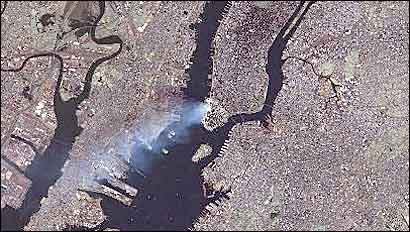
[David Ball forwarded this letter, which he wrote to a fellow friend of the late Bill Stiles. You know, it's over a year since Bill died, causing all of us who knew him to question why such a wonderful soul was taken from us so soon. It's hard to comprehend that the friends and family of 7,000+ people are asking the same thing right now. But enough of my musings -- here's David's letter.]
I'm just devastated. It is hard to think that anything matters. I'm having trouble getting beyond my fear and uncertainty. And yet I think we have to. In some ways this tragedy is an opportunity for us to prove our humanity, to truly vanquish the goals of the terrorists by proving that we are all heroes, that we can transcend our fear and anger and heal the world. I am hopeful that we can learn the true extent of our strength by being tested this way.
People talk about this as being an attack on "the American way of life". The only way of life that I can think of as being truly American--and I mean the good side, not the ugly American side, not the side that fucks up other countries in Latin America, not the side that did nothing in Rwanda and Bosnia and Tibet, or the side that aided the Taliban when they were fighting the Russians and which hates them now--is that we all get along together and we have tolerance and respect for one another. We are greater than the sum of our parts. We make something work that, on paper, seems wildly implausible. I wish we could all remind ourselves that what is important is not that no one messes with us and gets away with us, but that no one can prevent us from pursuing what is right and good. There's been a lot of talk about rage from politicians (Giuliani being a notable exception), and that scares me. The U.S. was founded in the spirit of justice: the real kind, not the frontier kind. And justice involves not just revenge and reprisal, but treating someone with dignity and clemency who doesn't fucking deserve it, because we're bigger than that. Because it's the right thing to do. And the right thing to do is never easy, but it is (or should be) its own reward. I wish I could say this is going to force us to think about what kind of country we want to be, but what disturbs me about all the anger is that anger doesn't involve reflection at all. We're just going to do stuff and figure out how we really feel about it later.
That is not to say I don't have my share of anger. I'm beyond rage that someone would kill so many people in cold blood. They destroyed the World Trade Center. And how the fuck can the U.S., which spends all that money on defense and not on education, let the SECOND plane hit, for Christ's sake? I am angry at my own impotence, which feeds into everyone's lust for revenge (including mine). I am angry at anyone who is happy that this happened.
But in this lust for revenge, again, people talk about THEM without thinking about who them is. If we end up killing people or start to talk in terms of acceptable collateral damage/civilian casualties, we're back where we started. The loss of innocents. People getting angry and killing other innocents. Indictment by synecdoche. And those ways of thinking are what lies behind some evil person's decision that innocent officeworkers are part of a THEM who deserves to be burned alive. That's why we can't give into the anger, much as we want to lash out and hurt someone, anyone else. When we do that, they win. We have agreed to take on their violent and hopeless view of the world. We have agreed to abandon our way of life and descend into hatred and never-ending cycles of grief and vengeance.
I especially worry about this as a Muslim. I'm especially angry about those fuckers as a Muslim, too.
It is obviously a shitty time to be a Muslim. I mean that in a couple of ways, but one of the ways I feel it is, I think, wrong. I feel pressure to differentiate myself from people who kill in the name (but not the spirit of or consistent with any of the teachings of) Islam. It is interesting that I didn't feel I had to justify my white maleness when McVeigh killed, but I do now. I feel like I have to justify Islam not only to others, but to myself, even though every Muslim I know is gutted by the news and looking for ways to help (a group of our Muslim friends who are doctors went to St.Vincents last night). I mean, religion is about peace. God is love. So I'm upset that bin-Laden has brought God into this and that we (the press, silent Muslims, people who don't listen to non-silent Muslims) have let him. The people who did this are insane. Why do we think they're right about what God thinks even though we know they're wrong about everything else? The most bitter, wrong-headed, evil people own the concept of Islam, and the rest of the 1 billion people who call themselves Muslims are what? Silent? Unheard? I don't know.
The English translation of the main part of the Muslim prayer goes like this:
God is the most gracious, the most merciful.
All praise be unto the lord of worlds.
The most beneficent, the most compassionate.
Master of the day of judgement.
You alone do we serve, to you alone do we come for help.
Show us the straight way.
The way upon whom is your favor.
Not of those who have earned your wrath, nor of those who are astray.
Compassion and mercy are at the fore of this. These monsters have clearly misread the way of favor (I'll get to that in a bit). But I wonder if they even care. I really wonder if they think they're doing the right thing or are letting hatred blind them. There is no mercy, no beneficence, no grace, no compassion in their actions, and if they are truly observant, they probably repeat these words more than 15 times a day, without listening (even though the first part of prayer is announcing intention, which is supposed to prevent your just saying words that you don't think about). The straight way is not about bloodlust. It is about submission to God, submitting to forgiveness and humility, and doing that all the time so you never forget the lesson. It is not about assuming that you know God's will and deciding to end the lives of thousands of people.
God's idea of the straight way re: terrorism and the killing of civilians is pretty clearly laid out. Referring to the Old Testament/Torah/whatever you want to call it from whatever perspective, the Koran says:
[5:32] "......, we decreed for the Children of Israel that anyone who murders any person who had not committed murder or horrendous crimes, it shall be as if he murdered all the people. And anyone who spares a life, it shall be as if he spared the lives of all the people. .............."
[2:256] "There shall be no compulsion in religion".
[60:8]"GOD does not enjoin you from befriending those who do not fight you because of religion, and do not evict you from your homes. You may befriend them and be equitable towards them. GOD loves the equitable."
And I don't want to get into it, but jihad is supposed to be about striving and in most places has a non-martial context. But I'm preaching to the converted here--ha ha--or, actually, I'm not, because it's pretty clear that there's no dialogue that these devils are interested in. I just wish people would remember that people who are in this country are here for a reason. They want freedom. They have no interest in destroying the American way of life, only sharing in it with their families.
Obviously I have chosen to live my life in a loving way and I feel like my voice, like all our voices, is being drowned out by hatred and violence. I meant that in general, but also specific to the community--however loosely defined or imposed, because I'm not the member of any community that would include these people. I'm feeling pretty helpless to counter that because I'm not in a position of power and I'm sure no one would take my opinion as "typical".
So I feel thwarted and helpless on a variety of levels. It is tough to generate the hope necessary to preach/be/embody/spread peace, but without peace, things are truly hopeless. So I guess we're back to generating hope and goodwill out of darkness, which is one of the lessons I learned from Bill [Stiles].
I'm having a hard time believing in permanence. I keep having flashes of what it must have been like. I am afraid, and yet I read about the people who carried down the wheelchair-bound woman from the 85th floor and I am heartened. Then I think about the couple who jumped off holding hands. I know they must have felt strength in jumping together, and I understand that, which terrifies me.
But we can leap off into nothing believing that if we're all in this together, we'll be all right. I hope people take each other's hands. We're all bootstrapping each other, whether we know it or not.
* Personal Experiences, Personal Responses: Reports from Brooklyn, Bellevue, Manhattan, San Francisco, Iowa
* Questions About "War"
* A Memorial Vision
* An Architect's View
* Other Voices: Edward Said, Falwell and Robertson, Osama bin Laden, Mark Twain, Shabana Mir, Michael Moore, Tamim Ansary
[Note: Because there's so much, it won't all fit on one blog page. You can read the rest here.]
"Beware when confronting a monster that you do not become a monster yourself." - Nietzsche
-------------------------------------------------------------------
9/18/01
It looks like rain today. Somehow the clouds fit our collective mood -- a sense of threat overhead, the muffled sun, the sky reminiscent of smoke. Now, crossing into Manhattan, I can't tell the remaining smoke, the smoke of the remains, from the clouds. The unthinkable drops into the background.
And I think: when it rains, what will happen to the posters of the missing? Will they wash away? Or will they run, smudge? As if they haven't wept enough already.
I saw dozens of those posters yesterday on Canal Street. It was like the tide had come in, surging downtown, broke against the police barricades, and receded, leaving posters and candles and yellow ribbons and letters from children in Philadelphia. The vendors are selling commemorative t-shirts. On the street you could buy postcards of the towers out of a cardboard box. A buck a piece.
I'd gone down, thinking that if I could only see it with my own eyes I could begin to comprehend it. Of course, they're only letting residents down there, and I couldn't even begin to think of a credible reason why I needed to go below Canal. Nearby, a glass storefront was covered with messages written on square labels. Some were sorrowful, some hopeful for peace -- but most were filled with rage. Kill them all and let God sort them out. I am frightened of such hatred. When does justice end and revenge begin?
The sky that day was so blue -- it was almost criminally beautiful. I was on my way in to work. It was supposed to be my first day back after a month of being home with Ben. On my way in to the station I heard word that the subways were closed, but the token booth clerk assured me that the trains were running OK, and sure enough the 2 train pulled in a minute later. (This was sometime between the 2nd plane and the 1st collapse.) I read the latest McSweeney's, an article by Breyten Breytenbach on stateless citizens, listening to the corresponding TMBG track, until we stopped, somewhere between Clark and Wall, Brooklyn and Manhattan. After a few minutes the PA announced that a building had collapsed. And then the guy next to me, who worked for Amtrak and had a huge suitcase, began telling me what had happened. Two planes. One for each building. Terrorists. I remembered, from reports after the '93 bombing, that the towers were built to withstand a direct impact of a jet airplane. They'll be fine. We kept chatting, the way New Yorkers do when they're thrown together. Hey, at least we have seats, I joked.
Then we started to smell smoke. And people started to get nervous. I'm not sure how long we were stopped. The Amtrak guy, who had seemed pretty together before, was getting panicky. Some woman was sobbing. There were several stampedes toward the front or back of the train. The smell got worse. I sat, with my head down, trying to breathe slowly, my tie wrapped around my face. I felt very calm.
They finally got us into the Wall Street station, which was filled with white smoke. And then we were in the atrium, and I could not believe what I saw outside. It was like a snowstorm had hit -- the streets were covered, the sky was thick with white, people were hurrying down the street. Except they were all hurrying in one direction, and everywhere was ashes.
Somehow, the eeriest sight was the abandoned bagel carts. You never see an abandoned bagel cart.
I followed everyone else -- at NYU hospital they were handing out masks -- and then we were at the Brooklyn Bridge, and then we were across. I walked all the way back to Park Slope with a web designer who was on my subway car. As we walked across the Bridge, we kept looking back. (Orpheus, Lot's Wife, and Me.) Where are the towers? he asked. Must be behind all that smoke. I didn't know until I got home (to a very relieved Debbie) that they were gone.
Later that afternoon, I watched a piece of paper flutter out of a clear blue sky and land right on 7th Avenue. Two girls picked it up -- a page from a budget, charred at the edges.
I'm so glad to have Ben now, to hold him, to focus on him, on life, on the future.
There's a lot here this week on the attack, and what happened to us, and what it means, and what we should do. I'm starting off with a few experiences of Ishbadiddlers. Then Alex has some questions about war -- responses next week. And then a vision of a memorial, and some other readings. I hope you don't mind the extra long edition, but there's a lot on our collective minds. When words fail us, we need more words...
-------------------------------------------------------------------
Patrick:
I was in my office on 34th street when the planes struck. I soon left the office on foot (not wanting to risk getting caught anywhere) and reached Katey and Nicholas in are apartment. Our neighborhood was not effected by the blasts but you could clearly see the plume of dust where the Trade Center had been and the people walking up first avenue to safer areas. We heard a lot of sirens. More than normal and we knew where they were all going. After about an hour of news overload we decided to turn of the tv and radio, but the temptation was too great. We decided to walk over to Tompkins square Park, where we assumed we would not hear any broadcast, see any smoke or hear any sirens. Although the park was pretty normal we eventually decided to walk up Ave. B to Katey parents and eventually ended up staying overnight with them.
-------------------------------------------------------------------
Liz:
I'm ok. Somehow the full magnitude of this just hasn't hit me yet. There are ways the disaster brushed incredibly close, and yet I just feel numb. I keep feeling I should grieve for the people who were killed, and yet it's so hard to believe that, even seeing the rubble, it still does feel like a special effect.
I work about two miles north of the trade center, and things were oddly calm up there on 23rd street. Most offices closed around noon, and the streets were filled with people, in the middle of the streets as well as the sidewalks. But most of them were astoundingly calm, focusing on how to get home, and seeing the city's well-organized response to the emergency in the process. Many buses passed us, heading downtown to help evacuate the area. The taxis we saw were all off duty, for some reason, and most people just seemed to be walking, slowly, but reasonably calmly. I passed one young woman staring down Fifth Avenue at the smoke pouring out of the hole.
I was the only one who made it into work yesterday. David has been driving me in because I'm having a tendon problem with my foot, and he dropped me off at about 8:30. We generally take the Battery Tunnel in, which exits just west of the former towers. So we drove by about half an hour before the explosions. I don't think I was even paying attention.
My boss was in DC yesterday; still is, as far as I know. He travels so often that his wife didn't even know what hotel he was staying at, and she called, frantic, to try to find out. (As it turns out, he was in Rock Creek Park, safely far away from the explosions.) I called our colleagues who work further downtown, and the person I spoke with had just seen the tower collapse, out her window. I left my office twice to try to give blood. The first time I couldn't get uptown; the second time, I started walking, realized I would never be able to go two miles on my aching foot, and finally was able to share a cab uptown with several other people. I had planned to meet David at his office, and we were to go together, since he had already been to the Red Cross center and was told there was a five-hour wait. He had also signed up to do grief counseling, and he had been picked up by one of the commandeered buses by the time I got to him. So I waited, read through almost the entire Table Talk thread, and listened to the radio. Meanwhile, he waited at the piers that were to be a temporary morgue, and eventually was dismissed because neither the bodies nor the grievers had arrived.
So, a lot of near misses, but we're all ok. David and I eventually got home to Brooklyn over the Triboro Bridge, which was the only one open, and stayed up far too late watching the rescue attempts and that very swiftly-moving plane. My office is closed today, but we're working from home, televisions and radios blaring.
Much love to you all. When you break a glass at a wedding, it's supposed to mean that you remember sorrow in the midst of joy. I think enough glass has been broken for years of weddings. But we'll see you at ours, God willing.
{Later}
The situation is actually quite a bit calmer up here on 23rd street. I tried to get over to give blood earlier, but there's a five hour wait in local hospitals. The streets are filled with people, most of whom are fairly calm, but who are walking slowly down the middle of the street instead of staying on the sidewalk. It reminds me of celebrations at the end of World War II, rather than what could be the beginning of one.
In a movie, the eerieness of this scene might be marked by silence or wailing, but what makes it particularly eerie is the normal behavior most people are lapsing back into. Most seem more focused on trying to get home. I overheard one conversation about the wtc collapse which transitioned into a discussion about Independence Day, and then into other Denzel Washington movies. But it's all under a literal pall from the smoke billowing out of the hole at the end of fifth avenue.
I am going to try again to give blood in a little while. This is an extraordinary and very frightening day.
-------------------------------------------------------------------
Ranya:
My Arab friends are already reporting a backlash. Of course, despite the images we saw on the news of the already-long-frustrated and desperate Palestinians celebrating the attack, most Arabs and Arab-Americans are horrified by this event and I'm sure many would like to show where their sympathy is by donating blood and by trying to help. A Palestinian friend of mine who grew up in wartime Beirut said this is what Beirut looked like. He also reported that veil-wearing Muslim women in Bay Ridge have been verbally harassed and an Arab shop owner was sprayed with pepper spray.
It is very important not to blame the millions of innocent Arabs and Muslims over this tragedy, and to do what we can to stop further spread of this hatred and blaming, which I'm sure will happen in the coming days and weeks.
David:
In 1977, when I became involved with the Clamshell Alliance trying to stop the proliferation of nuclear power, and I began to research the subject, two hypotheticals jumped out at me:
1. A meltdown, when the reactor core superheated and would, in theory, melt all the way down to China (hence the term "The China Syndrome", which became the title of a movie), but instead would hit ground water and "Contaminate an area the size of Pennsylvania." This hypothetical was actually referenced in the movie, which came out only a few weeks before the incident at the 3 Mile Island nuclear plant in Harrisburg, Pennsylvania, back in March, 1979.
2. In the event of a possible meltdown, how does one evacuate an area the size of Pennsylvania? The hypothetical that stuck with me all these years was that "It would take 2 1/2 hours to evacuate the World Trade Center -- without panic."
I have thought about that hypothetical many times over the years, including just yesterday morning, as Liz and I drove into the city through the Brooklyn Battery Tunnel, passing underneath the World Trade Centers at about 8:20 am, less than a half hour before the first plane hit.
We managed to get home to Brooklyn last night. The streets reeked of smoke. Taking the F train to Manhattan from Brooklyn this morning, you could still see the smoke, as high as skyscrapers and as wide and area as much of lower Manhattan, fortunately blowing south into the harbor, rather than north over the island.
I'm reminded of Phil Ochs' song, "Crucifixion," which he wrote after the assassination of JFK. He wrote this many years ago, and I'm just changing the pronouns of a couple of partial verses. The first verse I thought of upon first hearing the news, and the second after watching every replay from every angle:
....First, a smile of rejection at the nearness of the night
Truth becomes a tragedy, limping from the light
The Heavens are horrified! They stagger from the sight
And the Cross is trembling with desire
....But you know, I predicted it, I knew they had to fall
How did it happen? I hope the suffering was small
Tell me every detail, I've got to know it all
And do you have a picture of the pain?
I can't imagine what it must be like for Jesse, or for my Liz's brother-in-law Dennis, who both work at Bellevue Hospital, which houses the first makeshift morgue, and received the bulk of the first casualties. I volunteered as a Mental Health Professional yesterday, putting my hypnotherapy license to use as a grief counselor, and was bussed by the Red Cross to a makeshift morgue, but it wasn't set up yet, and they sent us all home without having had the chance to counsel anybody.
To say that our hopes and prayers are with the thousands upon thousands of people, alive and dead, who are still trapped under tons and tons of steel and rubble, feels to me like spitting into the ocean. And yet, New Yorkers rise to the occasion: there was a five hour wait to give blood yesterday at the hospital near my office, and as long a wait as that at the Red Cross center on 68th Street.
-------------------------------------------------------------------
Jessie:
Dear all:
I wanted to try to write something, both to let you know what I've seen and to help me get it off my chest, I fear I won't be as eloquent as others or as the occasion deserves. All that I write is my own musing and completely off the record. Thank you all for your concern and good vibes sent my way. As you may or may not kow there are 2 "level one" trauma centers in lower manhattan: St. Vincents and Bellevue. St. Vincents is closer to the site, but Bellevue is bigger. When we first heard about the initial disaster we had just finished our morning conference and really didn't know what had happened except that a plane had hit a building. We set up the ER for mass casualties and got assignments of duties. It was very efficient and under control. It turns out that many of the staff in the hospital had watched both crashes unfold as there are windows of the hospital that face south and had an unimpeded view of the towers. In the ER, though, we knew very little and simply readied ourselves for the worst. And then people started coming in. At first, there were a few victims, who had been picked up fleeing the scene, then we started getting rescue workers who had fallen and hurt themselves or who had suffered smoke inhalation or asthma attacks. And all the physicians in the hospital seemingly came down to the ER to lend a hand. We had facilities for over ten simultaneous trauma resucitations. People who had trained at Bellevue in the ER showed up thinking that we, and not their current hospital, would need help. But there just weren't very many patients. Finally at 1PM after feeling very agitated that I was basically standing around doing nothing, I came home for a few hours sleep figuring that all there docs would eventiually get tired and go home and they would need fresh people in the ER to stay up all night. While I walked home I couldn't believe that it was such a beautiful day. It seemed wrong, like it was too cruel a juxtaposition to have evidence of our divine gifts while experiencing such loss. When I went back to work at 8PM, nothing was much different. There was stil a lot of standing around. Occasionally some folks would go down to the site or to Chelsea piers where there's a triage center, but the people who came back said that there wasn't much for them to do there either. Surgeons slept on stretchers in the ambulance bay, there were so eager to save someone's life. I walked around in a daze. Thinking about how I used to look at the twin towers being built when we crossed the Brooklyn bridge when I was little. They finished one before the other. I don't remember which was which, but for a time, they were distinct for me. I started getting more and more sentimental about the firemen. They've suffered such huge losses. They mourned so hard when they lost that group of firefighter in Massachustts. Yesterday they lost hundreds. The docs who went down to the site said that the firefighter were superhuman. They would go and dig, get overwhelemed by smoke, come out, suck on some oxygen for a few minutes and, as soon as they felt better, go right back in. I thought about how they risk their lives without hesitation and what it really means to be a hero.
I feel like the entire day has been spent hoping that we'd get some patients, hoping that we could save some lives, thinking "with the death toll likely to be over 10,000, even if only 1% can be saved, we should be seeing a lot more people here." So we were a whole hospital with nothing to do, everyone was ready and willing (suddenly the laziest staff had a spring in their step), we just had so few patients and that was so horrible.
There were some people who came in who we probably saved, but it's such a small percentage. It's hard to comprehend the thoroughness of the destruction.
I'm going to watch some TV, eat breakfast and go to sleep. Love to you all.
-------------------------------------------------------------------
Matt F-B:
I'm turning around in my cocoon of shock, absorbing the astounding sight of so many lights on in the windows of apartment buildings, taking in the progressive slowing of Peter Jennings' train of thought, taking in the ratio of people walking down the street with a cigarette in their hand, taking in the child psychologists' advice that parents should reassure kids that they are there to keep them safe--around one's baby, maintain one's routines. The parenting experts also say that if the kids are talking about how excellent it is to see bodies flying from buildings, then maybe it is a good time to share one's adult feelings about the many people in that building who won't be with their families anymore.
I fear I find myself guessing what percentage of kids won't be getting plain-spoken reassurance from their parents this week. Then I find myself reassured that the homeless guys are walking by with their bags of cans, just as they usually do.
I am most thankful that, contrary to what I speculated to Chris earlier, my former roommate Kay was not in the building. It's an understatement to say to say that it was a good move she quite her job on the 102nd floor of the WTC 2 weeks ago.
I'd like to note, since we all will end up at some point discussing today's awfulness by invoking previous historical awfulnesses (another recommendation to the parents, actually), that not one of the disaster management professors or other talking heads on the airwaves have managed to remember to include the recent deaths of 100,000 or so Hondurans by earthquake on their list of acts perpetrated by God or the devil.
May we all remain well, suffer a minimum of loss to our immediate circles, and have the fortitude to help where we can.
Yitgadal v'yitkadash v'yimlach malchutay b'chayaychon v'yomaychon--God's holy canopy of peace, come and cover us quickly in our days.
-------------------------------------------------------------------
Xeni:
When I turned NPR on this morning and didn't hear Dick Estelle's Bookshelf, I knew something was terribly wrong because, as often as I've wished for it, nothing but nothing has ever preempted the froggy recitations of Dick Estelle. A man who was not Dick Estelle said something about a passenger plane flying into the Pentagon and two into the World Trade Center, and it seemed too unreal, too much some special effects nerd's wet dream ("We'll have a plane. No, wait--two planes! And we'll crash them into the World Trade Center!) to be true. I turned on my small tv, and there found terrible (if still surreal) confirmation of the NPR story. I tried calling New York, afraid for friends, for friends of friends, for people I don't know or know barely (I worked in one of the towers for a couple of weeks, doing secretarial stuff for a firm that specialized in, of all things, catastrophe insurance, and, oh, those poor, poor people; I pray they got out alright).
As grateful as I feel today to be living in a state that isn't ranked high by terrorists in iconic value, I wish that I could be closer to the people I care so much about. Because I can't right now, please email. And please, please be well.
-------------------------------------------------------------------
Chris:
It's a horror show down here. My family is okay; Debbie, last I spoke to her, was still waiting for word on Mike, who commuted into work this morning; but given the time he left (9ish), we suspect he -- thank God -- didn't get very far. I spoke to Jay and Andrea earlier, too -- they are fine.
My Dad's 70-something uncle Oscar, miraculously, got out of the second WTC building after the first crash. He got out in the 18 minutes between explosions. Incredibly, he got on a subway at Brooklyn bridge and made it home...we are so relieved. A cousin's father-in-law is still missing; we're praying for him.
I'm typing e-mail because I'm too nervous to do anything else.
My building is very close to the city and offers a perfect view of lower Manhattan. I was reading the paper on my back porch at around a quarter to 9 when ash began falling on me. I thought it was soft hail, but it's a sunny, totally clear day. Not knowing what was going on, I clambered up the fire escape to my roof and saw the smoke flowing out of the first building. Because of the wind, it was all heading toward Brooklyn.
In the time it took me to get down, turn on the TV and start calling family, I witnessed the second explosion live on TV. I soon returned to my roof and saw the first building collapse right in front of me, from my roof. Seeing the crashes on television was sickening, but watching the first collapse in person was absolutely horrific.
It was raining ash, also raining pieces of paper; one from a brokerage company, with some flowcharts on it, coated in ash, landed on my roof. The ash was a little at first, but about an hour ago it was so thick, people couldn't walk on the street in my neighborhood. The sun is back out from behind the cloud; my back porch coated in ash.
-------------------------------------------------------------------
Andrea:
Jay and I were both here in Park Slope this morning when the planes hit, and thank whatever, the only physical trace of tragedy to reach us is the ashen, wind-born taste of what's left of the tallest buildings in New York.
We can't see the double-amputated skyline; it's shrouded by a long gray cloud (an airborne hate-seeded event?) stretching over what had been a cloudless day. Then also, I had to take a break from watching TV. They're running the four-step carnage tape over and over again, and when I see the towers' steel lattices collapse downward, I can't stop imagining it as the staged demolition of some retired Vegas showplace, only somehow, oh god, they (puke) forgot to tell... everyone inside. No one knows how many there were yet, though I guess our friend Jessie is getting a sense. By now she must be in up to her elbows at the ER. We worship her.
For now, we've been stopping by the hospital down the street periodically to see when they'll have room for us to come give blood. Last time we were there, the paper sign posted out front made me tear up a little. It said: "Blood Donors: Due to overwhelming response, we cannot accommodate any more people today. Please come back on Wednesday, September 12."
When the earthquakes last hit in Turkey and and the murders at Columbine, I remember how the news of community response had a fairy-story feeling for me, how I didn't quite think that I lived in a place like that. Anyway, don't worry (about us, at least). We're a little shaken, but fine, and this is a place like that.
-------------------------------------------------------------------
Laura:
I feel this bizarre need to write to you all, to maintain constant contact, to repeatedly reassure myself that you are all OK and safe. I don't have the words to express my feelings, nor can I imagine what it must be like to be in New York right now. If I'm this shaken up, I can't begin to think what you must be feeling. My heart is breaking for you.
Even as far away as we are, this is all that anyone can talk about or think about. My students seem to be fine -- to most of them, this is something happening in a faraway place to strangers. The school psychologist has given us guidelines on how to reassure students and make them feel safe; somehow, we all feel like we're faking it to a certain extent. Still, they keep asking questions, you know, the really hard ones that only kids can ask and that adults usually make up answers to.
The teachers at my school are all zombies. We waited slowly to hear word from everyone's friends who worked in the towers -- some of the news was good, others received horrifying calls today and left school early, mourning, while the rest of us covered their classes and tried to act like everything was going to be OK. Only a few dozen people were on the flight to San Francisco, but somehow I keep hearing of people who knew the people aboard. Matt and I just stay glued to the TV, as if learning more about what is going on will help us to understand it better.
We'll be flying to New York in two weeks for the wedding, assuming that the airports get back to normal. I can't wait to see you all again in person. I can't stop thinking about you and how much you all mean to me.
-------------------------------------------------------------------
Some Questions from Alex
Does Ishbadiddle cover politics? I've had some questions eating away at me, and I'd love to know what other people think about them. If you think they're interesting, too, maybe you could include the questions (perhaps with some of your own) in the next Ishbadiddle and then print the answers in the next next version.
Here goes:
The attacks on New York and Washington Tuesday (and the hijacking/crash in Pennsylvania) were horrible and tragic. Thousands of innocent civilians were killed. Some commentators and politicians, including Pres. Bush, are calling these attacks acts of war.
As that word 'war' is used more and more frequently, and as our country seems to be preparing to wage war, here are the questions I keep asking myself. Maybe you can help me by sending in your thoughts.
Were these attacks acts of war (as opposed to acts of terrorism)? What is an act of war?
Should we now behave as if we're at war?
If we're in a war, who is the enemy? Is it the individual terrorists who planned and carried out the attacks? Is it the countries that support or "harbor" terrorists, too? Is it also the civilians in those countries?
What military actions are justified by these attacks, if any? If this is "war", as opposed to terrorism, are more extreme military acts justified?
Were these attacks equivalent to a Pearl Harbor? Are these terrorists now analogous to Japan then? Should we fight them now as we fought Japan then? Is that possible?
Is it possible to defeat terrorism through military action? Or will that serve only to fuel the fire (as seems to be happening in Israel and Palestine; Northern Ireland also comes to mind)? Or, if we fail to strike back militarily, will that encourage more terrorism?
Would it be more effective to tighten security than to wage war? Is it possible to defeat terrorism through tighter security? Or is there no way to stop a determined, suicidal fanatic?
A Memorial Vision
At night, from a distance, you can see the two towers. They climb into the blue-black sky, and carry with them several thousand glowing windows, illuminated from within. The lights are suspended like quiet spirits who watch over the city.
As day breaks, the towers are revealed anew: Two steel structures, identical to their hard-working and famous parents in frame only. Only raw, unadorned beams and girders, occasional panes of glass, make up these new edifices; you can see the sun and sky through them. There are no cranes, floors, ceilings or walls that seek to finish or adorn them. Solid, naked to the world they speak like bones from history, but really they represent something in progress, something great that will be. They are unfinished like the work of democracy is unfinished, like the road to peace and understanding is unfinished.
Stand directly under these mighty sculptures. Ask a uniformed woman about their immense trade-tower size. With a Brooklyn accent, she'll tell you, "They brought steel in from all over. Many countries helped. Each glass pane that lights at night represents someone who died that day. It's the greatest memorial the world has ever seen." She adds with pride, "Only in New York."
Tip your head far back. Try to absorb the vast volume of the former World Trade Center. The scale of these new structures draw your eye upward, unobstructed, along the beams -- a mixture of steel, glass, light and air -- to the top. You see a cloud hovering -- and the sky through crisscrossing beams -- and suddenly you feel all the weight that dropped on September 11th 2001, lifting. Perhaps, for the first time, you can wrap your mind around the immensity of what happened.
At any moment, hundreds or thousands of people like you are looking at these memorial towers with respect, contemplation and wonder. From night to day the buildings are a contradiction. So, too, is it strange to have such structures dedicated to neither home nor office on this bustling island. But this is fitting; we are each made of contrasting energies. It is this duality which makes us uniquely human, and therein we each must find our personal harmony. This place might help us find it.
The memorial towers invite you to place your hands on them. Every support beam contributes to its overall balance and support. Such unyielding metal can with stand unimaginable pressure. No one would dare throw themselves against it. Of course, we know better. A panel affixed with thick studs provides a simple list: Here are the many countries that gave workers, steel, engineering expertise, artistic input and lives. It is a testament to an America and an idea that will be ever vulnerable -- yet never alone.
Millions come here every year to pay homage, to remember, or to have their spirits lifted up as if in a glass elevator; past the terrible scenes and violence, past loss and fear, past facts and concerns, past redundant history, money, religion and tragic bitterness. People come here to be transported to the breezy 110th floor, where hope lives and works.
No casual tourist will ever photograph the view from here, or sip a cocktail. No electronic media eye will be placed on top. No phones will ring, no transactions will be made, no risks or measures taken, no voices at all. Up here, the dizzying heights are reserved for our spirits alone -- the living and dead. Down below, our humble feet will remain rooted to the ground.
How lucky we Westerners are to be living where and how we are living. How fitting it would be to create a set of memorial towers, unfinished by day, seemingly alive by night, where once stood the magnificent World Trade Center.
Once, the integrity of the city and the confidence of America had been badly damaged. Imagine the New York skyline reclaimed in such a form. Imagine this homage to industry, progress and hope, calling out to friends and foreigners as if to say: "Here in the great city of New York, and hopefully one day in all the world, is a good, safe place to be."
Mike and Debbie, I write this to you as a friend and New Yorker. On the evening of the tragedy, I slept for only a moment -- just long enough to dream of a single, incredibly comforting, image. I dreamed of the upper floors of the twin towers at night. These beautiful buildings were so good to see, and yet I knew they were different... I cannot describe properly my feelings but to say that I have become obsessed with realizing this picture in my mind. I can't shake the intense stirring I feel for this simple dream that is at once mammoth and possible.
I know there are a great many people who would be willing to assist in launching a memorial of this magnitude. Furthermore, I am convinced that something needs to be done soon to counter the sense of conflagration and doom that presently reigns over so many hearts. I want this tragedy to move our nation to greater acts of benevolence, not violence. And I hope this kind of memorial would provide a fixed harbor where we can work out our demons while at the same time providing a magnet for more good works. So much needs to be done in the world.
And it would mean a great deal to me if you could give me some feedback. I intend to pass this idea around to anyone and everyone. Ideally, you could refer to some of your many contacts and do similarly -- only please address them personally, for there is so much out there now. The idea is much larger than I, a single person with no experience or fixed notion as to where to begin. So I figured I'd start with what I do know: My friends. And so I look to you.
Sincerely, andrew krauss
PS. "It was as if the building had sprung forth from the earth and from some living force, complete, unalterably right." -- Ayn Rand, The Fountainhead.
Andrew:
I've been thinking about this since I read it -- and I can't shake the image from my mind. It's beautiful and right.
One thing comes to mind -- there should be some way for each of the memorial windows to light up. And on that person's birthday, anniversary, maybe even whenever anyone was thinking of them and called/emailed a special line, that window would glow. At the ground there would be a place -- like an electronic kiosk -- that would tell the lives of each of the victims and heroes. And when you went there to read about someone, their window would light up.
And of course, every September 11, the buildings would be a blaze of light.
-- MEL
-------------------------------------------------------------------
[This is an excerpt of a letter from a friend of a friend to a friend, included here for some useful information on the bin Laden / Taliban connection.]
This stuff about distinguishing between the terrorists and their hosts, at least in the specific case of bin Laden and the Taliban, is complete bullshit. First of all, there is no real distinction between the Taliban and bin Laden. The Taliban depends heavily on money from him, and Arab fighters recruited by him now form the backbone of the Taliban military which has as a result been kicking ass on the Afghan opposition. The heroic status bin Laden has also gives the Taliban much of its legitimacy. He has also married a daughter (wife #4) of the Taliban supreme leader, Mullah Mohammed Omar, so he is now family too. While the people of Afghanistan, who have suffered enough, should be spared as much as possible -- the idea of bombing cities in Afghanistan would be criminially stupid as well as criminal. But the Taliban has to go one way or another. I have not even mentioned that half of the country (the women) are essentially not allowed to leave their homes or do anything except cook and clean. Two weeks of air strikes (flying low for better precision rather than the recent practice (Kosovo) of flying at 30,000 feet so that not a American and British pilots are not at risk but with collateral damage much much higher) should take care of their military capacity and open the door for a new government there.
The broader point is that ultimately terrorists depend heavily on governments that support them or tolerate their presence. We really have no recourse against terrorists in the end, but we do have recourse against states. Today governments perceive no risk if they shelter terrorists. The worst that happens is that they get cited in annual State Department reports -- ooh, scary. If suddenly it becomes dangerous to harbor and support terrorists, with the Taliban as the object lesson, then a lot of states will think about changing their policies. I could imagine Syria thinking, boy, we may actually risk some punishment for allowing all these groups of killers to train and base themselves in the Bekaa Valley, maybe it's not worth it. Same goes for Iran (that is more of a stretch, at least until the old-line mullahs start dying of old age in greater numbers). Realistically, to say states will not be held responsible is to say we cannot and will not do anything against terrorism other than turn the US into a police state.
By Hugh Pearman:
Published first in Gabion
Minoru Yamasaki was a very small man - only 5 feet one inch tall - who designed what were briefly the world's tallest towers: New York's World Trade Center. He also wrote, in 1979, that he saw the towers as "a physical expression of the universal effort of men to seek and achieve world peace."
There are other ironies. Yamasaki (1912-86) was a first-generation American, son of a Japanese rice farmer who emigrated to Seattle. He encountered a great deal of racial hatred when growing up in the 1920s and 1930s. He was not allowed into public swimming pools, and remembered driving 30 miles with teenage friends to an almost-empty cinema, only to be told by the manager that they must go to the upstairs gallery rather than mix with the handful of whites downstairs. Astonished, Yamasaki and his friends demanded their money back and left.
Things reached a head after Pearl Harbour. By then Yamasaki was working for the American war effort, helping to design a naval base. In the hysteria following the disaster, Yamasaki was routinely stopped, and was once accused of being a spy.
Nor was this the first Yamasaki building to be destroyed. In 1972 his extensive Pruitt-Igoe housing development in St. Louis, built 1950-58, was dynamited by the authorities. This was an early example of a high-rise social housing project, and an equally early example of such a project going wrong socially. It had come to be hated by its residents, even to the extent of being the subject of arson attacks. Its demolition was seen by some critics, notably the post-modern champion Charles Jencks, as spelling the end of modernism. This proved not to be the case, though it certainly turned out to spell the end of that kind of social housing, for a good 30 years.
Though Yamasaki's best buildings are good, they are not great. He was far from being the finest architect of his generation. His appointment to the World Trade Center was a snub to the famous names of American architecture. Indeed, when first informed of the value of the contract, he assumed an extra zero had been typed in by mistake. On learning it was not a mistake, he protested that his firm was too small to be able to handle it. But his careful, analytical approach - he made 100 design studies before settling on the Twin Towers - won the confidence of his client, the New York Harbour Authority.
The towers were reviled by the critics either as being supremely dull, or as being too fussy. For critic Ada Louise Huxtable, it was "the world's daintiest architecture for the world's biggest buildings". She did not mean the overall form of the towers, but Yamasaki's busy latticework exo-skeletons. The buildings were framed tubes, with the load carried by the exterior. Each was structurally like a giant perforated box-girder standing vertically. The interiors were column-free. The central core played little role structurally, serving mainly to reduce the floorspans and provide lifts and services. Windows, inserted in this forest of external columns, were only 22 inches wide for most of the height of the towers. Critics protested that this removed much of the point of such towers - the view. Yamasaki replied that office workers were not meant to stare out of the window all day, and that anyway the narrow fenestration provided a feeling of security.
Because of the tall pointed arches at the bases of the towers - where Yamasaki drew every three columns down into one - Huxtable described the complex as "the ultimate Disneyland fairytale blockbuster. It is General Motors Gothic." There was much more in this vein. The towers were acclaimed for their technology, but won not a single architecture award.
Yet Yamasaki had invented the third-generation skyscraper. His was the concept of the "sky lobby" - where instead of having elevators rising the full height of the building, a railway-like system of express and local elevators, with interchanges, was devised. The large express elevators rose to skylobbies on the 44th and 78th floors. Local ones served individual floors. This system was devised to speed the flow of people - the centre could accommodate 50,000 people in both towers, with a further maximum 80,000 people movements per day - but also meant that the towers were very space-efficient. Conventional elevator arrays in skyscrapers meant huge areas of space were swallowed up on the lower floors. Yamasaki's big idea was to make each of his towers effectively three separate towers stacked on top of each other. The lift and service cores were much reduced, and net lettable area much increased. The World Trade Centre was 75 per cent space-efficient at a time when conventional towers achieved around 52 per cent.
This may seem mere developer-speak, but the design saved lives when the towers were destroyed on Tuesday September 11, 2001 by terrorist attack. During the all too brief period when the towers had each been hit high up by hijacked airliners, but were still standing, lifts continued to operate to the lower levels, allowing at least some people to evacuate.
Yamasaki and his engineers had designed the towers to withstand 150 mph hurricanes. Although plane strikes were not considered a likely threat, it was thought that the towers could handle such an event, and notices in the public observation gallery in the south tower said as much. This was true up to a point. The enormous lateral strength of the towers proved able to absorb the impact of the airliners, even though they sliced through the external structure. Reports from survivors record how the towers lurched and then stabilized.
But no steel-framed tower could withstand the intense heat generated by the firebomb effect of the planes' exploding fuel tanks. Their almost-full fuel loads made them cruelly effective missiles. The steel columns were fireproofed with sealed-in asbestos (the effects of this asbestos in the dust-storm provoked by the towers' collapse may have health implications for years to come), but this far exceeded any conventional fire. The columns would have turned to rubber in the fire zones. The progressive collapse that followed in each tower then became inevitable, for they were designed to support gravitational and operational loads, not vertical impact. The effect of the top sections of each tower falling onto the lower sections, as the columns in the fire zones below gave way, was like giant vertical hammer blows. Moreover, the latticework system of linked columns depended upon the integrity of the whole. Once the whole thing began to unzip, it weakened very rapidly.
This was why the collapse of the towers looked very like a controlled, deliberate demolition. In such controlled demolitions, the usual way to drop a tower vertically is to blow out supports and let the weight of the upper sections do the rest. How much of this was known by the organizers of the attack? Probably they knew very well: the 1993 bomb in the basement of the centre was intended precisely to achieve this effect by blowing the columns out sideways. But down there, the columns were very much stronger: the strength of the columns diminished with height because they carried less and less weight - good engineering practice, in peaceful times - and, as mentioned above, Yamasaki had drawn his many slender columns into fewer, much fatter, elements towards the base, better able to withstand blast.
Even so, the damage to the World Trade Centre caused by the 1993 bomb ran to $525 million. The cost of the whole building programme in 1974 was $800 million. At the time of their destruction, they had recently been purchased by a private developer for $2.2 billion. Clearly, with the enormous amount of collateral damage caused by the collapse of the twin towers - several surrounding buildings also collapsed and others, some huge, will have to be demolished - reinstatement costs will reach a new order of magnitude. A complete city district of Manhattan will have to be rebuilt from scratch.
In view of the almost unimaginable loss of human life in terrifying circumstances, and the doleful prospect of much more havoc to come worldwide as the political repercussions take effect, it might seem insensitive or na�ve to consider the architectural implications of the tragedy. Yet this must be done. Even at the height of the Blitz in London in 1941, plans were being laid for the post-war reconstruction.
There are two possible effects. The most obvious and immediate is that skyscraper design will change. The other is that people will stop building skyscrapers. The Twin Towers were leanly designed, engineered precisely for their purpose and no more. In contrast, other towers such as Canary Wharf in London - built in a country that is no stranger to terrorist and wartime bomb attack - is allegedly designed with a fair amount of "structural redundancy". In other words, it is stronger than is strictly necessary.
Building in such structural redundancy is not especially expensive - the above-ground structure is by no means the costliest element of skyscraper construction. Alternatives to Yamasaki's exo-skeleton, such as the structural central core, may also come to be preferred. This may well see the end of visionary "skyscraper city" projects such as Norman Foster's Millennium Tower project in Japan - which owes much to Yamasaki's pioneering work and also possesses a latticework exo-skeleton.
It is possible to build skyscrapers that could withstand the impact of the biggest airliner yet devised, and the fires that follow. It is possible to devise faster escape systems for skyscrapers. But will people want to? The trend in recent years has been for scattered organizations, private or public, to group themselves into single, landmark buildings, often towers. But even when they are not towers, such buildings are vulnerable to attack. Britain's spymasters became very visible - and a target for terrorists - when they moved to their admittedly blast-proofed Terry Farrell HQ in London. The Bilbao Guggenheim by Frank Gehry has been a focus for attack by Basque separatists and is seen by some as an example of American cultural imperialism.
To be highly visible - if you are an organization seen to be connected with a government, a regime, a religion, a belief system or simply wealth creation- may well now come to be considered unwise. The only way for an organization to safeguard itself against terrorist attack is fully to adopt the strategy of the terrorists' own bases. This means becoming invisible. This in turn means rejecting large centralized landmark buildings, of whatever kind, in favour of a network of scattered, far smaller, anonymous buildings.
Corporate pride may be hurt by this, but logically there is no reason why centralization of people should be necessary anyway. Electronic communications, we have been told for years, should make large office buildings unnecessary. This seems in part to be coming true as more and more people work from computers at home. And yet the giant corporate and governmental HQs continue to be built.
The long-term effects of the September 11 terror attacks on America may affect the way every city in the world is built, and even threaten the whole notion of the dense urban centre: adherents of the loose net of small nodes will find themselves being listened to with increasing attention.
So much depends on the aftermath, the knock-on effects, of September 11, politically and militarily. We await the aftermath with dread, though it is just possible to make out a case for hope. Never to be forgotten are the images of trapped people standing in Yamasaki's narrow windows high in the World Trade Center towers, choosing to jump to their deaths rather than be burned alive. As with similar images of the burning airship Hindenberg in 1937, this event marks a fundamental change in our perceptions and attitudes.
-------------------------------------------------------------------
Edward Said
Sunday September 16, 2001
The Observer
Spectacular horror of the sort that struck New York (and to a lesser degree Washington) has ushered in a new world of unseen, unknown assailants, terror missions without political message, senseless destruction.
For the residents of this wounded city, the consternation, fear, and sustained sense of outrage and shock will certainly continue for a long time, as will the genuine sorrow and affliction that so much carnage has so cruelly imposed on so many.
New Yorkers have been fortunate that Mayor Rudy Giuliani, a normally rebarbative and unpleasantly combative, even retrograde figure, has rapidly attained Churchillian status. Calmly, unsentimentally, and with extraordinary compassion, he has marshalled the city's heroic police, fire and emergency services to admirable effect and, alas, with huge loss of life. Giuliani's was the first voice of caution against panic and jingoistic attacks on the city's large Arab and Muslim communities, the first to express the commonsense of anguish, the first to press everyone to try to resume life after the shattering blows.
Would that that were all. The national television reporting has of course brought the horror of those dreadful winged juggernauts into every household, unremittingly, insistently, not always edifyingly. Most commentary has stressed, indeed magnified, the expected and the predictable in what most Americans feel: terrible loss, anger, outrage, a sense of violated vulnerability, a desire for vengeance and un-restrained retribution. Beyond formulaic expressions of grief and patriotism, every politician and accredited pundit or expert has dutifully repeated how we shall not be defeated, not be deterred, not stop until terrorism is exterminated. This is a war against terrorism, everyone says, but where, on what fronts, for what concrete ends? No answers are provided, except the vague suggestion that the Middle East and Islam are what 'we' are up against, and that terrorism must be destroyed.
What is most depressing, however, is how little time is spent trying to understand America's role in the world, and its direct involvement in the complex reality beyond the two coasts that have for so long kept the rest of the world extremely distant and virtually out of the average American's mind. You'd think that 'America' was a sleeping giant rather than a superpower almost constantly at war, or in some sort of conflict, all over the Islamic domains. Osama bin Laden's name and face have become so numbingly familiar to Americans as in effect to obliterate any his tory he and his shadowy followers might have had before they became stock symbols of everything loathsome and hateful to the collective imagination. Inevitably, then, collective passions are being funnelled into a drive for war that uncannily resembles Captain Ahab in pursuit of Moby Dick, rather than what is going on, an imperial power injured at home for the first time, pursuing its interests systematically in what has become a suddenly reconfigured geography of conflict, without clear borders, or visible actors. Manichaean symbols and apocalyptic scenarios are bandied about with future consequences and rhetorical restraint thrown to the winds.
Rational understanding of the situation is what is needed now, not more drum-beating. George Bush and his team clearly want the latter, not the former. Yet to most people in the Islamic and Arab worlds the official US is synonymous with arrogant power, known for its sanctimoniously munificent support not only of Israel but of numerous repressive Arab regimes, and its inattentiveness even to the possibility of dialogue with secular movements and people who have real grievances. Anti-Americanism in this context is not based on a hatred of modernity or technology-envy: it is based on a narrative of concrete interventions, specific depredations and, in the cases of the Iraqi people's suffering under US-imposed sanctions and US support for the 34-year-old Israeli occupation of Palestinian territories. Israel is now cynically exploiting the American catastrophe by intensifying its military occupation and oppression of the Palestinians. Political rhetoric in the US has overridden these things by flinging about words like 'terrorism' and 'freedom' whereas, of course, such large abstractions have mostly hidden sordid material interests, the influence of the oil, defence and Zionist lobbies now consolidating their hold on the entire Middle East, and an age-old religious hostility to (and ignorance of) 'Islam' that takes new forms every day.
Intellectual responsibility, however, requires a still more critical sense of the actuality. There has been terror of course, and nearly every struggling modern movement at some stage has relied on terror. This was as true of Mandela's ANC as it was of all the others, Zionism included. And yet bombing defenceless civilians with F-16s and helicopter gunships has the same structure and effect as more conventional nationalist terror.
What is bad about all terror is when it is attached to religious and political abstractions and reductive myths that keep veering away from history and sense. This is where the secular consciousness has to try to make itself felt, whether in the US or in the Middle East. No cause, no God, no abstract idea can justify the mass slaughter of innocents, most particularly when only a small group of people are in charge of such actions and feel themselves to represent the cause without having a real mandate to do so.
Besides, much as it has been quarrelled over by Muslims, there isn't a single Islam: there are Islams, just as there are Americas. This diversity is true of all traditions, religions or nations even though some of their adherents have futiley tried to draw boundaries around themselves and pin their creeds down neatly. Yet history is far more complex and contradictory than to be represented by demagogues who are much less representative than either their followers or opponents claim. The trouble with religious or moral fundamentalists is that today their primitive ideas of revolution and resistance, including a willingness to kill and be killed, seem all too easily attached to technological sophistication and what appear to be gratifying acts of horrifying retaliation. The New York and Washington suicide bombers seem to have been middle-class, educated men, not poor refugees. Instead of getting a wise leadership that stresses education, mass mobilisation and patient organisation in the service of a cause, the poor and the desperate are often conned into the magical thinking and quick bloody solutions that such appalling models pro vide, wrapped in lying religious claptrap.
On the other hand, immense military and economic power are no guarantee of wisdom or moral vision. Sceptical and humane voices have been largely unheard in the present crisis, as 'America' girds itself for a long war to be fought somewhere out there, along with allies who have been pressed into service on very uncertain grounds and for imprecise ends. We need to step back from the imaginary thresholds that separate people from each other and re-examine the labels, reconsider the limited resources available, decide to share our fates with each other as cultures mostly have done, despite the bellicose cries and creeds.
'Islam' and 'the West' are simply inadequate as banners to follow blindly. Some will run behind them, but for future generations to condemn themselves to prolonged war and suffering without so much as a critical pause, without looking at interdependent histories of injustice and oppression, without trying for common emancipation and mutual enlightenment seems far more wilful than necessary. Demonisation of the Other is not a sufficient basis for any kind of decent politics, certainly not now when the roots of terror in injustice can be addressed, and the terrorists isolated, deterred or put out of business. It takes patience and education, but is more worth the investment than still greater levels of large-scale violence and suffering.
Partial transcript of comments from the Thursday, September 13, 2001 edition of the "700 Club"
JERRY FALWELL: And I agree totally with you that the Lord has protected us so wonderfully these 225 years. And since 1812, this is the first time that we've been attacked on our soil and by far the worst results. And I fear, as Donald Rumsfeld, the Secretary of Defense, said yesterday, that this is only the beginning. And with biological warfare available to these monsters - the Husseins, the Bin Ladens, the Arafats - what we saw on Tuesday, as terrible as it is, could be miniscule if, in fact - if, in fact - God continues to lift the curtain and allow the enemies of America to give us probably what we deserve.
AT ROBERTSON: Jerry, that's my feeling. I think we've just seen the antechamber to terror. We haven't even begun to see what they can do to the major population.
JERRY FALWELL: The ACLU's got to take a lot of blame for this.
PAT ROBERTSON: Well, yes.
JERRY FALWELL: And, I know that I'll hear from them for this. But, throwing God out successfully with the help of the federal court system, throwing God out of the public square, out of the schools. The abortionists have got to bear some burden for this because God will not be mocked. And when we destroy 40 million little innocent babies, we make God mad. I really believe that the pagans, and the abortionists, and the feminists, and the gays and the lesbians who are actively trying to make that an alternative lifestyle, the ACLU, People For the American Way - all of them who have tried to secularize America - I point the finger in their face and say "you helped this happen."
PAT ROBERTSON: Well, I totally concur, and the problem is we have adopted that agenda at the highest levels of our government. And so we're responsible as a free society for what the top people do. And, the top people, of course, is the court system.
JERRY FALWELL: Pat, did you notice yesterday the ACLU, and all the Christ-haters, People For the American Way, NOW, etc. were totally disregarded by the Democrats and the Republicans in both houses of Congress as they went out on the steps and called out on to God in prayer and sang "God Bless America" and said "let the ACLU be hanged"? In other words, when the nation is on its knees, the only normal and natural and spiritual thing to do is what we ought to be doing all the time - calling upon God.
PAT ROBERTSON: Amen.
-------------------------------------------------------------------
EXCLUSIVE INTERVIEW: Conversation with Terror Osama bin Laden lashes out against the West: TIME's January 1999 interview
This interview originally appeared in TIME's January 11, 1999 issue
Tall and lean, he was dressed in a traditional shalwar kameez--baggy trousers and long shirt--under a military fatigue jacket, with a scarf to fight the desert cold. An AK-47 assault rifle stood at his side. He spoke softly, in Arabic, praising God in nearly every sentence, but his voice rose whenever he criticized the United States. That he did often during the four-hour interview, his first since the U.S. tried to kill him.
Osama bin Laden, the Saudi financier accused of masterminding the Aug. 7 bombings that took 224 lives at two U.S. embassies in Africa, escaped an American missile attack on his headquarters in southern Afghanistan nearly two weeks after the embassy blasts. In the months that followed, bin Laden heeded the orders of his host, the Taliban militia that controls most of Afghanistan, to avoid public statements. The Taliban's leaders evidently didn't want to complicate their budding relations with the outside world. But last month's U.S. bombing of Iraq evidently convinced them they had little to lose from letting bin Laden talk. The exile himself wanted to deny involvement in the embassy bombings--and dispel rumors he is dying of cancer.
So late last month, bin Laden summoned Rahimullah Yusufzai, a well-connected journalist who reports for Pakistan's The News, as well as TIME and ABC News, to his tented encampment in Afghanistan's Helmand province. Bin Laden has been on the move since the U.S. attack on his headquarters, and he avoids using a satellite phone for fear it could betray his location. During Yusufzai's late-night conversation with bin Laden, the man the U.S. calls Public Enemy Number One appeared to be in good health, though he admitted to a sore throat and a bad back. He continually sipped water from a cup, and Yusufzai caught him on videotape walking with the aid of a stick (bodyguards erased that footage). Excerpts from the interview:
EXCLUSIVE INTERVIEW: Conversation with Terror
TIME: Are you responsible for the bomb attacks on the two U.S. embassies in Africa?
Osama bin Laden: The International Islamic Front for Jihad against the U.S. and Israel has issued a crystal-clear fatwa calling on the Islamic nation to carry on jihad aimed at liberating holy sites. The nation of Muhammad has responded to this appeal. If the instigation for jihad against the Jews and the Americans in order to liberate Al-Aksa Mosque and the Holy Ka'aba [Islamic shrines in the Middle East] is considered a crime, then let history be a witness that I am a criminal. Our job is to instigate and, by the grace of God, we did that--and certain people responded to this instigation.
TIME: Do you know the men who have been arrested for these attacks?
bin Laden: What I know is that those who risked their lives to earn the pleasure of God are real men. They managed to rid the Islamic nation of disgrace. We hold them in the highest esteem.
TIME: But all those arrested are said to have been associated with you.
bin Laden: Wadih el-Hage was one of our brothers whom God was kind enough to steer to the path of relief work for Afghan refugees. I still remember him, though I have not seen him or heard from him for many years. He has nothing to do with the U.S. allegations. As for Mohamed Rashed al-'Owhali, we were informed that he is a Saudi from the province of Najd. Mamdouh Salim is a righteous man who memorizes the holy Koran. He was never a member of any jihad organization. The fact of the matter is that America, and in particular the CIA, wanted to cover up their failure in the aftermath of the events that took place in Riyadh, Nairobi, Dar es Salaam, Capetown, Kampala--and other places, God willing, in the future--by arresting any person who had participated in the Islamic jihad in Afghanistan. We pray to God to end the plight [of the arrested men], and we are confident they will be exonerated.
TIME: If the targets of jihad are Americans, how can you justify the deaths of Africans?
bin Laden: This question pre-supposes that it is me who carried out these explosions. My answer is that I understand the motives of the brothers who act against the enemies of the nation. When it becomes apparent that it would be impossible to repel these Americans without assaulting them, even if this involved the killing of Muslims, this is permissible under Islam.
TIME: How do you react to the December attack on Iraq by U.S. and British forces?
bin Laden: There is no doubt that the treacherous attack has confirmed that Britain and America are acting on behalf of Israel and the Jews, paving the way for the Jews to divide the Muslim world once again, enslave it and loot the rest of its wealth. A great part of the force that carried out the attack came from certain Gulf countries that have lost their sovereignty. Now infidels walk everywhere on the land where Muhammad was born and where the Koran was revealed to him. The situation is serious. The rulers have become powerless. Muslims should carry out their obligations, since the rulers of the region have accepted the invasion of their countries. These countries belong to Islam and not to the rulers.
TIME: What can the U.S. expect from you now?
bin Laden: Any thief or criminal or robber who enters another country in order to steal should expect to be exposed to murder at any time. For the American forces to expect anything from me, personally, reflects a very narrow perception. Muslims are angry. The Americans should expect reactions from the Muslim world that are proportionate to the injustice they inflict.
TIME: The U.S. says you are trying to acquire chemical and nuclear weapons. How would you use these?
bin Laden: Acquiring weapons for the defense of Muslims is a religious duty. If I have indeed acquired these weapons, then I thank God for enabling me to do so. And if I seek to acquire these weapons, I am carrying out a duty. It would be a sin for Muslims not to try to possess the weapons that would prevent the infidels from inflicting harm on Muslims.
TIME: Can you describe the U.S. air strikes on your camps?
bin Laden: The American bombardment had only shown that the world is governed by the law of the jungle. That brutal, treacherous attack killed a number of civilian Muslims. As for material damage, it was minimal. By the grace of God, the missiles were ineffective. The raid proved that the American army is going downhill in its morale. Its members are too cowardly and too fearful to meet the young people of Islam face to face.
TIME: The U.S. is trying to stop the flow of funds to your organization. Has it been able to do so?
bin Laden: The U.S. knows that I have attacked it, by the grace of God, for more than ten years now. The U.S. alleges that I am fully responsible for the killing of its soldiers in Somalia. God knows that we have been pleased at the killing of American soldiers. This was achieved by the grace of God and the efforts of the mujahedin from among the Somali brothers and other Arab mujahedin who had been in Afghanistan before that. America has been trying ever since to tighten its economic blockade against us and to arrest me. It has failed. This blockade does not hurt us much. We expect to be rewarded by God.
TIME: What will you do if the Taliban asks you to leave Afghanistan?
bin Laden: That is not something we foresee. We do not expect to be driven out of this land. We pray to God to make our migration a migration in His cause.
TIME: Do you expect any more attacks if you stay in Afghanistan?
bin Laden: Any foreign attack on Afghanistan would not target an individual. It would not target Osama bin Laden personally. The fact is that Afghanistan, having raised the banner of Islam, has become a target for the crusader-Jewish alliance. We expect Afghanistan to be bombarded, even though the non-believers will say that they do so because of the presence of Osama. That is why we, together with our brothers, live on these mountains far away from Muslims in villages and towns, in order to spare them any harm.
TIME: Is your Islamic message having an impact?
bin Laden: Winds of change have blown in order to lift the injustice to which the world is subjected by America and its supporters and the Jews who are collaborating with them. Look at what is happening these days in Indonesia, where Suharto, a despot who ruled for 30 years, was overthrown. During his reign, the media glorified him, depicting him as the best president. The media in the Arab countries, regrettably, is doing the same these days. But things will change. The time will come, sooner rather than later, when criminal despots who betrayed God and His Prophet, and betrayed their trust and their nation, will face the same fate.
TIME: But there are many Muslims who do not agree with your kind of violence.
bin Laden: We should fully understand our religion. Fighting is a part of our religion and our Shari'a. Those who love God and his Prophet and this religion cannot deny that. Whoever denies even a minor tenet of our religion commits the gravest sin in Islam. Those who sympathize with the infidels--such as the PLO in Palestine, or the so-called Palestinian Authority--have been trying for tens of years to get back some of their rights. They laid down arms and abandoned what is called "violence" and tried peaceful bargaining. What did the Jews give them? They did not give them even 1% of their rights.
TIME: America, the world's only superpower, has called you Public Enemy Number One. Are you worried?
bin Laden: Hostility toward America is a religious duty, and we hope to be rewarded for it by God. To call us Enemy Number One or Two does not hurt us. Osama bin Laden is confident that the Islamic nation will carry out its duty. I am confident that Muslims will be able to end the legend of the so-called superpower that is America.
(c) 1999 Time, Inc.
-------------------------------------------------------------------
(Mark Twain apparently dictated "The War Prayer" around 1904-05; it was found after his death among his unpublished manuscripts. The actual prayer is also sometimes seen in poem form.)
The War Prayer
It was a time of great and exalting excitement. The country was up in arms, the war was on, in every breast burned the holy fire of patriotism; the drums were beating, the bands playing, the toy pistols popping, the bunched firecrackers hissing and spluttering; on every hand and far down the receding and fading spread of roofs and balconies a fluttering wilderness of flags flashed in the sun; daily the young volunteers marched down the wide avenue gay and fine in their new uniforms, the proud fathers and mothers and sisters and sweethearts cheering them with voices choked with happy emotion as they swung by; nightly the packed mass meetings listened, panting, to patriot oratory which stirred the deepest deeps of their hearts, and which they interrupted at briefest intervals with cyclones of applause, the tears running down their cheeks the while; in the churches the pastors preached devotion to flag and country, and invoked the God of Battles beseeching His aid in our good cause in outpourings of fervid eloquence which moved every listener. It was indeed a glad and gracious time, and the half dozen rash spirits that ventured to disapprove of the war and cast a doubt upon its righteousness straightway got such a stern and angry warning that for their personal safety's sake they quickly shrank out of sight and offended no more in that way.
Sunday morning came--next day the battalions would leave for the front; the church was filled; the volunteers were there, their young faces alight with martial dreams--visions of the stern advance, the gathering momentum, the rushing charge, the flashing sabers, the flight of the foe, the tumult, the enveloping smoke, the fierce pursuit, the surrender! Then home from the war, bronzed heroes, welcomed, adored, submerged in golden seas of glory! With the volunteers sat their dear ones, proud, happy, and envied by the neighbors and fiends who had no sons and brothers to send forth to the field of honor, there to win for the flag, or , failing, die the noblest of noble deaths. The service proceeded; a war chapter from the Old Testament was read; the first prayer was said; it was followed by an organ burst that shook the building, and with one impulse the house rose, with glowing eyes and beating hearts, and poured out that tremendous invocation
*God the all-terrible! Thou who ordainest! Thunder they clarion and lightning thy sword!*
Then came the "long" prayer. None could remember the like of it for passionate pleading and moving and beautiful language. The burden of its supplication was, that an ever-merciful and benignant Father of us all would watch over our noble young soldiers, and aid, comfort, and encourage them in their patriotic work; bless them, shield them in the day of battle and the hour of peril, bear them in His mighty hand, make them strong and confident, invincible in the bloody onset; help them to crush the foe, grant to them and to their flag and country imperishable honor and glory--
An aged stranger entered and moved with slow and noiseless step up the main aisle, his eyes fixed upon the minister, his long body clothed in a robe that reached to his feet, his head bare, his white hair descending in a frothy cataract to his shoulders, his seamy face unnaturally pale, pale even to ghastliness. With all eyes following him and wondering, he made his silent way; without pausing, he ascended to the preacher's side and stood there waiting. With shut lids the preacher, unconscious of his presence, continued with his moving prayer, and at last finished it with the words, uttered in fervent appeal, "Bless our arms, grant us the victory, O Lord our God, Father and Protector of our land and flag!"
The stranger touched his arm, motioned him to step aside--which the startled minister did--and took his place. During some moments he surveyed the spellbound audience with solemn eyes, in which burned an uncanny light; then in a deep voice he said:
"I come from the Throne--bearing a message from Almighty God!" The words smote the house with a shock; if the stranger perceived it he gave no attention. "He has heard the prayer of His servant your shepherd, and will grant it if such shall be your desire after I, His messenger, shall have explained to you its import--that is to say, its full import. For it is like unto many of the prayers of men, in that it asks for more than he who utters it is aware of--except he pause and think.
"God's servant and yours has prayed his prayer. Has he paused and taken thought? Is it one prayer? No, it is two--one uttered, the other not. Both have reached the ear of Him Who heareth all supplications, the spoken and the unspoken. Ponder this--keep it in mind. If you would beseech a blessing upon yourself, beware! lest without intent you invoke a curse upon a neighbor at the same time. If you pray for the blessing of rain upon your crop which needs it, by that act you are possibly praying for a curse upon some neighbor's crop which may not need rain and can be injured by it.
"You have heard your servant's prayer--the uttered part of it. I am commissioned of God to put into words the other part of it--that part which the pastor--and also you in your hearts- -fervently prayed silently. And ignorantly and unthinkingly? God grant that it was so! You heard these words: 'Grant us the victory, O Lord our God!' That is sufficient. the *whole* of the uttered prayer is compact into those pregnant words. Elaborations were not necessary. When you have prayed for victory you have prayed for many unmentioned results which follow victory--*must* follow it, cannot help but follow it. Upon the listening spirit of God fell also the unspoken part of the prayer. He commandeth me to put it into words. Listen!
"O Lord our Father, our young patriots, idols of our hearts, go forth to battle--be Thou near them! With them--in spirit--we also go forth from the sweet peace of our beloved firesides to smite the foe. O Lord our God, help us to tear their soldiers to bloody shreds with our shells; help us to cover their smiling fields with the pale forms of their patriot dead; help us to drown the thunder of the guns with the shrieks of their wounded, writhing in pain; help us to lay waste their humble homes with a hurricane of fire; help us to wring the hearts of their unoffending widows with unavailing grief; help us to turn them out roofless with little children to wander unfriended the wastes of their desolated land in rags and hunger and thirst, sports of the sun flames of summer and the icy winds of winter, broken in spirit, worn with travail, imploring Thee for the refuge of the grave and denied it--for our sakes who adore Thee, Lord, blast their hopes, blight their lives, protract their bitter pilgrimage, make heavy their steps, water their way with their tears, stain the white snow with the blood of their wounded feet! We ask it, in the spirit of love, of Him Who is the Source of Love, and Who is the ever-faithful refuge and friend of all that are sore beset and seek His aid with humble and contrite hearts. Amen.
(*After a pause.*) "Ye have prayed it; if ye still desire it, speak! The messenger of the Most High waits!"
It was believed afterward that the man was a lunatic, because there was no sense in what he said.
Shabana Mir:
September 11 was described as the Pearl Harbor of the 21st Century. Yesterday I could not stop feeling like this whole day was a horrible coming home. When the headlines in Pakistani newspapers announced (many times), "Indian troops gather at border,"I was on the other side of the border, and my parents had seen the 1965 war with India. The 1971 war had taken place in our absence, when my father was studying for a PhD in London, and I was already two years old. When the Iranian hostage crisis happened, I was on this side of the Iranian border. When the newspapers screamed "Soviets attack Afghanistan," I was there too. I was there when Pakistan was targeted repeatedly for terrorist attacks while Pakistan was the conduit for US aid to the Afghan mujahideen against Soviet forces. Bomb blasts at crowded bus stops, unprecedented serial killings of unprecedented violence and brutality, and increasing rates of drug addiction due to drug trafficking from Afghanistan were some of the costs Pakistan bore for helping America fight its war on a distant land. And Afghanistan, in the end, was what brought the dreaded superpower to its knees. Hard to remember, now that bin Laden has made Afghanistan his headquarters.
Now Charles Krauthammer declares in The Washington Post that Afghanistan is the enemy of the US and war must be declared on it. Different Muslim nations, who were once allies, are being mentioned indiscriminately by media commentators as targets of possible revenge. Jihad at that time was cool. General Zia with his Islamization policies was supported by the US. The Afghans were armed by the US, but they fought the USSR out of their land with the same spirit of jihad--a struggle against the forces of evil. To this day, Afghans are plagued with the impact of the war--in an appalling rate of disabilities, landmines, poverty, lawlessness and disorder. Did we pay attention to the Afghans when the Soviets were retreating and the Afghans found themselves free but traumatized? Or is it only when the Taliban started implementing their insane policies that we turned our gaze toward Kabul? So difficult for Americans to imagine how it must be to live from day to day in the shadow of terror. We can't imagine the lives of Iraqi mothers who, because of US sanctions, watch their infants die before their eyes. We can imagine the lives of American mothers fearful for their children's safety in New York. We cannot know how it is to grow up in a Palestinian refugee camp, to have family members who have been shot dead in childhood, to know the place that used to be home. We know what it is to look toward the World Trade Center and to no longer find it there. We don't know how it is to herded together by Serbs, starved and killed in concentration camps. We don't know how it is to experience aerial bombings, together with collateral damage.
The terror is unprecedented, but Americans have no idea what it is to be, "attacked." Yet suddenly, yesterday, I felt like I did in a Third World country, full of economic and political instability, surrounded by turmoil. Life was suddenly unpredictable again. Suddenly, my husband's safety when he goes to work in DC is at risk. Suddenly, my cousin at the university of Maryland is not safe. She wears a headscarf.
Yesterday, a young woman (photographed in The Washington Post) was stopped and frisked by police because she wears a headscarf. The voice of a tearful Palestinian-American twenty-two year old narrated on a radio show how colleagues accused "her people" of committing this heinous crime. Two Muslim men-one of them is a friend-were beaten up in Chicago. Bulletin boards were spotted with messages of hate, racism and bigotry, targeting Muslims, Arabs, Pakistanis. At the Islamic Community Center in San Francisco, a threatening phone call announced that a message had been left at the doorstep for bin Laden. The bag was full of blood, and the bag was labeled--"pig's blood." At my home campus, Indiana University, yesterday alone six Muslim women were harassed. Two of them were physically threatened. All over North America, Muslim women who veil are being told to keep a low profile. Just like women in Afghanistan. Muslims in America are doubly attacked. To the fear of terrorism is added the fear of undeserved revenge. In all of the racist rhetoric against Muslims, Arabs and Islam, I felt like my name was being associated with Osama bin Laden and my soul revolted against that association. I am not bin Laden, I am not a terrorist, I am a Pakistani Muslim Sufi woman, I have spent years doing multifaith and intercultural work. As we listened to television commentators and surfed the internet for news, the hearts of thousands of American Muslims sank yesterday. Pearl Harbor was followed by the terrible internment of thousands of Japanese Americans. Will the terrorist attacks on the World Trade Center and the Pentagon be followed by similar acts of discrimination and persecution against American Muslims? Have Americans learned that their greatest strength is in standing together? Have they learned to differentiate between friends within and enemies without? Have they learned the lesson that the United States has taught us--that we come from all corners of the world, that we are of all different colors and creeds, yet we are all united in our lives and loves in this homeland?
When you breathe a prayer of safety for your child in school, so does the veiled Syrian American mother in Virginia. When you attend university and learn about allegiance, democracy, terrorism and national security, so does the young Pakistani American man at Columbia University. Your sister or brother who works in New York might take a cab driven by a Somali American refugee working hard to send his children to school.
The terrorists--whoever they were, for it is hard to remember that we have no evidence to prove their identity yet--do not differentiate among Americans, Muslims and non-Muslims. A Pakistani civil engineer works on the 42nd floor of the WTC, and spent about two years rebuilding it. He survived the first bombing, and now he has survived this attack. Arshad, a New York Muslim who was planning a trip to Manhattan, barely missed the attack. I could have been at the Pentagon bus stop. There are difficult times ahead. Our family has to prove its strength under times of crisis. We have made huge mistakes in the past, but we must show that we learned from them. Hate is what characterizes terrorists. It succeeds when it enters your hearts. Islam means peace. Islam does not mean world domination, whatever bin Laden and his brothers may think. It does not mean fighting anyone who is not a Muslim. Anti-abortionists who blow up a clinic full of women do not represent all Christians. Israeli soldiers who shot Muhammad Durra, the young Palestinian boy as his father tried to shield him, do not represent all Jews. Osama bin Laden does not represent me.
I shouldn't have to say that. You should know. That's what your justice system is based on. I am innocent until I am proven guilty, and it shouldn't matter if a Pakistani is caught dealing drugs or a Muslim is convicted of terrorism. I am not Osama bin Laden. I speak Arabic, but not with him. I pray five times a day, but not with him. I fast during Ramadan, but I do not break bread with him. I believe in democracy, peace, conflict resolution, the power of communication, justice, and compassion. When you fail to distinguish between him and me, you belittle American beliefs and you sabotage American unity. I am a graduate student, researching minority educational policy, looking forward to having a child in a few years, not a wealthy international terrorist blowing up planes full of men, women and children. We miss our loved ones, laugh with our friends, take the metro to work, love a sunny day, bleed when you prick us. When schoolchildren speak in stereotypes they have learned at home or on TV, our children are hurt. We are upset when you send us a hurtful email, we are afraid when you make threatening phone calls, we are poor when you will not employ us, we are glad when you say we will stand together and that you understand the difference between peace-loving Americans and terrorists. We are your local doctors, your children's schoolteachers, your cab drivers from work, your neighborhood Seven-Eleven owners, your college professors, your colleagues, your fellow students at school and university. We are not Osama bin Laden. Don't, ever, lump us together.
-------------------------------------------------------------------
Subject: SUBJECT: Letter from Michael Moore
Sat, 15 Sep 2001 13:27:28 -0400 (EDT)
From:
Posted 09.12.2001
Death, Downtown
Dear friends,
I was supposed to fly today on the 4:30 PM American Airlines flight from LAX to JFK. But tonight I find myself stuck in L.A. with an incredible range of emotions over what has happened on the island where I work and live in New York City. My wife and I spent the first hours of the day -- after being awakened by phone calls from our parents at 6:40am PT -- trying to contact our daughter at school in New York and our friend JoAnn who works near the World Trade Center.
I called JoAnn at her office. As someone picked up, the first tower imploded, and the person answering the phone screamed and ran out, leaving me no clue as to whether or not she or JoAnn would live. It was a sick, horrible, frightening day. On December 27, 1985 I found myself caught in the middle of a terrorist incident at the Vienna airport -- which left 30 people dead, both there and at the Rome airport. (The machine-gunning of passengers in each city was timed to occur at the same moment.) I do not feel like discussing that event tonight because it still brings up too much despair and confusion as to how and why I got to live... a fluke, a mistake, a few feet on the tarmac, and I am still here, there but for the grace of... Safe. Secure. I'm an American, living in America. I like my illusions.
I walk through a metal detector, I put my carry-ons through an x-ray machine, and I know all will be well.
Here's a short list of my experiences lately with airport security:
* At the Newark Airport, the plane is late at boarding everyone. The counter can't find my seat. So I am told to just "go ahead and get on" -- without a ticket!
* At Detroit Metro Airport, I don't want to put the lunch I just bought at the deli through the x-ray machine so, as I pass through the metal detector, I hand the sack to the guard through the space between the detector and the x-ray machine. I tell him "It's just a sandwich." He believes me and doesn't bother to check. The sack has gone through neither security device.
* At LaGuardia in New York, I check a piece of luggage, but decide to catch a later plane. The first plane leaves without me, but with my bag -- no one knowing what is in it.
* Back in Detroit, I take my time getting off the commuter plane. By the time I have come down its stairs, the bus that takes the passengers to the terminal has left -- without me. I am alone on the tarmac, free to wander wherever I want. So I do. Eventually, I flag down a pick-up truck and an airplane mechanic gives me a ride the rest of the way to the terminal.
* I have brought knives, razors; and once, my traveling companion brought a hammer and chisel. No one stopped us.
Of course, I have gotten away with all of this because the airlines consider my safety SO important, they pay rent-a-cops $5.75 an hour to make sure the bad guys don't get on my plane. That is what my life is worth -- less than the cost of an oil change. Too harsh, you say? Well, chew on this: a first-year pilot on American Eagle (the commuter arm of American Airlines) receives around $15,000 a year in annual pay.
That's right -- $15,000 for the person who has your life in his hands. Until recently, Continental Express paid a little over $13,000 a year. There was one guy, an American Eagle pilot, who had four kids so he went down to the welfare office and applied for food stamps -- and he was eligible!
Someone on welfare is flying my plane? Is this for real? Yes, it is.
So spare me the talk about all the precautions the airlines and the FAA is taking. They, like all businesses, are concerned about one thing -- the bottom line and the profit margin. Four teams of 3-5 people were all able to penetrate airport security on the same morning at 3 different airports and pull off this heinous act? My only response is -- that's all? Well, the pundits are in full diarrhea mode, gushing on about the "terrorist threat" and today's scariest dude on planet earth -- Osama bin Laden. Hey, who knows, maybe he did it. But, something just doesn't add up.
Am I being asked to believe that this guy who sleeps in a tent in a desert has been training pilots to fly our most modern, sophisticated jumbo jets with such pinpoint accuracy that they are able to hit these three targets without anyone wondering why these planes were so far off path?
Or am I being asked to believe that there were four religious/political fanatics who JUST HAPPENED to be skilled airline pilots who JUST HAPPENED to want to kill themselves today? Maybe you can find one jumbo jet pilot willing to die for the cause -- but FOUR? Ok, maybe you can -- I don't know. What I do know is that all day long I have heard everything about this bin Laden guy except this one fact -- WE created the monster known as Osama bin Laden! Where did he go to terrorist school? At the CIA!
Don't take my word for it -- I saw a piece on MSNBC last year that laid it all out. When the Soviet Union occupied Afghanistan, the CIA trained him and his buddies in how to commits acts of terrorism against the Soviet forces. It worked! The Soviets turned and ran. Bin Laden was grateful for what we taught him and thought it might be fun to use those same techniques against us. We abhor terrorism -- unless we're the ones doing the terrorizing. We paid and trained and armed a group of terrorists in Nicaragua in the 1980s who killed over 30,000 civilians. That was OUR work. You and me. Thirty thousand murdered civilians and who the hell even remembers!
We fund a lot of oppressive regimes that have killed a lot of innocent people, and we never let the human suffering THAT causes to interrupt our day one single bit. We have orphaned so many children, tens of thousands around the world, with our taxpayer-funded terrorism (in Chile, in Vietnam, in Gaza, in Salvador) that I suppose we shouldn't be too surprised when those orphans grow up and are a little whacked in the head from the horror we have helped cause.
Yet, our recent domestic terrorism bombings have not been conducted by a guy from the desert but rather by our own citizens: a couple of ex-military guys who hated the federal government. From the first minutes of today's events, I never heard that possibility suggested. Why is that? Maybe it's because the A-rabs are much better foils. A key ingredient in getting Americans whipped into a frenzy against a new enemy is the all-important race card. It's much easier to get us to hate when the object of our hatred doesn't look like us. Congressmen and Senators spent the day calling for more money for the military; one Senator on CNN even said he didn't want to hear any more talk about more money for education or health care -- we should have only one priority: our self-defense. Will we ever get to the point that we realize we will be more secure when the rest of the world isn't living in poverty so we can have nice running shoes?
In just 8 months, Bush gets the whole world back to hating us again. He withdraws from the Kyoto agreement, walks us out of the Durban conference on racism, insists on restarting the arms race -- you name it, and Baby Bush has blown it all. The Senators and Congressmen tonight broke out in a spontaneous version of "God Bless America." They're not a bad group of singers! Yes, God, please do bless us. Many families have been devastated tonight. This just is not right. They did not deserve to die. If someone did this to get back at Bush, then they did so by killing thousands of people who DID NOT VOTE for him! Boston, New York, DC, and the planes' destination of California -- these were places that voted AGAINST Bush! Why kill them? Why kill anyone? Such insanity...
Let's mourn, let's grieve, and when it's appropriate let's examine our contribution to the unsafe world we live in. It doesn't have to be like this...
Yours,
Michael Moore
[email protected]
Michael Moore Home
www.michaelmoore.com
-------------------------------------------------------------------
Tamim Ansary
Subj: Letter from an Afghani-American
Written on or about 9.13.01.
Dear Friends, Yesterday I heard a lot of talk about "bombing Afghanistan back to the Stone Age." Ronn Owens, on KGO Talk Radio allowed that this would mean killing innocent people, people who had nothing to do with this atrocity, but "we're at war, we have to accept collateral damage," and he asked, "What else can we do? What is your suggestion?" Minutes later I heard a TV pundit discussing whether we "have the belly to do what must be done."
And I thought about these issues especially hard because I am from Afghanistan, and even though I've lived here for 35 years I've never lost track of what's been going on over there. So I want to share a few thoughts with anyone who will listen. I speak as one who hates the Taliban and Osama Bin Laden. There is no doubt in my mind that these people were responsible for the atrocity in New York.
I fervently wish to see those monsters punished. But the Taliban and Ben Laden are not Afghanistan. They're not even the government of Afghanistan. The Taliban are a cult of ignorant psychotics who captured Afghanistan in 1997 and have been holding the country in bondage ever since. Bin Laden is a political criminal with a master plan.
When you think Taliban, think Nazis. When you think Bin Laden, think Hitler. And when you think "the people of Afghanistan" think "the Jews in the concentration camps." It's not only that the Afghan people had nothing to do with this atrocity. They were the first victims of the perpetrators. They would love for someone to eliminate the Taliban and clear out the rat's nest of international thugs holed up in their country. I guarantee it.
Some say, if that's the case, why don't the Afghans rise up and overthrow the Taliban themselves? The answer is, they're starved, exhausted, damaged, and incapacitated.
A few years ago, the United Nations estimated that there are 500,000 disabled orphans in Afghanistan--a country with no economy, no food. Millions of Afghans are widows of the approximately two million men killed during the war with the Soviets. And the Taliban has been executing these women for being women and have buried some of their opponents alive in mass graves. The soil of Afghanistan is littered with land mines and almost all the farms have been destroyed.
The Afghan people have tried to overthrow the Taliban. They haven't been able to. We come now to the question of bombing Afghanistan back to the Stone Age. Trouble with that scheme is, it's already been done. The Soviets took care of it. Make the Afghans suffer? They're already suffering. Level their houses? Done. Turn their schools into piles of rubble? Done. Eradicate their hospitals? Done. Destroy their infrastructure? There is no infrastructure. Cut them off from medicine and health care? Too late. Someone already did all that. New bombs would only land in the rubble of earlier bombs.
Would they at least get the Taliban? Not likely. In today's Afghanistan, only the Taliban eat, only they have the means to move around. They'd slip away and hide. (They have already, I hear.)
Maybe the bombs would get some of those disabled orphans, they don't move too fast, they don't even have wheelchairs. But flying over Kabul and dropping bombs wouldn't really be a strike against the criminals who did this horrific thing.
Actually it would be making common cause with the Taliban--by raping once again the people they've been raping all this time. So what else can be done, then? Let me now speak with true fear and trembling. The only way to get Bin Laden is to go in there with ground troops.
I think that when people speak of "having the belly to do what needs to be done" many of them are thinking in terms of having the belly to kill as many as needed. They are thinking about overcoming moral qualms about killing innocent people.
But it's the belly to die not kill that's actually on the table. Americans will die in a land war to get Bin Laden. And not just because some Americans would die fighting their way through Afghanistan to Bin Laden's hideout. It's much bigger than that, folks.
To get any troops to Afghanistan, we'd have to go through Pakistan. Would they let us? Not likely. The conquest of Pakistan would have to be first. Will other Muslim nations just stand by? You see where I'm going. The invasion approach is a flirtation with global war between Islam and the West.
And that is Bin Laden's program. That's exactly what he wants and why he did this thing. Read his speeches and statements. It's all right there. AT the moment, of course, "Islam" as such does not exist. There are Muslims and there are Muslim countries, but no such political entity as Islam.
Bin Laden believes that if he can get a war started, he can constitute this entity and he'd be running it. He really believes Islam would beat the west. It might seem ridiculous, but he figures if he can polarize the world into Islam and the West, he's got a billion soldiers. If the West wreaks a holocaust in Muslim lands, that's a billion people with nothing left to lose, even better from Bin Laden's point of view.
He's probably wrong about winning, in the end the west would probably overcome--whatever that would mean in such a war; but the war would last for years and millions would die, not just theirs but ours. Who has the belly for that? Bin Laden yes, but anyone else?
I don't have a solution. But I do believe that suffering and poverty are the soil in which terrorism grows. Bin Laden and his cohorts want to bait us into creating more such soil, so they and their kind can flourish. We can't let him do that. That's my humble opinion.