 |
| Stretching |
| Why do we need to stretch - especially before and after dancing? What benefits do I receive from stretching? Is it all to do with loosening up before exerting myself? |
| Hmmmmm....... All very important question and all have important answers. For most us stretching ranks right up there with flossing and oven cleaning on our list of least-favourite activities. But although it is not quite as exciting as Irish Dancing, it is something that all must do. It is a wise investment in your body - what you put into your body, will pay immense dividends. Well if you did not know for starters - stretching exercises burn calories or kilojoules whatever the case may be. So there is a benefit straight away!!! I mentioned stretching "exercises" as contrary to popular opinion, stretching is NOT the first thing that you should do when you walk into your dance school or studio. You should not start stretching until you have warmed up a little. Perhaps a little amount of light jogging on the spot or a similar type of light exercise to warm up your muscles, tendons and ligaments Stretching also helps to strengthen your muscles and bones and prevent dancing injuries by making you more flexible. The more flexible your muscles will become - the less likely you are to tear those precious tendons and ligaments when you dance or do any form of exercise. As quoted on the Basic Health site "some health care professionals think stretching may help you increase your athletic (or dancing) performance" although there isn't any conclusive evidence for this. Also some health care professionals think stretching, along with other forms of exercise, helps to increase the level of endorphin's in your body, which may increase your energy level and even keep your spirits up!!! This idea sounds wonderful!!! Dancers need to stretch endlessly as most dance techniques require flexibility. Irish Dancers are required to perform high kicks, neat and precise cut-ups, lots of quick and involved legs movements and to have a good turn out of their feet. Stretching will help you achieve these movements, will make your body more flexible, more resilient, more toned , more energised and more relaxed. Have you ever danced next to someone in your class and wondered "Why can't I get my leg up that high"? Stretching will help you achieve the full potential for your body shape. Flexibility is inherited and unique to each person: Joint Shape, muscle length and stiffness, connective tissue stiffness and nervous system regulation of muscle tension are all determining factors. Between the ages of 8-18 is the best time to stretch and strengthen your bones and soft tissues because they are very malleable at that time. Unfortunately the older we get the harder it is - but it's not totally impossible!!!! So if you don't have a regular stretching routine, or your dancing school does not have a warm up and warm down time during classes - you need to start now. Once you start stretching you will discover that the more you stretch - the more you feel like you need to stretch. You will need to stretch regularly to make all your hard work pay off. When you start to "loosen" your muscles through stretching, you will need to keep at it, as you will find that once you stop or have a break; those muscles will tighten up again to pre-stretching length generally within 2 weeks. Stretching is usually associated with exercise - the two go together naturally and for some very good reasons; if you warm up before you stretch (like doing some light lifting routines, a brisk walk, or a short on the spot jog) you'll find that the increased blood flow to your muscles will make it easier to stretch. Then if you dance after you have stretched - you will find that your muscles are more able to do the work that you require from them. Likewise stretching after dancing helps your muscles recover. When you have a major work out during your dancing class, you are stretching and straining (maybe even ripping and tearing) your muscles; doing stretching exercises afterwards will help to repair them, so you'll feel less soreness and pain. Be careful not to OVER-STRETCH which creates micro-damage, pulling muscle fibres apart. Don't bounce your stretches only go as far as you can and hold for as long as you can. You will find that persistence will pay off - after a period of time your flexibility will increase and you will be able to stretch that little bit further. Like that famous saying "Rome wasn't built in a Day"!!!! Stretching and Flexibility - Introduction Handy pointers for when you stretch: ** Target muscles and set a safe achievable goal; ask your dance teacher for guidance. ** Get into stretch position and as you stretch "breathe out" ** Move slowly and continually. Ease into a stretch slowly, extending the joint and muscle only to the point where you feel a slight pulling sensation. If you start to feel pain or serious discomfort - ease back a little ** Whilst in the stretch position, breath slowly and rhythmically - breathing out longer than breathing in and try to hold the stretches from 15 to 60 seconds. Don't bounce the stretch, only go as far as you can ** Repeat stretches 4 to 5 times ** Stretch systemetrically - what you do on your right then do on your left If you consider stretching too boring or too complicated you could try something a little different. The mind-body exercise movement is in full force in different venues across the globe. Yoga, Pilates and meditation are now staples in many gymnasiums. You can also buy mind-body videos which specialise in stretching exercise techniques. Why not try the New York City Ballet Workout video, I have bought that one and find it of great assistance. YOGA Yoga offers an active time-out to energise your body and calm your mind. Take yoga for a while and you will become more aware of your body - how to stand, sit and walk. Most people begin to see and feel improvements in their flexibility, strength and stress levels after only a few classes. Over a long term yoga can help make your body feel young. This would be a great enhancement to Irish Dancing, helping you with body strength and flexibility. The Yoga site Yoga Directory Yoga Ireland PILATES Joseph Pilates, a former carpenter and gymnast invented this technique for injured dancers. Many of the moves were inspired by Yoga or patterned after movements of zoo animals such as swans, seals and big cats. Pilates is designed to work your powerhouse muscles - abs, lower back, thighs and buttocks - all the things that we use in Irish Dancing. Pilates develops so much of what dancers need strength, flexibility, muscular endurance, coordination, balance and good posture - with virtually no risk of injury. Pilates moves require you to engage virtually your whole body. At times you might try to strengthen one muscle whilst stretching another. Anyone can benefit from Pilates - lots of professional Ballet dances take Pilates classes to enhance their dancing. Unfortunately it can be expensive at times - checkout your local gym and fitness centres for classes. The Pilates Institute of Australasia The Pilates Studio Pilates Method Alliance References: 98six.com - Sports Health: Stretching |
|
|
 |
 |
 |
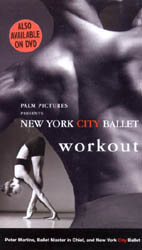 |
| If you are interested in following a exercise and stretching program at home - that will help you with your dancing - have a look at the New York City Ballet Workout Video. It contains 17 easy to do exercises that concentrate on areas such as - warms ups, stretching and posture, strengthening your abs which support your entire body whilst you are dancing, leg exercises and much more. With a special introduction by Sarah Jessica Parker, New York City Ballet Workout is the most comprehensive, exciting, interactive and definitively cool workout programme yet. Many elements of the workout were once confined to the world's elite rehearsal studios. Now these elements have been designed as a comprehensive, holistic approach to the body that can be used by anyone. Available through Blackstar or Amazon.com |
 |
|
| Can S-T-R-E-T-C-H-I-N-G make you stiff??? New Research has revealed that stretching might not be all it appeared to be. Do you ever feel that you tighten up easily even though you stretched alot? Do you feel a bit weak or wobbly in the legs after stretching? Does Stretching affect your jump? Does stretching prevent injuries? A new wave in research has been looking at the role of stretching in managing injuries in athletes. As the dust settles we're left looking at a picture that is very different - it's not what we have previously thought. We all know that dancers need flexibility but many struggle to maintain it. Some find that they tighten up all too easily and they have to keep starting all over again. The question is: Why do muscles tighten up in the first place? STRETCHING AND STIFFNESS We have been lead to believe that the more you stretch the looser you will get. Some dancers are realising that this just isn't the case. The answer lies in the fact that there are two major structures involved in the stretching process, not just the one that gets most of the publicity - muscle. Muscle is a fairly straightforward structure in that it contracts and lengthens. It is also an obedient structure and only does what it is told by the other, more important structure - the nerve. In fact the brains behind every muscle activity is its nerve supply. Without a nerve supply there is no muscle action of any sort - it become floppy and useless. Whenever stretching is written about it is generally the muscle that is discussed. Nerve is very rarely mentioned, as it is a far more complex process. The most obvious cases of nerve damage are paraplegics and quadriplegics. Their muscles are fine but they have suffered such severe nerve damage that their muscles do not work the way they should. Stretching a muscle can loosen stiffness, but it can be a constant battle with muscles, that stiffen up easily. These dancers feel the need to stretch again and again. What may be happening is that they are reaching a point where the nerve begins to be stretched. This is where the story changes and stretching might be leading to stiff muscles. Why? We've all seen or had our knee reflexes tested. A sharp tap with a rubber hammer on the knee produces a quick extension of the knee. This is because when the tendon is hit it produces a quick stretch on the quadriceps muscle and a nerve reacts, via a reflex action, to protect the muscle from overstretching. It tells the muscle to contract. The same thing can happen when stretching. Pull on a muscle and it initially lengthens but only up until the nerve starts t o stretch. If you go too far it will send a message to protect and tighten up the muscle. The more this happens the stronger the message becomes until the muscle stiffens, cramps or contracts so strongly that it ultimately tears. The problem is that everyone is a little different. While some dancers can improve their flexibility by stretching alot, there are others who are already quite flexible and will stiffen up when they begin to spend a lot of time stretching. THE STRETCHING CURVE We would like to think that the more stretching we do the looser we will get. The real fact is that stretching will loosen up muscles to a point, reaching optimum flexibility. Continuing to stretch beyond this point will bring in nerve reaction and cause muscle to stiffen. Alot of dancers are actually overstretching so much that they spend much of their time to the right of the 'red star' battling a protective muscle spasm that will not let them gain or maintain greater flexibility. The answer here is that less stretching will actually make them looser!!! This will be different from person to person. While some will reach the optimum very easily and not need to stretch a lot to maintain it. Others will need to stretch a lot to get flexibility. JUMPING AND STRETCHING As discussed earlier, stretching can affect the nerves, which also affects the way those nerves work. The nerves can become longer and thinner. The pressure in the nerve will increase as a result and cause the messages to the muscle to slow down. This makes muscles slower to respond. Hence, they feel weaker. Muscle power will be affected and jumping will be alot more difficult. Even standing up can be less controlled as the muscle struggles to respond. This is often seen as "jelly legs". At this time dancers can be more vulnerable to injury. Although this situation will return to normal within five to 10 minutes, it may take longer. Repeatedly doing this can cause permanent damage to the nerve, so that it will take longer and longer to recover strength in the legs after stretching. STRETCHING AND INJURY PREVENTION Athletes and coaches are beginning to notice that many injuries are occurring soon after stretching. Rather than preventing injury, as was previously thought, stretching may actually be causing injury. Recent major research conducted in Australia showed that there was absolutely no difference in injury rates between one group which did stretch and another which didn't. If you look further into the research that has been done over the years you will find that there is no evidence to show that stretching will prevent injuries. WHAT IS YOUR STRETCH CAPABILITY? A few quick tests can determine what your tissue flexibility is like. Some people are born with loose tissue (or collagen) and some with stiff tissue. It depends mainly on how well you chose your parents - as the laxity of the tissues that makes up your body is hereditary. A simple way to find out is to test a part of your body that you don't stretch regularly, such as your thumb. If you bend your thumb back towards your wrist and it touches your wrist easily or goes beyond it, you have loose tissue/collagen and are naturally flexible. You are probably not going to need to stretch alot to get good flexibility and could easily stiffen up from stretching rather than loosening up. If your hamstrings are tight then stretch less and see what happens. However, if you thumb is a long way from your wrist you have stiff collagen and are not naturally flexible. You will probably benefit from stretching and have little chance of causing problems with the nerves. There are of course exceptions to every rule and injuries will also play a part. This is a simple test just to give a guideline. ADVICE ON STRETCHING The lesson to be learnt from all this is that stretching is not to be taken to extremes if we are to avoid injury. If you feel looser after holidays or a few days of not stretching then you may me overstretching. Less stretching may give you greater flex. If you are not getting looser from stretching, reduce or stop stretching exercises for a while. See if you get looser. Why not try? Of course, if you don't have any problems with flexibility or weakness, then stretching may just be the thing you need and you will gain all the benefits that a good stretching program gives. Just remember that the human body does have limits and going beyond any limit will cause damage. Craig Phillips is a former dancer turned physiotherapist. He is director of the Dance Medicine Australia in Melbourne. Article from Dance Australia magazine December/January issue |