 |
| Dancing Tips |
| Welcome to the Dancing Tips Page- If you have any handy hints or great tips for other dancers that you wish to add to this page - please email me!!! |
| It may seem a little odd that a 44 year old man would wake up one morning and decide he needed to learn the Irish Jig, but that's pretty much the way it happened. I started in March of 1999 by taking an adult, continuing education class at the local high school. It was a lot of fun and, of the two dozen or so adults who began the 4-weeks of classes, five of us signed up for regular classes with the same instructor, Christine Boland of the Boland School of Irish Dance. At this point, I am a rank amateur with little to add to the plethora of information about Irish Dance already out there on the web--except, perhaps, a unique point of view MIKE'S TIPS I've only been at this for a little while and am, therefore, not qualified to hand out advice. However, these are things that seem to be working for me, and if you're just starting out, maybe they'll work for you, too. 1. You're out of shape. Deal with it. Even if you engage in other physically challenging activities, you'll be using muscles you didn't know you had. Exercise them whenever you get a chance. Building strong leg muscles is especially important for the beginning adult because you are NOT a 9-year old child lifting 50-60 pounds into the air with each jump. Take the stairs (Yes, going up, too.), walk during your lunch hour or jog in your leisure time; anything to build stamina and strength. 2. Practice. 3. Flexibility is also important. Do some stretching exercises to put some of the limber back in your limbs. 4. Practice. 5. Don't over do it. You don't want to pull a muscle or sprain your ankles. If you're getting too tired or too sore, give it a rest. 6. Practice. 7. Balance is important. Try standing on your toes; you can do this any time, anywhere (preferably when no one is watching). And it helps build up the muscles in your feet as well. 8. Practice. 9. Some tips I learned from other web sites that have worked for me: Hold a ruler behind your back while practicing; this forces you to keep your shoulders back and your fists closed and at your sides. Smile when you practice and it will become a habit. 10. Practice. 11. Visualize. If you do not have a great deal of leisure time to devote to practice, use other down time (travel, waiting rooms, boring meetings) to visualize yourself doing the steps in your mind. If the situation allows, you might even shuffle your feet in synch with the steps. This does a lot more good than you might imagine. In a recent study, a control group of basketball players was split into two teams. One team spent a set amount of time practicing foul shots while the other spent the same amount of time visualizing themselves practicing foul shots. It was found that the 'visualizing' team improved their performance almost as much as the team that had actually been on the court. 12. Practice. |
|
 |
|
| The article below delves into the Psychology of adult learning and shows some of the frustrations that an adult may feel whilst learning to Irish Dance. I have seen this situation happen with adult students - who are afraid to ask to see something again, or question a step, as they do not want to look silly or slow. They then stew on things and end up leaving out of frustration, which is quite sad. My motto is ASK, ASK ASK - even if it drives your teacher bonkers! The teacher often does not know what you are thinking and teaching adults is also very new to some of them. Many thanks to the unkown author of this article - it was posted on the old Irish Dancing for the Young at Heart message board last year. ADULT LEARNING The man with a master's in adult education and several decades experience teaching adults said that adults tend to learn by extrapolating from past experience and hanging new knowledge on a framework of existing knowledge, while kids tend to treat everything as brand new. This set off a light bulb over the head of a teacher with a degree in education (geared toward children) and experience teaching ID to both adults and children. She'd noticed that children pick up a new step faster, but adults pick up correct form faster. An adult remembers that if the foot was pointed and the knee straight in a previous step, it will probably be so in the new step, while the kids have to have "point your foot" drummed into them every single time. But since the kids aren't worrying about correct form and fitting the new step in with previous knowledge, they absorb the gross movements of the new step more quickly. So if adults need to see the step repeated more, they need to say so. And if the kids crowd the teacher so no one else can see her feet, they need to speak up. (The kids do that in classes I've been in. I think the teachers assume the adults can see over the kids, and we have to remind them we can't see their feet through a forest of legs.) Most teachers may know how to teach kids, and assume that teaching adults will be the same, and therefore treat them the same at least from the teacher's point of view. We came up with a number of reasons why this can lead to friction. For one thing, when the class is dancing in a line while the teacher checks whether they've got the step, the teacher is checking for gross motor patterns. The adult who is very hesitantly doing more or less the right thing will pass unnoticed (especially since her foot is probably pointed and her knee straight) while the child who is waving her leg in entirely the wrong direction will be corrected. Then when everybody's got the bigger movements going in at least the right direction, smaller details are checked, and once again, the adult's foot is pointed & her knee straight, so it's the ones who are flopping every which way that get the attention. Meanwhile, the adult who really needed another walk through of the step feels bewildered and frustrated. But being an adult, she will keep her feelings hidden and plow on, which brings up another difference. Children who are unhappy/confused/lost or whatever in class tend to show signs that are obvious to the teacher -- often they stop moving entirely and won't budge until their problem is Addressed. Adults have been educated out of the behaviors that dance teachers are used to seeing as signs of help being needed, so the teacher doesn't get that there is a problem. The easiest solution is to ask huge amounts of Questions: "Can you tell me if I do this part right? Does the heel go here, or over here? How high should my foot be? Should it actually touch my thigh or just get really close? I'm totally lost on the last 2 bars; can you show me again? I'm still lost, can we do it again? I can't see, can you have people move over? I still can't see your feet; I don't know how the step goes." Adults are generally too polite to do this -- they don't want to hold up the class, or interrupt, or be pushy. But the kids have no such concerns; if they have a question, they want it answered NOW. The teacher is used to that. Meanwhile, the child goes home and remarks to her mother that another girl gets all the attention in class, and other girls get to perform at dance-outs, why doesn't she? The adult goes home and remarks to her family that the teacher pays more attention to the kids, and adults are never asked to perform though the kids are. The child's mother promptly talks to the teacher, who says that Jenny is paralyzingly shy and therefore receives extra encouragement,and of course your child can perform, she'll be worked into the next program, or performance is earned by proficiency in certain items & I'll work on those with your daughter. Problems resolved. The adult's family Gives her a hug and forgets about it. Her mother lives in another state and has never met the teacher. :) Which brings us to the phenomenon of the adult student boiling over with frustration over a very real problem that is going on and on and on and getting worse and making a perpetual hindrance to learning anything. The student may approach the teacher, who may see that the student is upset or even angry, and the teacher may be totally surprised that there is even a problem, and bewildered as to why the student is so angry when all they have to do if they want help is to say so. The problem that seems obvious to the adult student wasn't obvious to the teacher, who had no clue that the adult was unhappy since she was always smiling and/or alert, as opposed to children who are unhappy and consequently scowl/pout/wear expressions of painful vacuity. Even if the problem is resolved promptly, the confrontational feelings that arose make everyone unhappy. My roommate used to teach ceili classes to adults, and she said that some days the only way she could wrench any feedback at all out of them was to get them angry. Then they would yell and complain and accuse. But until then nothing but silence and passive expressions. She said the following pattern was all too familiar: Teacher teaches new step. Walks through it several times, has class go through it several times. It looks reasonably good. Teacher asks if everybody's got it. Silence. Teacher asks if anyone wants to work it some more, or should the class go on? Silence. Teacher moves on. 15 minutes later the teacher incorporates the step into a more complex movement, and the class plodes: "We can't just DO it yet! You have to give us more time to practice!!! You can't just expect us to do it Without more drilling!!" -- all uttered in terms of Righteous outrage. Teacher doesn't know whether to be annoyed or laugh, but Being a teacher, she does neither and drills the step again, thinking fond thoughts of children who stomp right off the floor when they're unhappy but at least don't yell.:) So my roommate had some suggestions: If something bugs you at all, speak up right away. Do not wait 3 or 4 weeks or until you're mad. Say, "how is it decided who gets to perform?" the first time it crosses your mind instead of saying, "why don't I get to perform" when you've convinced yourself there's some injustice involved. (I know, I know, there may really be some injustice involved. But then again, maybe it's just the school policy that performance is something you have to actively ask for.) If you think you get less corrections in class, ask detailed questions that force the teacher to look at what you're doing. If you need to see the step again, say so. Remember that you are your own parent, and that parents do more negotiating for us than we are ever aware of and that adults have to do it for themselves. Remember that the teacher can't read your expression the way she can with the kids, so you have to tell her what you're thinking |
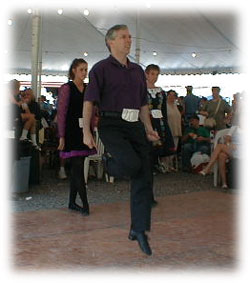
| Mike in action!!! He dances with the Boland School of Irish Dance in Troy, NY and has been kind enough to provide us with his handy, helpful hints!!! |
|
| How to be a Better Irish Dancer! Checkout the helpful guide to what makes a better dancer, and exercises to help you to be that dancer! Go to the fabulous Irish_Dancer.co.uk site |
 |
 |
| GOING THE DISTANCE - as stated in that famous Pantene commercial "It won't happen overnight, but it will happen". The most important message here is that truely noticeable results don't occur instantly, but they don't take as long as you might think. Approach your dance fitness quest as a lifestyle change, not just a quick fix. Take it slowly,avoid injury and your dance fitness will build. |
|
| THINGS THAT YOU CAN DO AT WORK Apart from leaping around the office, factory, store, warehouse etc in an effort to practise your Irish Dancing there are other ways, during your normal working day, that you can enhance your dancing fitness. A few minutes here and a few minutes there and you will soon be noticing the change in your body fitness. Yes small incidental exercises are easily achieved even whilst you work **Don't take the lift or the escalators, take the stairs. Hey....dig deep take two at a time. Feel the stretch in your legs and concentrate on tensing your muscles as you go. Once you are fit enough try hopping or jumping up those stairs,this is a great work out. **Walk or cycle to work if possible, catch public transport or drive part of the way and then walk or cycle the rest of the way. Time yourself and work at shaving a few moments off each week. **Take a Break, especially if you job involves a lot of sitting. Stand and stretch for 5 minutes each hour walk to the photocopier or around the office, if stretching in your working environment is difficult. **Do some exercises, whilst at the fax machine or photocopier do some subtle stretches or rise up on demi-point five times both feet together and then each foot separately. A full jig or reel in the office may not impress your boss but a little subtle enhancement to your normal movement around the work place may not be noticed!!! **Go for a walk during your lunch hour. Offer to go out and do that task that no-one wants to do, offer to go out and buy the coffee, taking the stairs whilst you do this. **Squeeze your butt. Yep you heard it - squeeze your butt whilst you are standing or sitting. It may feel a little odd at first, but squeeze and hold for 10 and then release, do this several times. Not a soul will notice!!! ** Work those thighs, when you next visit the bathroom, sneak in a few lunges or squats. They're just as effective for strengthening those thighs and butt within the cubicle as at the gym or whilst dancing. |
 |
| THINGS THAT YOU CAN DO AT HOME Maybe you do not have enough room at home to practise your dances in your home. Maybe your neighbours have been complaining about the noise from you leaping around practising that reel step or maybe they have complained about you practising in your Jig Shoes on the kitchen tiles, thinking that their plumbing was about to burst through the wall. Or you just simply want to enhance your day with additional exercise to improve your dancing ability. ** Washing your car: A task that is not that enjoyable, but you can turn it around to work for you. Who cares what the neighbours think!!! Scrub really hard as you wash the card, perform lunges and squats as you dip the sponge into the bucket to wash the car. Stretch your hamstrings whilst you are washing the bonnet, by bending over with a really straight back and keeping your heels flat on the ground. Rise up on demi-point and hold whilst you are cleaning the roof. **Mowing your lawn: Another one of those less enjoyable tasks but hey - why not offer to mow your neighbours lawn as well. Keep your back upright and straight and really push and stretch with your legs. **Cleaning Your House: Vacuuming might not be a glamorous pastime, but if your focus your energy you'll end up with a sparkling floor, plus some impressive abs. As you are vacuuming, pull in your stomach and tense your abs - as though someone is going to punch you. Hold this tension for 15 seconds and then release - repeat as you go. Have you considered wearing ankle weights as you vacuum?? **Hanging out the Washing: Yes those lunges and squats again - great for strengthening the thighs. Make sure you keep your back straight and your butt in. Try picking up each piece of washing one at a time. **Iron you clothes with Gusto: Hard to imagine doing this isn't it??? But you can add some creativity to ironing. Stretch your hamstrings and achilles heels as you iron, keeping your heels flat on the ground. How about Squat and lunges (not again!!!) to pick up each item that you need to iron. **Exercise as you watch TV: Do some resistance exercises - Squats, lunges and sit-ups are oldies but goodies. **Washing up: Another one of those lesser enjoyable tasks - but whilst you are washing those dishes, 'work-out' your feet. Rise up on demi-point hold for the count of 5 and then slowly go back down again. Keep repeating this as you wash. |
|
| THINGS THAT YOU CAN DO AT PLAY **Walking the Dog: This is a most enjoyable exercise and you both gain out of it!!! Why not vary where you walk your dog, if you live near a hill incorporate some speed work into walking that hill. Timing yourself each time you follow that path. Stroll for one block and then speed walk the next. Soon you will be setting an impressive pace and building muscle strength as you go. The added bonus - your dog will become very fit as well!!! **Walking the Bambino: Pushing your child, or that of a friend, in a pram gets you outdoors and into the fresh air. The lucky baby will be enchanted with being outdoors and you will get fit whilst you stride. If you are really keen, why not invest in a pram designed for power walking or jogging. **Dig it: Well it's not quite play - but many adults enjoy gardening, why not add a special little pep to your gardening routine. Stretches and yes those 'Squats and Lunges' again. **A hole in one: Golf is a wonderful pastime - Don't take the buggy, walk around the golf course. The walking will build up strength and stamina in those dancing legs. References: Fitness for Dummies, Australian and New Zealand Edition - Kelly Baker, Suzanne Schlosberg, Liz Neporent, MA |
|