
 |
 |
 |
 |
 |
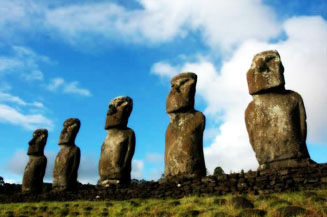 |
Easter Island is the world's most isolated inhabited island. It is also one of the most mystifying places on Earth, possessing a history that remains as unclear as it is evocative. One of the most famous sites on the island is Rano Raraku, where 70 moai seem to rise from the earth. The remains of over 150 other figures lie in a nearby volcanic crater, where the rock for the moai was extracted. It is still unclear how the moai were moved from these rock quarries to other parts of the island. The restored village of Orongo offers another Easter Island mystery. The village sits in a spectacular setting, between the volcano of Rano Kao and a sheer cliff drop-off. Rocks found at the village contain 150 carvings showing figures with a man's body and a bird's head. |

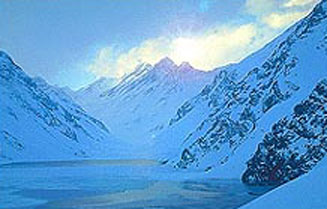 |
Over the crystal of ice that in winter covers this lake, on nights of the full moon one hears the cries of sorrow that break through the deep quiet. It is perhaps an enchantment that produces these sad sounds. Legend has it that the cries are the soul of the Inca Illi Yunqui that wanders restlessly over the watery tomb of his beloved Princess Kora-Lle . The Princess fell to a tragic death during the celebration of a nascu , or Royal Hunt. The Inca, whose sadness disturbs the peace of these mountains, believed with the soul of a poet that no human tomb could be comparable to these deep waters. As it was lowered to the blue depths of the lake, the water turned emerald, dyed by the color of the Princess' lovely eyes that the son of the Sun, Illi Yunqui, could no longer awaken. Thus came to be this spirit of love and mystery that wanders here, covered by the silent mantle of snow. |

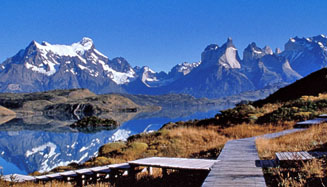 |
The most famous region of Chile, Chilean Patagonia offers all the dramatic landscape one would expect from the world's ultimate land's end. Here the South American continent falls away in a dazzling explosion of islands, glaciers, icebergs and mountains. Among the other wondrous sites in this remarkable region are: the Torres del Paine, a spectacular mountain range, which frames the Park of the same name, and extend to heights of up to 9,000 feet; the Cuernos del Paine, with a height of 6,300 feet; the hypnotic waterfalls of Salto Chico and Salto Grande; the Grey, Pingo, del Frances and Dickson glaciers; the Pehoe, Nordenskjold, Sarmiento, Pingo and Dickson lakes; and the Verde and Azul lagoons. |

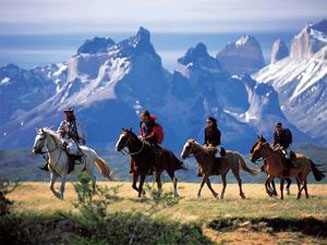 |
Punta Arenas is the southernmost city on Earth, overlooking the Straits of Magellan. Although the port's importance diminished after the opening of the Panama Canal, the city reached even greater prosperity early in this century as the center of Chile's international wool trade. Today, Punto Arenas reflects a great mix of cultures, from English sheep ranchers to Portuguese sailors, and it remains an utterly fascinating testament to the Chile's rich history. Punta Arenas is also the starting point for excursions to some of the most spectacular scenery in the world. From Punta Arenas, it is an easy day trip to the pinguineros, the nearby penguin settlements and the Parque Nacional Torres del Paine, which provides the perfect introduction to Chilean Antarctica. |
