PROBLEMS
THEORETICAL PROBLEMS - EXPERIMENTAL PROBLEMS
THEORETICAL PROBLEMS
|
THEORETICAL COMPETITION Tuesday, July 23rd,
2002
Please read this first:
· Used Answer Sheets in order · Scrap papers · The sheets you do not wish to be marked · Unused sheets and the printed question Place the papers inside the envelope and leave everything on your desk. You are not allowed to take any sheets of paper out of the room. |
||||||
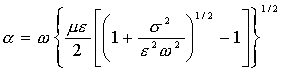
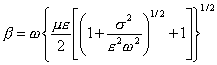
I. Ground-Penetrating Radar where Eo is constant, a is the attenuation coefficient and b is the wave number expressed respectively as follows
with m,e,
and s
denoting the magnetic
permeability, the electrical permittivity, and the electrical
conductivity respectively. The
signal becomes undetected when the amplitude of the radar
signal arriving at the object drops below 1/e (» 37%) of its initial value.
An electromagnetic wave of variable frequency (10 MHz – 1000 MHz) is usually used to allow adjustment of range
and resolution of detection.
Questions: (Given :
mo
=
1.
Assume that the ground is non-magnetic (m=m0)
satisfying the condition
2.
Determine the maximum depth of detection of an object in the ground
with conductivity of 1.0 mS/m and permittivity of 9e0,
satisfying the condition
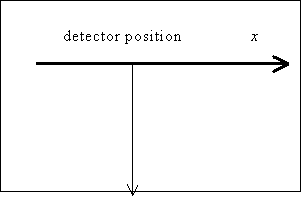
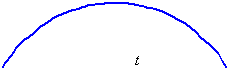
3. Consider two parallel conducting rods buried horizontally in the ground. The rods are 4 meter deep. The ground is known to have conductivity of 1.0 mS/m and permittivity of 9e0. Suppose the GPR measurement is carried out at a position aproximately above one of the rod. Assume point detector is used. Determine the minimum frequency required to get a lateral resolution of 50 cm [3.5 pts]. 4. To determine the depth of a buried rod d in the same ground, consider the measurements carried out along a line perpendicular to the rod. The result is described by the following figure:
Graph of traveltime t vs detector position x, tmin = 100 ns.
|
||||||
II.
Sensing Electrical Signals
Some
seawater animals have the ability to detect other creatures at
some distance away due to electric currents produced by the creatures
during the breathing processes or other processes involving muscular
contraction. Some predators use this electrical signal to locate
their preys, even when buried under the sands.
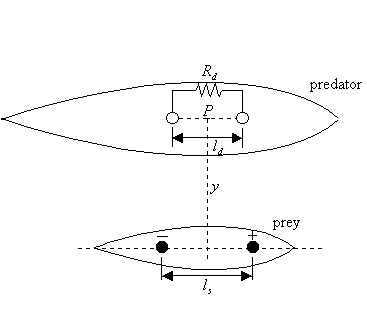
The physical mechanism underlying the current generation
at the prey and its detection by the predator can be modeled as
described by Figure II-1. The current generated by the prey flows
between two spheres with positive and negative potential in the
prey’s body. The distance between the centers of the two
spheres is ls,
each having a radius of rs,
which is much smaller than ls.
The seawater resistivity is r. Assume that the resistivity of the prey’s body
is the same as that of the surrounding seawater, implying that
the boundary surrounding the prey in the figure can be ignored.
Figure II-1. A model describing the detection
of electric power coming
from a prey by its predator.
In order to describe the detection of electric power
by the predator coming from the prey, the detector is modeled
similarly by two spheres on the predator’s body and in contact
with the surrounding seawater, lying parallel to the pair in the
prey’s body. They are separated by a distance of ld,
each having a radius of rd
which is much smaller than ld.
In this case, the center of the detector is located at a distance
y right above the source and the line connecting the two
spheres is parallel to the electric field as shown in Figure II-1.
Both ls and ld are also much
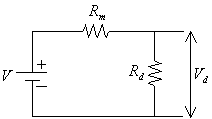
smaller than y. The electric field strength along the line
connecting the two spheres is assumed to be constant. Therefore
the detector forms a closed circuit system connecting the prey,
the surrounding seawater and the predator as described in Figure
II-2.
Figure II-2. The equivalent
closed circuit system involving the sensing predator, the prey
and the surrounding seawater. In the figure, V is the voltage difference between
the detector’s spheres due to the electric field induced
by the prey, Rm is the inner resistance due
to the surrounding sea water. Further, Vd and
Rd are respectively
the voltage difference between the detecting spheres and the resistance
of the detecting element within the predator.
Questions:
1.
Determine the current density vector
2.
Based on the law
3. Determine
for the same current Is,
the voltage difference between the source spheres (Vs) in the prey [1.5
pts]. Determine
the resistance between the two source spheres (Rs)
[0.5 pts] and
the power produced by the source (Ps) [0.5 pts].
4. Determine
Rm [0.5 pts], Vd [1.0
pts] in Figure II-2 and calculate also the power transferred
from the source to the detector (Pd) [0.5 pts].
5. Determine
the optimum value of Rd
leading to maximum detected power [1.5
pts] and determine also the maximum power [0.5 pts].
|
||||||
III. A Heavy Vehicle Moving on An Inclined Road Figure III-1: A simplified model of a heavy vehicle moving on an inclined road.
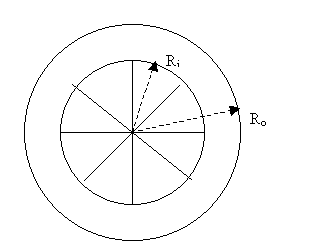
The above figure is a simplified model of a heavy vehicle (road roller) with one rear and one front cylinder as its wheels on an inclined road with inclination angle of θ as shown in Figure III-1. Each of the two cylinders has a total mass M(m2=m3=M) and consists of a cylindrical shell of outer radius Ro , inner radius Ri = 0.8 Ro and eight number of spokes with total mass 0.2 M. The mass of the undercarriage supporting the vehicle’s body is negligible. The cylinder can be modeled as shown in Figure III-2. The vehicle is moving down the road under the influence of gravitational and frictional forces. The front and rear cylinder are positioned symmetrically with respect to the vehicle.
Figure III-2: A simplified model of the cylinders.
The static and kinetic friction coefficients between the cylinder and the road are ms and mk respectively. The body of the vehicle has a mass of 5M , length of L and thickness of t . The distance between the front and the rear cylinder is 2 l while the distance from the center of cylinder to the base of the vehicle’s body is h. Assume that the rolling friction between the cylinder and its axis is negligible.
Questions:
Download PDF document: TheoProb_III.pdf |

 ,
, ,
,

 )
) . Derive the expression of propagation speed
 (current per unit area) caused by a point current
source Is at a distance r in an infinite
medium. [1.5 pts]
(current per unit area) caused by a point current
source Is at a distance r in an infinite
medium. [1.5 pts] ,
,  at the middle of the detecting spheres (at point P)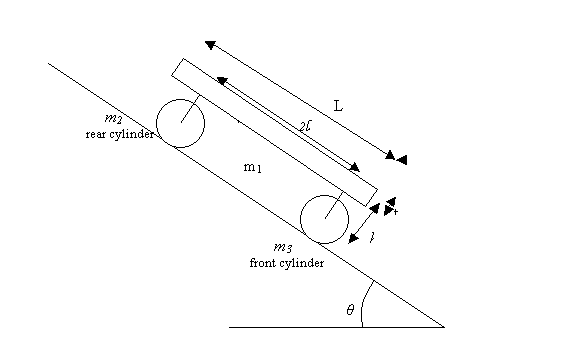


EXPERIMENTAL PROBLEMS
|
EXPERIMENTAL COMPETITION Thursday, July 25th, 2002 Please read this first:
Place the paper inside the envelope and leave everything on your desk. You are not allowed to take any sheets of paper and any material used in experiment out of the room .
Use the following symbols in your answer
Download PDF document: ExpProb_O.pdf |
||||||||||||||||||||||||||||||||||||||||||||||||||||||||||||
Experimental Problem I |
||||||||||||||||||||||||||||||||||||||||||||||||||||||||||||