
Soumaya's Page on Margaret Fuller
"By birth a child of New England, by adoption a citizen of Rome; by genius belonging to the world" -inscription on Margaret Fuller Memorial in Cambridge, Massachusetts

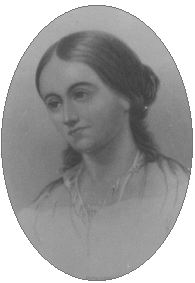
Picture from: <http://courses.washington.edu/hum523/fuller>
Welcome! You have stepped into a page on the life and works of Margaret Fuller. She was a feminist, the first female foreign correspondent on the Italian revolution of 1848. In addition to this, she was an author and a transcendentalist. The purpose of this page is to shed some light into the life of an extraordinary woman and her great achievements.
Margaret Fuller was born on the May 23, 1810. She was born to Mary Crane and Timothy Fuller, who lived Cambridgeport (now a part of Cambridge) Massachusetts. Educated by her father, a Harvard-schooled lawyer, she received a truly rigorous education. The regimen of studies included learning Latin, Greek, German, French and Italian. She was enrolled in a finishing school in Groton, Connecticut. In her mid-twenties, she was hired by Bronson Alcott as a teacher in his progressive Temple School. It was around 1835 that she met Ralph Waldo Emerson, who would become her mentor and teacher. A couple of years later, in 1837, she moved to Providence, Rhode Island and became a principal teacher at the Green Street School for two years.
After moving from Rhode Island to Boston, in 1839, she began holding “conversations” in her home in Boston for women in that area. In the beginning, Fuller wanted to bring together a circle of “’well-educated and thinking women’ to help them ‘systematize thought and give a precision and clearness in which our sex is so deficient…’ (Chevigny 199).” She felt that the women were deficient in this precision and clearness due to the lack of encouragement and opportunities offered to them. Over a period of five winters, Fuller had covered subjects such as fine arts, ethics, education and the influences of women in areas such as the family, school, church, society and literature as well. The group began to meet in a fellow transcendentalist and instructor by the name of Elizabeth Peabody’s bookstore. Her vision of a small group brought forth many positive and profound fruits. By the end of it, there were many men who attended this growing circle.
Also in 1840, Fuller accepted an editor position for the Dial, which was the transcendentalist quarterly, founded by Emerson. By now, she had become more affiliated with the transcendentalist group. Between May and September of 1843, Fuller and a group of her friends decided to take a tour of the Midwest. As soon as she returned, Fuller began writing of her experiences. This was published as Summer on the Lakes in 1843. At this time, in 1843, the Dial also published her essay “The Great Lawsuit, Man versus Men. Woman versus Women.” She later expanded this into a book titled Woman in the Nineteenth Century which was published in 1845, a year after her move to New York City.
In 1844, Fuller was asked by Horace Greeley to join the staff of the New York Tribune as a book review editor. There, she wrote nearly 250 reviews and a few essays in the year and a half that she worked for the paper in New York (Myerson 1). In 1846, she became foreign correspondent for the Tribune. She became one of America’s first foreign correspondents. It was at this time that she traveled to Europe and wrote extensively on life there. These articles were published as At Home and Abroad in 1856. While in Rome, in the summer of 1847, Fuller became witness to the political upheaval of that time. She sympathized and supported the Republicans and the Roman Republic in the Papal States.
At this charged time, she was reporting back to the Tribune on the situation of Rome. She fell in love with Giovanni Angelo Ossoli, who was an Italian nobleman fighting for a return of the republic to Italy. In September of 1848, Fuller gave birth to a son, whom they kept a secret until they married in the following year (Huffman 2). Growing political pressure and lack of financial resources cause her and her new family to return to the United States in hopes of finding a publisher for her history of the Italian Revolution. On July 19, 1850, the ship carrying the family struck ground and broke apart near Fire Island. The entire Ossoli family died in the disaster. Only the son's body was found.
“The Great Lawsuit. Man versus Men. Woman versus Women” (Published in the Dial, 1843)
In this article for the Dial, which was a transcendentalist newspaper, Fuller calls for the equality of women in society. It is here that she begins to attack the laws of men that restrict women from moving up in society.
Summer on the Lakes (Published in 1843)
Upon her return from a tour of the Midwest with some of her friends, Margaret Fuller embarked on an account of her experiences. This piece of literature is not to be valued for its factual nature, although one could very well do that. The true essence of this book lies in its “poetic impression of the country at large (Myerson 1).” There is much sympathy for the plight of the Indians and their treatment by the white man. Fuller also described the Western imitation of the East at the expense of their own unique lifestyle. She describes the natural beauty around her in very detailed passages. With this work, Fuller gained recognition not only as an author, but also as a literary critic and essayist for the New York Tribune.
Check this:
Woman in the Nineteenth Century (Published in 1845)
This book is the continuation of the above mentioned article. This is Fuller’s best-known work and the only one that is more available to students. Fuller takes the opportunity to attack the two-faced ideals of men, ideals that have hindered the woman’s improvement in society while allowing for blacks to finally achieve their rights. She states that it is unfair for men to say that women are unable to conduct certain affairs simply because they are physically or emotionally unable (Myerson 1). The book is a clear and bold statement of women’s rights and was the catalyst which helped bring about the Seneca Falls Women’s Convention three years later (Bois 1).
Check this:
1. Chevigny, Bell Gale. “Margaret Fuller.” Portraits of American Women. Ed.
G.J.Barker-Benfield and Catherine Clinton. New York, NY: St. Martin's Press, 1991. 189-207.
- Bois, Danuta. Distinguished Women of Past and Present. 1998.
20 Feb. 2002 <http://www.distinguishedwomen.com/biographies/fuller-m.html>
- Huffman, Joan B. Sarah Margaret Fuller, Marchessa Ossoli. 14 Feb. 1999.
University of Ohio. 20 Feb. 2002 <http://cscwww.cats.ohiou.edu/~Chastain/dh/fuller.htm>
- Myerson, Joel. “Sarah Margaret Fuller 1810-1850.” Early Nineteenth Century:
1800-1865. (Course Packet for Eng 323)
Cool links:
Treatment of Slaves--a look at Slave Narratives
Any questions or comments?
email me: