|
Chapter 11
Satisfaction
with Life
The Satisfaction
with Life Scale (Diener et al, 1985) was designed to
assess the satisfaction people felt with their lives
as a whole, allowing them to consider and weigh their
life domains (such as health or finances) in whatever
way they choose (Fineburg, 2002). It is a very
short measure, consisting of only five statements with
a 7-point rating scale; it results in a global score
that ranges between 5 and 35 and an interpretation that
ranges between 'Extremely Dissatisfied' and 'Extremely
Satisfied'. The scale itself takes only about a minute
to complete and this aspect was particularly important
within the current research due to a pressing need to
keep interviews as short as possible (see Question 45,
Appendix B). The scale has been tested in many
countries and settings worldwide, where it was found
to have high validity for research purposes.
The importance of including measures of quality of life
has not received enough attention in relation to social
and economic issues, according to Marsella, Levi &
Ekblad (1997). Too much focus concentrated on
improving material levels of living without
addressing the psychological creates an imbalance,
and one that fails to take into consideration 'actual
peoples' perceptions of life satisfaction and subjective
well-being (Marsella et al, 1997, p55). The present
research, although limited in many ways, has attempted
to address this perceived shortcoming and, along with
considerable efforts to be holistic, empowering and
participative throughout, has included the Satisfaction
with Life scale in order to record this important aspect
of women's lives.
A person's well being may
be defined as an all-embracing sense that life has been,
and continues to be, good. It is an ongoing perception
that life is fulfilling, meaningful and pleasant (Myers,
1993). Subjective well-being is a field of psychology
that attempts to understand people's evaluation of their
lives (Diener, Suh, & Oishi, 1997). Life satisfaction,
as a cognitive component of subjective well-being, focuses
on a person's feelings and relates, in many
ways, to the achievement of life goals. Even small successes
on the path towards realising these individual goals
can contribute to feelings of life satisfaction.
Where matters of health and well-being are concerned,
improving positive states of health with the appropriate
allocation of public funding can reap rewards and long-term
benefits that have yet to be measured or calculated
(Gandjour, 2001).
As such, the psychological
measure used in this research proved a very useful method
of estimating the Satisfaction with Life (SWL) scores
of the women participants. The overall average
score recorded for the entire sample was 23.33, which
equates with them feeling "Slightly Satisfied"
with their lives. However, a lot more tellingly,
the results from this scale were found to be especially
important in identifying links between levels of life
satisfaction and the various experiences and situations
of the different groups of women in Inishowen.
In a research report of this size and scope only a few
of these areas can be looked at in any great detail
- those chosen for closer examination are therefore
restricted to only six: marital status, long-term perception
of poverty, present financial circumstances, paid work
and perceived income balance.
11.1
Marital Status and Satisfaction with Life
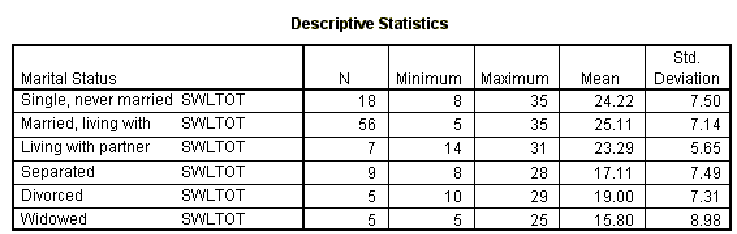
As
can be seen in Table 30, married women living with their
husband have the highest average (mean) SWL score of
24.22; this score indicates that they are, in general,
only slightly satisfied with their lives. Single
women, with an average score of 24.22, and women living
with their partners, with an average score 23.29, are
also in this 'Slightly Satisfied' category. All
of the others, women who are divorced, separated and
widowed, are deemed to be slightly dissatisfied with
their lives. In previous research (e.g.Glenn &
Weaver, 1979), currently married individuals consistently
report greater subjective well-being than those who
were never married, and these, in turn, report higher
levels than those who were previously married and are
now divorced, separated or widowed.
Such similar comparisons for marital status are found
to be very much the same across the world - with the
benefit of being married over being divorced or separated
smaller for societies where there was a high tolerance
for divorce (Diener, Gohm, Suh & Oishi, 2000).
This high tolerance for divorce may not exist in the
Inishowen area and may, therefore, go some distance
in explaining the worryingly low levels of SWL in these
groups of women. What cannot be explained, however,
is the generally low levels evident across the sample
as a whole; feeling only slightly satisfied, at best,
is not a result that could be considered a recommendation
for any woman's status in life.
|
|