
Chapter 5 Employment 5.1
Women's Work A
report in the "Irish Times" (Healy, 20/11/02)
quoted the Minister of State with responsibility for
Labour Affairs, Mr. Frank Fahey's belief that women
currently working in the home could displace foreign
workers by entering the labour force. Mr. Fahey
was speaking at the launch of a new FAS programme called
"Gateway for Women", which is specifically
geared to the needs of women returning to employment.
The Minister is quoted as saying that it was 'quite
remarkable' that so many women did not appear to availing
of job opportunities, while 36,000 work permits had
been issued to non-EU Nationals. A representative
from the National Women's Council, Ms.Grainne Healy,
pointed out in the article that lack of affordable childcare
was one barrier, frequently then added to in later life
by lack of appropriate elder care. 5.2
Paid Work One
in three (34) of the current sample of women have no
paid work; fourteen of these women were seeking employment
at the time of the survey, of which less than half (6)
were represented on the live register (see also Figure
5). More than half of those without a paid job
(18) were working full-time in the home. The remaining
women (9) were retired, suffered from ill health or
disabilities, or were pursuing further education.
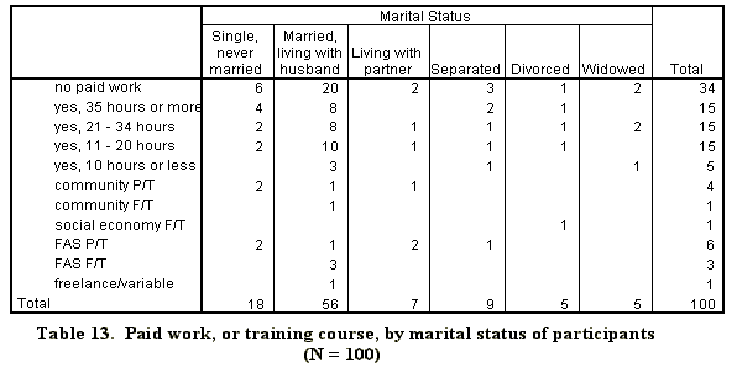
Table 13 gives a breakdown of paid work by the
marital status of the women surveyed, including whether
the work was full-time, part-time or various FAS, social
economy or community schemes. From this table,
it can be seen that 1 in 6 of the women as a whole is
in full-time employment; more than one third of the
reminder are in some form of part-time employment (less
than 34 hours per week). Only 1 in 7 of a total
of fifty-six married women in this survey is in full-time
employment. |
||
|
||
