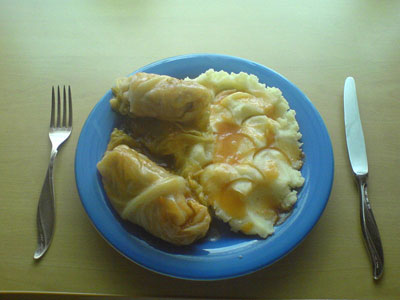
Golabki is a hearty traditional Polish dish consisting of boiled cabbage leaves stuffed with ground beef , chopped onions , and rice or barley, baked in a spicy tomato sauce ; similar to a Cabbage roll .Golabki rolls are usually fist-sized when fully stuffed or rolled. Spiced Pork is sometimes used instead of, or in addition to, beef. There is an unverified story or myth that the Grand Duke of Lithuania and King of Poland Casimir IV Jagiellon fed his army with golabki before a key battle outside of Malbork against the Teutonic Order around 1465 . Victory over the Teutonic Order was partially credited to strength of the hearty meal of golabki given to the allied Polish and Prussian troops. The defeat of the Teutonic Order in Malbork led to the end of the Thirteen years' war , and the ceding of Prussia to the Kingdom of Poland in 1466 . |
 |
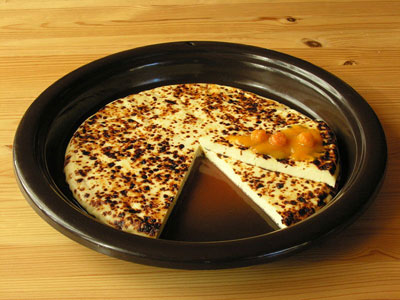 |
Leipäjuusto or juustoleipä , which is also known in English as Finnish squeaky cheese , is a fresh cheese traditionally made from cow 's beestings , rich milk from a cow that has recently calved. Reindeer or even goat milk can also be used. Commercially available versions are typically made from regular milk , and they lack some colour and flavour because of this. The cheese originally comes from Ostrobothnia , Northern Finland and Kainuu . The milk is curdled and set to form a round disk from two to three centimeters thick. After this, leipäjuusto is baked, grilled or flambéed to give it its distinctive brown or charred marks. Leipäjuusto can be eaten warm or cold. In Ostrobothnia, leipäjuusto is called juustoleipä. However, this varies as people have moved around, and both names are used while leipäjuusto is the more commonly known name for this cheese. |
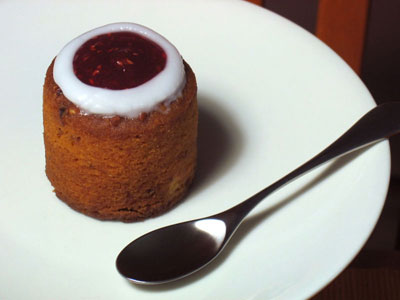
Runeberg's tart is a Finnish pastry that is seasoned with almonds and rum and it usually weighs about 100 grams . There is usually raspberry jam in a sugar ring on the tart. The tart got its name from the Finnish poet Johan Ludvig Runeberg who, according to the legend, enjoyed the tart with punsch . Runeberg's tarts are typically eaten only in Finland and are generally available from the beginning of January to Runeberg's birthday on February 5 . |
|
 |
 |
 |
 |
 |