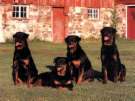
What is this dog that performs time-honoured duties with great perfection? What is this dog that
possesses the cleverness, intuition, and confidence necessary to master cattle herds over great
distances, and is equally as willing to pull a cart loaded with goods or slaughtered meat to the
market? It is of course, the butcher's dog of Rottweil, a dog so highly esteemed in medieval days,
that citizens were jailed for stealing the butcher's dog.
History of the Rottweiler
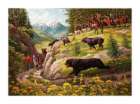
The wind is blowing from the southwest today, picking up a cold sting from the rolling
Swabian Mountains. Dressed warmly, for amisty rain is beginning to fall, the stalwart
butcher watches carefully as his dogs work to keep a
dozen restless cattle together along this worn valley road. The cattle are from the Neckar River
Valley, having been purchased two days prior, and are headed to Rottweil to be butchered.
With only his two dogs as help, the butcher is well aware that herding even this small, jittery
group of cattle is a formidable task and one that can be
fraught with dangers.
A step ahead of his master, the larger of the two dogs has already spotted and marked his
challenge. An older steer, the leader of this group of cattle, is nervous and considering bolting
from the herd. Without control of this
steer, the entire herd can fall to pieces and scatter within seconds. Quickly and without a sound,
the dog boldly confronts the steer, face to face, staying but a yard or so away
from the animal's horns. The steer lowers his head and shakes it threateningly, blowing loudly
from his flared nostrils. The dog lowers his head and shoulders slightly and returns a steely
glare.
It is a battle of wills, with the steer outweighing the canine by close to a thousand pounds. The
dog charges at the menacing steer, both to enforce his point and cement his position as
the leader of his herd. Meanwhile, the other dog works the far side of the herd, keeping
the cattle moving together and forward as a group. The challenging steer finally
acquiesces to the dog, deciding it is better not to deal with what this dog might do,
and reenters the herd. With the ringleader in control, the dogs now have command
of the entire herd and the cattle move a little less nervously along the road.
The lead dog casts a quick eye back at his master. A nod and a grunt of approval are all
that are needed for reassurance of a job well done, and the butcher's dogs go back to
their silent trotting alongside the herd, keeping an ever-watchful and keen eye for trouble.
Not only must the dogs keep the cattle herd together and calm, they must also protect
the herd and their master from robbers and wolves along the way.
Early History
In a land edged by the Alps to the south and the Black Forest to the west, the town of Rottweil is
credited with developing the breed known as the Rottweiler. The dog's adeptness at herding
and driving cattle and sheep, as well as his ability to guard livestock and the butcher's
money from thieves (the dog would wear the purse filled with money around its neck),
quickly gained him recognition in surrounding cities and countries.In Rottweil itself, the
dog was referred to as simply "the butcher's dog" or "Metzgerhund"; however, people
from other areas soon began to identify the sturdy and intelligent dog with his origins. Thus, the
butcher's dog became "the dog of Rottweil," or "Rottweiler."
The Town of Rottweil
By the late 700s A.D. the town that had once been known as Arae Flaviae by the Romans, had
become known by its new inhabitants as Rotuvilla, and later Rottweil. As Rottweil, the town
flourished again. It had a King's Court that was tasked with looking after an administrative
district for Charles the Great. By the mid-1200s Rottweil was considered one of the most
important cities in what was then known as Swabia, a country that included parts of
France and Switzerland, as well as this area of Germany. By 1378 Rottweil became a
"free city," with its own constitution. It is at the same time that Rottweil established itself
as a trading post for cattle and cereals, and continued to be a leading town in Southern
Germany for centuries.
Loss of Work for the Rottweiler
In the mid-1800s, the Rottweiler suddenly found himself out of the cattle-herding business. With
the advent of the railroad and a more efficient means of transporting cattle, the demand
for the Rottweiler as a working dog fell dramatically. A law was also passed
at this time forbidding driving cattle over roads, further reducing the need for this cattle-herding
dog.
With no job, the working Rottweiler reportedly nearly became extinct by the end of the
nineteenth century. Fortunately, at this same time, German breeders showed renewed
interest in the breed and organized an International Club for Leonberger and Rottweiler
Dogs. A breed standard was written in 1883 by Albert Kull and published by the club in
1901.
The First Standard
Interestingly, the first Rottweiler standard shows that the breed had much more variation that it
would even 20 years later. It included the colour scheme of today (black with rust to
mahogany markings), but also included brindle on grey with fawn markings. The standard
also noted that some white markings (chest and legs) were allowable and occurred
frequently.
Introduction to the United States
As a breed, the Rottweiler has become popular - and meteorically so - only within the last 20
years. Prior to this time, the breed was relatively obscure. In fact, the
American Kennel Club (AKC) parent club for the Rottweiler, the American Rottweiler Club
(ARC), was not established until 1973.
The first Rottweiler recorded in the AKC Stud Book appears in 1931, with a
breed standard published in 1935. The first title awarded to the breed was, appropriately,
an obedience title in 1939. The first AKC championship was not awarded to a Rottweiler
until 1948.
Additional national breed clubs have also formed since the inception of the ARC, and include the
United States Rottweiler Club (USRC) and
The American Rottweiler Verein (ARV). The USRC and ARV both sponsor Schutzhund
events and European-style (FCI) conformation shows. They also offer breeding suitability
tests and maintain registrations that are separate from the
AKC.
Rise in Popularity
In the early 1980s the obscurity of the Rottweiler in the United States vanished. Suddenly, the
great virtues of this breed were discovered and it seemed as though every American had
to have a Rottweiler. By 1990 Rottweiler registrations withe the AKC numbered nearly 60,500.
In four years this number jumped to 102,596. Until recently, the Rottweiler maintained the
number two most popular purebred dog in registrations with the AKC.
Though the breed is popular, obviously the Rottweiler is not for everyone. Before deciding to
purchase this tremendous dog, a thorough understanding of the breed's qualities and
challenges is required.
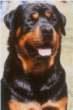
Whether a Rottweiler fan or simply a dog enthusiast,
the mere sight of a conditioned and well-bred Rottweiler commands the onlooker's attention. To
see a Rottweiler perform in agility, herding, obedience or a variety of other sports is show
stopping. Though the breed may look quite different today than his Roman progenitors and
even his predecessors from the 1800s, the Rottweiler has developed into a striking breed that
combines working abilities with brawny beauty.
The
Rottweiler is, of course, much more than a handsome dog. His true mettle goes much
deeper, and as any devoted Rottweiler owner will tell you, the beauty of this dog begins with the
dog's heart. Steadfast in his affections and courageous beyond bounds, the Rottweiler rightfully
has earned the undying respect and loyalty of fanciers around the world.
General Appearance
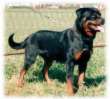
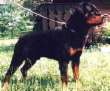
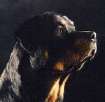
The Rottweiler has a massive, powerful body. Muscular and athletic.
It has a broad head and rounded forehead. The muzzle is well-developed with a scissors
bite. Its eyes are dark with an expression of goodwill and loyalty. The ears are triangular,
carried forward, and its nose is wide and black. The tail is customarily docked. The coat is
short, hard and thick. It is black with brown markings on the cheeks and muzzle, paws and legs.
Size, Proportion, Substance
Dogs - 24 inches to 27 inches. Bitches - 22 inches to 25 inches, with preferred size being midrange
of each sex. Correct proportion is of primary importance, as long as size is within the standard's
range.
The length of he body from prosternum to th rear most projection of the rump, is slightly longer
than the height of the dog at the withers, the most desirable proportion of the height to length
being 9 to 10. The Rottweiler is neither coarse nor shelly. Depth of the chest is approximately
fifty percent of the height of the dog. His bone and muscle mass must be suffecient to balance his
frame, giving a compact and a very powerful appearance.
Head
Of medium length, broad between the ears; forehead line seen in profile is moderately
arched; zygomatic arch and stop well developed with strong broad upper and lower jaws.
The desired ratio backskull to muzzle is 3 to 2. Forehead is preferred dry, however some
wrinkling may occur when dog is alert. Expression is noble, alert and self-
assured. Eyes if medium size, almond shape with well-fitting lids, moderately deep-set,
neither protruding nor receding. The desired colour is a uniform dark brown.
Forequarters and Hindquarters
Shoulder blade is long and well laid back. Upper arm equal in length to shoulder blade, set so
elbows are well under body. Distance from withers to elbow and elbow to ground is
equal. Legs are strongly developed with straight, heavy bone, not set closer together. Pasterns
are strong, springy and almost perpendicular to the ground. Feet are round, compact with well
arched toes, turning neither in or out. Pads are thick and hard. Nails short, strong and black.
Dew-claws may be removed.
Angulation of hindquarters balances that of forequarters. Upper thigh is fairly long, very broad
and well muscled. Stifle joint is well turned. Lower thigh is long, broad and powerful, with
extensive muscling leading into a strong hock joint. Rear pasterns are nearly perpendicular
to the ground. Viewed form the rear, hind legs are straight, strong and wide enough apart
to fit with a properly built body. Feet are somewhat longer than the front feet, turning neither
in or out, equally compact with well arched toes.
Coat
Outer coat is straight, coarse, dense, of medium length and lying flat. Undercoat should be
present on neck and thighs, but the amount is influenced by climatic conditions. Undercoat
should not show through outer coat. The coat is shortest on head, ears and legs, longest on
breaching. The Rottweiler is to be exhibited in the natural condition with no trimming.
Color
Always black with rust to mahogany markings. The demarcation between black and rust is to be
clearly defined. The markings should be located as follows:
a spot over each eye; on cheeks; as a strip around each side of muzzle, but not on the bridge of
the nose; on throat; triangular mark on both sides of
prosternum; on forelegs from carpus downward to the toes; on inside of rear legs showing down
the front of rear legs from hock to toes, but not completely
eliminating black from rear of pasterns; under tail; black pencilling on toes. The undercoat is
grey, tan, or black. Quantity and location of rust markings
is important and should not exceed 10 percent of body colour.
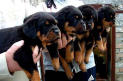
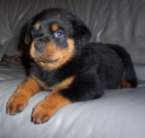
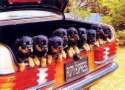
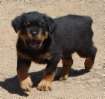
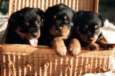
If puppies were judged on a scale of cuteness from 1 to 10,
Rottweiler puppies would surely score an 11. Few people can resist playing with a healthy,
bouncy, furry black-and-mahogany bundle that exudes
pure puppy love. Without question, Rottweiler puppies are among the most attractive of puppies
and their inquisitiveness, intelligence, and sheer joy of life never fails to entrance potential puppy
owners.
What Puppy Ownership Involves
Puppy ownership, particularly with a Rottweiler, is not all fun and games. It involves a lot
of hard work, sleepless nights, and a good dose of patience to make it through the puppy's
first year. That's not to say that raising a puppy from the time he is only a couple of months
old doesn't have tremendous benefits. It's just that sometimes the responsibilities involved
in raising a Rottweiler can be overwhelming for some owners - particularly those who don't
know what they're getting into.
For this reason alone it is wise for a potential puppy owner to understand exactly what is
involved in raising a Rottweiler. Armed with this knowledge, a puppy owner can avoid rearing
mistakes that might affect the dog's temperament, health, or behaviour. On the other hand,
the potential Rottweiler owner, with a knowledge of just what raising a Rottweiler entails,
may choose instead to adopt a reused Rottweiler and avoid many of the problems of
puppyhood.
- Benefits of Puppy Ownership
Obviously, one of the advantages to owning a Rottweiler puppy is that they are absolotely
adorable. This is a once in-a-lifetime phase, and when a Rottweiler is grown up, he may still be
very playful but he won't ever be that little bundle of black-and rust fur again. However,
there are many other reasons to choose a Rottweiler as a puppy. Following are some of the
areas in which you can influence the growth of your Rottweiler puppy:
- Temperament
:
Researches believe that as much as 40 percent of a dog's temperament is a result of the dog's
environment and experiences while growing up. This means that as an owner,
you have an incredibly profound impact on the temperament of your Rottweiler. If you raise your
Rottweiler puppy to be a good-natured, congenial dog, the odds are in your favour that your dog
will develop into a tremendous companion.
- Good Health
: It is
correct that you can't change the inherited health (genetic diseases) of a puppy; however, if you
raise a Rottweiler as a puppy, there is much you can do to foster good health and prevent illnesses.
Quality food, fresh water, exercise, and regular, excellent veterinary care will do much to help
develop the vigor of your growing Rottweiler. A full series of vaccinations will prevent many
life-threatening disease and regular heartworm preventive will ward off this deadly
parasite.
- Acclimating to lifestyle
:
Though there are adult dogs that can walk into a new home and settle in within days, it is
generally much easier for a dog to adapt to a household as a puppy.
- Respect
:
Another benefit of raising a Rottweiler as a puppy is that during the development of the
Rottweiler, the puppy can be taught to respect all members of the family, from the smallest
toddler to a live-in grandparent. The puppy can be taught from day one to be handled and
respond to commands from all family members regardless of size or strength, preventing
potential future issues over leadership.
- Ease in training
:
Training a puppy that is small, willing, and eager to learn is much simpler than teaching a large,
unruly animal that isn't sure he needs to obey you.
- Pitfalls of Puppyhood
Rottweiler puppies are cute, impressionable, and easily, trained as youngsters, but it wouldn't be
fair to say this breed isn't without its challenges as puppy. Some of the most common problems
involving Rottweiler puppies are listed below.
- Activity Level
:
The Rottweiler is known as a relatively calm dog with a moderate activity level. A mature
Rottweiler likes to have fun, but he does not have the high activity levels of some of the
on-the-go sporting breeds and non-stop terriers.
- Teething
:This is generally a very trying
time for puppy owners and requires a lot of patience, and consistency in training. Because of
the Rottweiler's incredibly jaw strength, this chewing phase can be quite destructive and,
depending on what items your Rottweiler seeks out to chew, this phase can also be quite
expensive.
- Obedience
:With a Rottweiler puppy,
there is no exception to the training rule. All Rottweiler puppies need to begin training as soon as
possible, and this training must continue through their lives. But training takes time, effort, and
patience - things a potential dog owner may not always have.
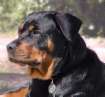
There is nothing more beautiful than a healthy Rottweiler. With a thick, glossy
black-and-mahogany coat, bright eyes, physical strength, and a vibrance that defies
description, a well-cared for Rottweiler is truly a wonderful sight.
Brushing
There are times that your Rottweiler shed so much amount of hair everyday.
The stuff will stick to carpets and furniture, waft in clumps in the air, and flit across the floor
as you try to chase it down with a broom. You can cut down on the excess
hair in your home and on your clothes by regularly brushing your dog. A good
pin brush is all you will need. The rounded pin bristles of the brush will
go deeply into your dog's coat and will help to pull out loose hairs.
Bathing
Rottweilers don't require frequent bathing. In fact, if you regularly brush your rott, you may need
to bathe your dog only once every couple of months. Resist the urge to give your dog a full
bath every week; excessive bathing can dry the skin and deplete the dog's coat
of natural oils.
Nail Trimming
Rottweilers tend to have a "thing" about having their feet touched. They may tolerate having
their feet handled but they don't really like it. It is important, however, that your Rottweiler
allows you to handle their feet so that their toenails can be trimmed. Toenails that are allowed to
grow too long force the toes splay and eventually can cause damage to the dog's paws.
Nutrition
Proper nutrition is very important to the overall
health of your Rottweiler. If he does not receive the nutrients he needs on a daily basis,
he can become malnourished or develop certain diseases.
Feeding Guidelines
- When to Feed
There are a couple of rules to follow when feeding puppies and adults:
- You must try to feed your Rottweiler at regular times. Puppies should be fed three times
a day up until they are six months old, at which time
they can be fed twice a day. The feeding should be spread as equally apart as possible and
you should allow for proper "relief" time afterward.
- You must adjust your Rottweiler's feeding schedule to accommodate any period
of heavy exercise. The general philosophy is to give your Rottweiler at least one hour to
digest his food before he exercises, and not to feed him for at least one hour after his
exercise.
- How Much to Feed
It is important to keep a puppy trim and not allow him to get overweight. It is equally
as important to keep adult dogs in good shape. To determine where your Rottweiler is in
terms of weight, you will need to feel him. Work your way into the coat covering his ribs
and push lightly toward his ribs. If you can't feel any ribs, he most likely needs to have his food
cut back a bit.
- Changing Foods
Sudden changes in diet - switching from one
brand of food to another - can cause bouts of diarrhea. In order to switch foods without
causing your Rottweiler any distress, use a ten-day plan:
- Work in one part of new food to nine parts of the previuos food on the
first day.
- On the second day, substitute two parts of new food with eight parts of the previous
food.
- Continue working the new food into the previous food until you are
feeding entirely new food.