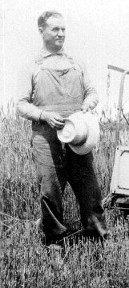
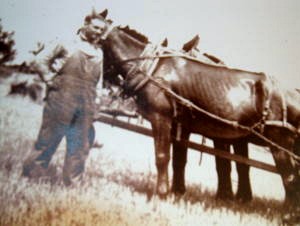
My dad was born on the old John D. Hearst River Farm near Vineland, Missouri, in 1891 - - maybe. Maybe, because along about then St. Joachim�s partially burned. All the parish records - - birth, marriages, deaths, that were kept in the basement suffered water damage. His church birth record was blurred and a civil record suggested 1888. St. Joachim�s is still there, the parish for La Vielle Mine - - the old mine. Old Mines was a village in Missouri French Country � representing just a part of King Louis XIV�s grand dream of a new France. Descendants of these two hundred French miners who arrived with Phillipe Francois Renault in 1723 to mine lead are still there, scattered among the hills, south of St. Louis.
St. Louis was a newcomer among French settlements. Some of the first, like Cabanage a Renaudiere, about 1710, have long disappeared. Others like Mine La Motte, 1714, at the origin of Big River, and a cluster of communities in Washington County like Mine a Renault, 1724, and Vielles (Old) Mines, 1726, are still there. The most famous village, of course, was Ste. Genevieve, fondly nicknamed �Misere� � (Miserable) about 1722. The Missouri French built their villages in clusters, since the Osage with brazen impunity, would travel one hundred miles to steal a fine horse. The land was divided into arps � a measure about 192�6� square. Each lot was one arp wide but perhaps a mile deep. This close community suited the social, fun-loving French an disgusted the first English and Americans, reared in the glumness of their Puritan Ethic. The villagers were Catholic, but less ardent than those in Canada or France. They practiced a frontier religion in a frontier life. They were not lazy, but easy going and gregarious. They enjoyed themselves much more that their American counterparts. There was no brutality of man against man in those early days; no evidence of a single duel among these villagers. The most common crime was horse theft, and that was usually by Indians. They saw nothing wrong in dancing on Sunday. In fact, Sunday was for celebrations; one ball in the afternoon for children and another Sunday night for the adults. The men would work in the mines and fields Monday and Tuesday from dawn till dark to get enough work done by Wednesday noon so they wouldn�t have to return o work till the next Monday. These extra long weekends they would play cards, sing, dance, and tell tall tales. But these were a genteel people, with elegant manners. The wives were treated as full partners and slaves were usually treated as members of the family. Sometimes the balls would last two or three days. The slaves and Indians were always invited - - and they came. The early Missouri French hardly knew the meaning of the word prejudice. Rough frontier travelers of the middle valley were astounded to find imported silk, satin, velvet and silver; in this wilderness, a genteel, compact civilization.
|