 |
| WARNING: If you have not yet gone past, oh, Algebra, in school, much of this will make no sense to you. It will look like another language. It will look like I am making fun of you and you can't understand it, and are therefore stupid and uneducated. Well, I probably am, and you might just be... but you won't know until you take some math classes! MUAHAHAHAHA! |
| This is my friend, (Point to the empty chair beside you) the square root of negative Fred. |
| "Oh my gosh, it's almost Pi over 4 out, I'd better get my coat!" |
| Black holes are where God divided by zero. |
| "So a vertical asymptote doesn't always have to be... vertical?" -A student at my highschool |
 |
 |
|
 |
|
|
 |
|
| Jokes and Quotes |
 |
|
|
|
|
| Pictures and Comics |
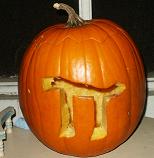 |
| (^ I carved it.) |
|
| I do not think -- therefore I am not.
Here is the illustration of this principle: One evening Rene Descartes went to relax at a local tavern. The tender approached and said, "Ah, good evening Monsieur Descartes! Shall I serve you the usual drink?". Descartes replied, "I think not.", and promptly vanished. -From http://www.math.utah.edu/~cherk/mathjokes.html |
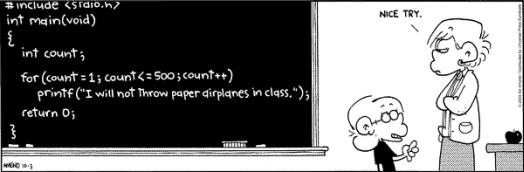
| <limited7> i have for(n = 1; n < 99; n = n /2) why is it loopin forever? -From bash.org |
|
|
 |
 |
 |
| Mathematician: 1 is prime, 3 is prime, 5 is prime, 7 is prime, therefore, by induction, all odd numbers are prime.
Physicist: 1 is prime, 3 is prime, 5 is prime, 7 is prime, 9 is a bad data point, 11 is prime, 13 is prime... Engineer: 1 is prime, 3 is prime, 5 is prime, 7 is prime, 9 is approximately prime, 11 is prime, 13 is prime... Computer Scientist: 1 is prime, 1 is prime, 1 is prime, 1 is prime, 1 is prime, ... |
|
| 42 |
| In place of infinity we usually put some really big number, like 15. -Anonymous Computer Science professor From http://www.chemistrycoach.com/fields_of_mathematics.htm |
|
| "Hey baby, if you were 2x I'd want to be x squared so I could find the area under your curve." -Becky |
|
| new |
| Proof that 0 = 1
(1/x)dx = (integration by parts) | u= 1/x; du = -1/(x^2); dv = x; v = dx | = (1/x)x - ?x[-1/(x^2)]dx = 1 + 1/x dx Therefore: (1/x)dx = 1 + 1/x dx Subtracting 1/x dx from both sides, O = 1 Why is this wrong? Highlight the next few lines to find out. The constant of integration was omitted. It should have been: (1/x)dx = 1 + 1/x dx C = 1 + C Which is perfectly legitimate, since the C�s do not have to be equal. Many thanks to my Calc II teacher, Prof. Khalmanova for this. |
|
 |
|
|
|
|
|
|