|
|
|
With an area of 175,069 square kilometers, Kerman is one of the largest provinces of Iran, and it includes 11% of the total area of the country. It is located on the south-east part of Iran and its main cities and towns are: Kahnooj, Shahr-e-Babak, Syrjan and Zarand. Geography and History of the Province The mountainous area of
the province is a part of the central mountains of the country and they
are formed by some old volcanic highlands which starts from Azarbaijan, on
the north-west of the country and ends in Balouchestan. Between mountain
chains of the region There are many plains. Bashagerd and Koohbanan
mountains are the highest in the region, while there are some famous peaks
such as Toghrol, Aljerd, Syrach, Abareq and Tahrood. There are some other
|
|
|
History
The history of the
people of this province goes to 4000 BC, which turns the region into a
historical site as a whole.During its long history, a valuable collection
of historical and cultural heritage have been gathered there, which
constitutes a valuable part of the Persian Civilization and deserves
attention of tourists. Every historical space in today Kerman reveals a
part of the people history, their ways of living, their local governments
and structure
|
|
historical The most important historical and tourism sites of Kerman are as followings: Mineral springs and hot water sites of Areen, Qalaa Askar Tah-Khatoon, Gherghereh, Abareq, Boujan, Reza-Abad, Pachenar, Beesheh, Ekhteyar Abad, Houze-nou, Baghra and Houzeabad. Countryside of Mahan, Jopar, Raien, Koohpayeh and other places. Historical and cultural
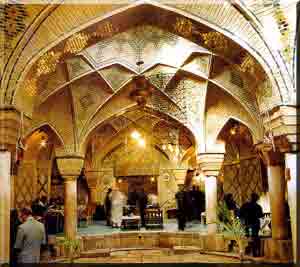
complex of Ganj Ali Khan including water storage, Public bath and teahouse
(cafe). Caravansaries of Chaharsouq (4 bazaars), Wakeel, Mirza Alinaqi,
Lahafdoozhan, Haj Mehdi, Hindoha and Haj Aqa Ali. Old schools of Ganj Ali
Khan, Hayati and Ibrahim Khan. Tombs of Shaykh Nematollah Waly, Khoajeh
Atabak, Shahzadeh |
|