Imam Khomeini’s International Quds Day:
From Street Marches to Cyber-Demonstrations*
Mansoor L. Limba**
Quds Day in
the Real World: Street
Quds Day in the Virtual World: Cyber-Demonstrations
Cyber-Demonstrations: Their Various Forms
1. Messages/Statements
2. Invitations
3. Feature articles
4. Web pages
5. News and Audio/visuals
Cyber-Demonstrations: Their Merits and Demerits
Consecration
of the last Friday of Ramadan as International Quds Day is among the precious legacies
bequeathed to us by Imam Khomeini. Since its consecration in August 1979, march
demonstrations around the world has intensified every year both in terms of the
scope and number of participation in the demonstrations.
With the
advent of the Internet, Quds Day rallies and marches have found a new space—the
cyberspace. Now, the street marches in the real world are complemented by the
various forms of Quds Day demonstrations in the virtual world, which have their
own particular peculiarities as well as limitations compared to the actual
demonstrations.
“I invite all
Muslims over the globe to consecrate the last Friday of the holy month of
Ramadan as ‘Quds Day’ and to proclaim the international solidarity of Muslims
in support of the legitimate rights of the Muslim people of Palestine.”[1]
Ruhullah al-Musawi al-Khomeini
Ramadan 1399 AH (August 1979)
The
victory of the Islamic Revolution in 1979 not only marks the triumph of the
Islamic movement in
In
his first message on the occasion of the auspicious day, the Imam of the ummah reveals that Quds day is a global
day; thus, a day not exclusively for Quds. For him, it is a day of
confrontation for nations that have been under tyranny. Accordingly, it is a
day when the oppressed should become equipped against the oppressors and “they
should rub their noses in the dirt.”[3]
Now,
a quarter of a century after the declaration of the last Friday of every month
of Ramadan as Quds Day, it is high time to assess the extent of the global
Muslims’ paying heed to the call for espousal of the right of the Palestinian
nation. With the advent of the Internet, Quds Day rallies and marches have
found a new space—the cyberspace. The street marches in the real world are
complemented by the various forms of Quds Day demonstrations in the virtual
world.
Against this backdrop, a descriptive-analytical survey of the various
forms of cyber-demonstrations for the Quds Day since mid-1990s is the main
concern of this study.
This
paper sought to know the various forms of Quds Day demonstrations in the
cyberspace. Standing on the proposition that the ‘online’ demonstrations do not
substitute the ‘offline’ marches and rallies, but complement each other, this
paper examines the prospects and constraints of the former (i.e.,
cyber-demonstrations). In particular, this article attempted to address the
following queries, thus:
1.
What is the significance of Imam Khomeini’s
sanctification of the last Friday of Ramadan as International Quds Day in the
struggle of the Palestinian people?
2.
Has the participation’s scope and number intensified
in the Quds Day demonstrations around the world?
3.
What are the various forms of Quds Day demonstration
in the cyberspace and what are their merits and demerits compared to the actual
march rallies in the streets around the world? What is the nature of
relationship between the street marches and the cyber-demonstrations?
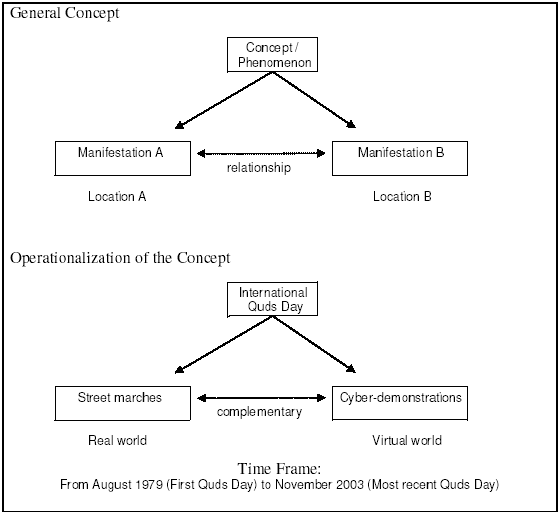
Diagrammatically, this academic inquiry can be
represented as follows:
Figure 1 Diagrammatical Representation of the Study
Initially,
this paper explored the significance of the Quds Day in expressing solidarity
to the Palestinian nation against the Zionist occupier regime.
Then,
it gave a descriptive survey of the Quds Day march rallies in the ‘real’ world
since August 1979.
Thereafter,
it dealt lengthily on the various forms of Quds Day demonstrations in the
cyberspace. While acknowledging that cyberspace constitutes wider political,
social, economic, cultural, and financial networks of software and hardware,[4] in
this paper it mainly refers to the Internet. In other words, throughout the
paper the Barlovian cyberspace is referred to and not the Gibsonian’s.
Barlovian cyberspace is that which is understood as the space computer networks
create as opposed to the Gibsonian cyberspace which is understood as a
fictional and visionary conception of the same.[5]
Cyberspace, in contrast to the ‘meatspace’ (i.e., the real world) is hereby
alternatively referred to as the ‘virtual world’, ‘offline’ and ‘informational
superhighway’.
To fully grasp the importance of the declaration of
the last Friday of Ramadan as Quds Day, it is necessary to quote at some length
the first message of the champion of the oppressed, which lays down the
cornerstone of the Imam’s conception of, and philosophy behind, the
declaration, and the subsequent messages are based on these declarations.
Thereafter, we will analyze the implication of the key points of the statements
towards the Palestinian Question.
“In the Name
of God, the Compassionate, the Merciful
“For many years I have been warning
Muslims of the menace posed by the usurper
“I call on the Muslims of the world
as well as on all Islamic governments to join forces to cut down this usurper
and its supporters. I invite Muslims all over the globe to consecrate the last
Friday of the holy month of Ramadan—which is a ‘day of fate’ and which could
also become the day on which the fate of the Palestinian people might be
determined—as ‘Quds Day’ and to proclaim the international solidarity of
Muslims in support of the legitimate rights of the Muslim people of Palestine.
“I pray to the Almighty for the
victory of the Muslims over the infidels.
“May peace and mercy of God be upon
you.”
Ruhullah
al-Musawi al-Khomeini
Ramadan 1399
AH (August 1979)
“In the name
of God, the Compassionate, the Merciful
“Quds day is a global day. It is not
a day exclusively for Quds. It is a day when the oppressed confront the
oppressors. It is a day of confrontations for nations that have been under the
tyranny of the American government and other oppressors. It is a day when the
oppressed should become equipped against the oppressors and they should rub
their noses in the dirt. It’s a day when committed individuals are preferred
over hypocrites. Dedicated people consider today as Quds day and act as they
are obliged. The hypocrites and those who are secretly acquainted with the
superpowers and are friendly with
“Quds day is a day when the fate of
the oppressed nations must be determined. Oppressed nations should make their
presence known to the oppressors, just like
“It is a day when we have to rescue
the oppressed from the claws of the oppressors. It is a day when the Islamic
society should make its presence known to all superpowers and their pulp,
whether in
“Quds day is the day when
superpowers should be warned that they must leave the oppressed alone and sit
back and take their own place.
“Quds day is the day of announcing
such an issue. It is the declaration that the satanic superpowers want to isolate
the Islamic nations and impose themselves on the scene of action. Quds day is a
day when their wishes should be chopped and they should be warned that those
times are gone.
“The day of Quds is the day of
Islam. All Muslims must be warned and must understand how strong their
spiritual and economic powers are. Muslims are one billion people, supported by
God, Islam and the power of faith. Why should they be afraid? ...
“All the governments of the world
must know that Islam is invincible. Islam and the Qur’an will conquer the
world. A true religion should be a divine religion. Islam is a divine religion
and thus must be promoted throughout the whole world.
“The Day of Quds is such a day and
announces such a goal, announcing the progress of the Muslims all over the
world. The Day of Quds is not only the Day of
“The Day of Quds is the day that we
will realize which regime and persons are cooperating with international
conspirators and thus are opposing Islam. Those who do not participate in these
demonstrations are opposing Islam and thus are in agreement with
“The Day of Quds is a day to
distinguish between truth and falsehood. I ask God Almighty to give victory to
Islam over all of the other faiths and support the deprived in order to defeat
the arrogant ‘those who cause deprivation’. I implore God to free our Muslim
brothers in
“Peace and blessings be upon the
Messenger of God and the Imams of the Muslims.”[6]
A
close scrutiny of the foregoing message would bring to light the following
points with paramount import to the Palestinian issue:
First
of all, by stressing that “For many years I have been warning Muslims of the
menace posed by the usurper
Secondly,
though “all Islamic governments” are mentioned, undoubtedly Imam Khomeini’s
invitation to consecrate the last Friday of the fasting month is mainly
addressed to the Muslim masses of the world as suggested by the remarkable
repetitions—“I have been warning Muslims,” “I call on the Muslims of the
world,” and “I invite all Muslims all over the globe.” It shows that he is
pinning hope on the masses, and not their governments, as they have the power
to mobilize once organized. Another reason behind his reliance on the people is
indicated by his remarks,
“It’s a day [Quds day] when committed individuals are
preferred over hypocrites. Dedicated people consider today as Quds day and act
as they are obliged. The hypocrites and those who are secretly acquainted with the superpowers and are friendly
with
Quality as represented by “committed individuals” are
favored over quantity as represented particularly by “the hypocrites”—alluding
to those in the high echelon of the governments in the Muslim world—who,
according to the Imam, “are indifferent and do not allow the nations to
demonstrate today.”[9]
Thirdly,
in this message the Supreme Leader of the Islamic Revolution points to the true
nature and scope of the Quds day as the day of all the oppressed and deprived
people in confrontation with the world devourers and oppressors: “Quds day is a
global day. It is not a day exclusively for Quds. It is a day when the
oppressed confront the oppressors.” If it is named “Quds Day” it is only
because the Palestinian Question is a paradigmatic example of an oppressed
nation under the yoke of a regional power fully backed by superpowers. Besides,
in this clash between the oppressed and the oppressors, the modus operandi
proposed by Ayatullah Khomeini is for the oppressed unified front to exhibit
their existence and resistance against the arrogant powers and their surrogate
agents in a bid to demonstrate their power of unity, will and dedication: “It
is a day when the Islamic society should make its presence known to all
superpowers and their pulp.”[10]
Fourthly,
by declaring that “The day of Quds is not only the day of
Lastly,
taking into account the Islamic nature of the issue, which is supposed to have
a place in the heart of every true believer, Imam Khomeini views the
International Quds Day as a distinguisher [faruq]
and criterion [furqan] when he
rightly argues:
“The Day of Quds is the day that we will realize which
regime and persons are cooperating with international conspirators and thus are
opposing Islam. Those who do not participate in these demonstrations are opposing
Islam and thus are in agreement with
In
sum, championing the legitimate cause of the Palestinians had been part of Imam
Khomeini’s agenda long time before the formation of the Islamic political
establishment in
Quds Day in
the Real World: Street
During
the past twenty-five years since the unprecedented sanctification of the last Friday
of the majestic month of Ramadan as International Quds Day by the Imam of the ummah, what has been the response of the
global Muslims to this call for demonstration of camaraderie with the
Palestinian people? Has the Quds day mass rally been restricted to
An
examination of the news around the world on every last Friday of Ramadan shows
that mass demonstrations in the different parts of the globe during the past
two decades have gained momentum qualitatively and quantitatively. In major cities
from
In
the Philippines where Muslims constitute a minority of five to ten percent of
the total population of the country, initially, mostly Iranian students were
staging march rally in front of the US and Israel embassies in Manila. As years
passed by, however, non-Iranian local Muslims can be seen participating
actively. Moreover, similar demonstrations are also held in
In
2001, Quds day was observed in
During
the 1997 Quds day in
Second
only to
“Marking this occasion every year has two sides:
marking al-Quds Day and marking the course and method of al-Quds’ imam, the ummah’s imam, inspirer,
leader, the revolution’s maker, the resurrection creator, the one who restored
religion and hope in the twentieth century and on the eve of the third
millennium—the Great Imam Khomeini.”[18]
With
the theme, “Quds: Symbol of Honor and Solidarity,” a five-day exhibit was held
in
In 1999 the Morocco-based Arabic News reported that Islamic states mark al-Quds day. It
stresses that the commemoration of the day is “an opportunity for Muslims to
renew their attachment to the third Islamic holy shrine and their refusal of
the Zionist policy which seeks to obliterate the Arab and Islamic identity of
the city.”[20]
In
the populous western African state of
In
Turkey the participation of a certain Nureddin Sirin in the Quds day program in
1997 led to his conviction for 17 and a half years of imprisonment. According
to his narration while in Bandirma Prison in Bahkesir, he was invited as a
speaker to al-Quds Day meeting on
“We are Muslims and as Muslims we take the maintenance
of Al-Quds as the greatest task. We sincerely support Muslims who fight against
After
the defense he was sentenced to 17 years and 6 months’ imprisonment while
having no regret in his participation in the Quds day commemoration.
Home to only about two percent of the country’s Muslim
populace,
Interestingly
enough, even Saddam Takriti who orchestrated and masterminded an eight-year war
from 1980 to 1988 against the initiator state of the International Quds Day, in
the 9th cabinet session which he chaired in February 2001 he could
not help but to declare November 22[25]
of every year “as a national day to be called Quds Day, in which the Iraqis
remember their honorable position in al-Quds Call Day in which millions of
Iraqi volunteers participated in a parade to liberate Palestine.”[26]
In
the midst of December winter in 2001 in
“Judaism stands completely opposed to Zionism. Zionism
although founded by people of Jewish birth does not make it a Jewish
conception; communism was also founded by people of Jewish birth but it is not
a Jewish conception, and Zionism is no more Jewish than communism… We pray
daily for the dismantlement of the Zionist state (Israel).”[28]
In
the United States,
it is reported that
a rally was organized by the CCMO, Coordinating Council of the Muslim
Organizations on December 22, 2002 in the Washington Metropolitan Area. The
rally started in front of the White House. Muslims gathered, made the Friday
Prayers, and then marched to the U.S. State Department shouting slogans
condemning Israel’ s brutal actions against innocent civilians in the Holy
Land. At the end of the rally, an Israeli flag, a symbol of aggression and
terrorism, was burned by the people in front of the State Department.[29]
Quds Day in
the Virtual World: Cyber-Demonstrations
When Imam Khomeini in a statement
released in August 1979 [Ramadan 1399 AH] proclaimed the sanctification of the
last Friday of Ramadan as International Quds Day and called on all Muslims of
the world to stage demonstrations as a manifestation of unity with the
Palestinian nation, the mass media—radio, TV and printed media—has played a vital
role in portraying the presence of Muslims in the scene for the liberation of
al-Quds. Since 1990s, thanks to the unprecedented surge of progress in the
information technology as embodied by the computer and Internet, Quds Day has
found the information superhighway (as a noteworthy extension of the real
streets in the urban centers) as a new-found locus of protests. And in many
ways access to the virtual world of the Barlovian cyberspace has provided a
remarkable assistance to the marches, rallies and demonstrations in the real
world.
Cyber-Demonstrations: Their Various Forms
In
the Internet messages or manifestos of invitation including newsgroup messages
to observe the International Quds Day are posted. There are articles featuring
Quds Day. Web pages including those in the personal sites focusing on the Quds
Day and related activities, such as schedule of Quds Day rallies in the
different countries and cities, can be found. The last but not least are the
news stories of events related to the observance of Quds Day demonstrations in
the different parts of the world as in the foregoing pages in the websites or
Internet editions of mass media.
1. Messages/Statements
In
the cyberspace, messages, statements and addresses of Islamic groups and
leaders of the Islamic movement on the International Quds Day are posted. A
good example is the messages of the Supreme Leader of the Islamic Revolution,
Ayatullah Sayyid ‘Ali Khamene’i, in different languages accessible in the web
site of the Islamic Republic of Iran Broadcasting;[30]
the Ahl al-Bayt World Assembly (ABWA);[31]
and Syed Hamid Ali Shah Moosavi of the Tehreek Nafaz-e-Fiqh-e-Jafariya
Pakistan.[32]
Similarly, the addresses and speeches on Al-Quds Day of Ma‘allam Ibrahim
al-Zakzaky of the Islamic movement of Nigeria,[33]
Hizbullah Secretary General Sayyid Hasan Nasrullah[34]
and a certain Dr. Obada Kayali at the Canberra Islamic Centre in Australia are
accessible online.[35]
Described as Jews united against Zionism, the Neturei
Karta International has issued statement on al-Quds Day on
As part of their expression of support for the
Palestinian cause, representatives of Neturei Karta take part in protests,
which draw attention to the Palestinian struggle, whenever they can. Therefore,
on this Al-Quds Day March Neturei Karta would like to express its solidarity
with the Palestinian People and explain the following points:
The ideology of Zionism is completely opposed to
Judaism…
Zionism in general and its conduct against the Palestinian
People in particular is against the Torah, beliefs and the hopes of the Jewish
people…
The Jewish Religious teaching is that the Jewish
People have no right to rule in
Exile means that Jews must be loyal subjects of the
government of the countries in which they live and not attempt to attain
political power over other peoples…
According to the Torah and Jewish faith, the present
Palestinian Arab claim to rule in
2. Invitations
Along with messages of Islamic groups and their leaders, which usually
contain the call for participation of the Quds Day demonstrations, there are
specific invitation campaigns for Quds Day participation in the Internet. For
example, a Yahoo! Newsgroup “4islam” posted a Quds Day invitation in its
Message Board.[38]
The Innovative
Minds has posted the 2001 Quds Day Rally details for
3. Feature articles
There are articles featuring Quds Day. See, for
example, “Quds Day,” Islamic Digest
Website;[41] Iqbal
Jassat, “Quds Day: New Efforts to Ensure
In mosques throughout the world, the last Friday of
the Muslim fasting month of Ramadan has been devoted to highlight the problems
facing the Palestinians in their struggle for freedom from Zionist occupation.
Ever since the outbreak of the first intifidah
(uprising) the spotlight in the Muslim world has been firmly focused on the
valiant struggle being waged against the fourth most powerful country in the
world –
Elsewhere in the article, it states:
The achievement of the Palestinians in the fourth year
of the inifadah is remarkable. Making
A poem on Al-Aqsa sent to the editor of a national
daily in Sri Lanka by a certain Siddiq Ghouse describes the Quds Day as
follows: “The last Friday of Ramadan Muslims the world over hold as Al-Quds
day, to awaken a billion souls’ conscience to noble duty and struggle in
Allah’s way.” “Letters to the Editor,” The
Sunday Times Website, January 25, 1998.[46]
The World Service Section of the Islamic Republic of Iran Broadcasting (IRIB)
has posted the electronic version of a book on Imam Khomeini’s statements on
Palestine,[47] a
chapter of which focuses on the Imam’s announcement of the holy day.[48]
4. Web pages
Many sites have also focused on the importance of the
annual Quds Day such as the following: “The Worldwide Day of Quds” at the
Muslim Students’ Association Website;[49]
“The Day of Qods,” Islamic Thought Foundation site;[50]
and “Al-Qods Day: The Day of Islam” posted in a Geocities personal site
seemingly owned by a Lebanese student.[51]
The other pages of the site contain beautiful relevant portraits along with
statements, mostly of Imam Khomeini, such as the following:
The world Qods day is the day for proclaiming
commitment to accepting responsibilities for defending the honor and dignity of
the Muslims. The Qods day is the day of unity among Muslims and their solidarity
with the innocent Palestinian nation as well as the day of the awakening of the
world people’s conscience.[52]
The initiation of the world Qods day is a framework
for preservation of unity, solidarity and active participation of Muslims for
defending the Islamic holy lands and their non-submission to any form of force,
insult or subservience.[53]
The world Qods day has helped Muslims to further
strengthen their ties with the Qods ideals so that the satanic designs of the
Zionist entity would be rendered futile in creating a fissure in the strong tie
that exists among Muslims.[54]
The commemoration of the world Qods day is a means to
demonstrate the Muslims’ abhorrence of and anger at the Zionist usurpers who
are occupying the holiest precincts of Islam.[55]
Qods could not be freed through negotiations with the
usurper Zionist regime and that jihad and struggle is the only way left open
for freeing the holy city of
Other articles are “Qods Day” in the site of a certain
Jamia Uloom-e-Islami;[57]
“Jordan-Imam Khomeini” available at the site of the Lebanese Islamic
Resistance;[58]
“Al-Quds: the Focus of Muslims’ Grief” at the Geocities-based Ahlul-Bayt Islamic Library;[59]
and “Quds Day,” Innovative Minds Website.[60] Innovative Minds site is not only active
in Quds Day activities but also in Israel Boycott Campaign,[61]
which resulted in the closing down of its original site,[62]
in what it describes as “Zionist terrorism in cyberspace”.[63]
The Shaheed Foundation has made downloadable a series of
free Al-Quds Day wallpapers on the wallpaper gallery of its site.[64]
5. News and Audio/visuals
The last but not least are the news stories of events
related to the observance of Quds Day demonstrations in the different parts of
the world as in the section, Quds Day in
the Real World: Street Marches, in the websites or Internet editions of mass
media. Along with this news coverage of the street march rallies around the
world are the relevant photos and audio-video clips of the rallies.
The Innovative
Minds site has web pages that show photos with interesting captions as well
as audio clips of the slogans chanted and du‘a
[supplication] recited on the 2000 and 2001 London Quds Day processions.[65]
The Al-Quds Day 2002 photo report is accessible at the Islamic Human Rights
Commission (IHCR) and the United Islamic Students Association of Europe sites.[66]
This is while the photo account of the 2003 march from
In
Cyber-Demonstrations:
Their Merits and Demerits
The
virtual world of the cyberspace offers a variety of advantages for both
individuals and groups in observing the International Quds that are unavailable
or improbable in the ‘meatspace’. Among its merits the following can be
identified: (1) global; (2) real-time; (3) permanency; (4) virtual freedom; (5)
anti-hierarchy; and (6) variety of demonstrations. Cyber-demonstrations are
global in the sense that the activities and resources related to the expression
of support to the Palestinian struggle for self-determination on Quds Day are
lived and managed on a worldwide basis. These activities and resources do not
exist within any national boundary and information therein is available
worldwide. One-million-strong Quds Day marches in the main streets of
Activities
and resources relating to the annual Quds Day also provide real-time experience
as the actions and reactions to them occur immediately with no delay. News
report of a Quds Day rally in Tehran can be uploaded instantly by the reporter
and thus be available online. Quds Day demonstrators passing by a café net in
Beirut can be seen ‘live’ and their slogans heard through a web cam by Internet
users around the globe.
While
Quds Day is a one-day event in the real world, it is not so in the online life
as the cyberspace provides a veneer of permanence to the multimedia and
information items related to it. Pictures of the Quds Day demonstration in
London in 2002 are still available online at the Innovative Minds web site,[73]
among others. The circumstances surrounding the landing to jail of a Turkish
Quds Day demonstrator in 1997 can still be read at the online archive of the Crescent International.[74]
If in
your locality or country, demonstrations on the last Friday of Ramadan are not
permitted by the government authority, the information superhighway is the
right place for you. The virtual world gives you a virtual freedom to
participate in the global movement of support for the world’s oppressed on Quds
Day demonstrations. You can express your solidarity in various ways: building a
site dedicated to the Quds Day, writing and uploading a feature article,
posting a message in a newsgroup where you are a member, sending email to net
pals inviting or encouraging them to participate in the rally in their
respective locality, or dispatching a news article on Quds Day to an electronic
newspaper or newspaper with online version. If you have not seen yet a Quds Day
demonstration in your city and that you wanted to know about the event and its
message, the world of the computer networks called the Internet can provide you
ample information.
One
plus point of the cyberspace with respect to the cause of the Quds Day is its
anti-hierarchical nature. The cyberspace is the space where offline hierarchy
can be defied. A commoner in the ‘offline’ life who can merely join the march
rally in his locality and has no chance to deliver a speech before his fellow
marchers, can have more active participation in the ‘online’ sphere if he is
capable enough. He can develop a personal site focused on the Quds Day, post a
message and invitation, etc. He can do all of this while member of the
‘offline’ elite such as leader of an Islamic group who often has a central role
in the march procession can’t necessarily do so.
Identity fluidity, another key feature of the
cyberspace, reinforces its anti-hierarchy. A person who is restricted to join
the Quds Day rally in his country and to express any means of support to the
Palestinian struggle can assume a different online identity or identities. In
doing so, he can defy the dictate of an ‘offline’ elite that represents pro-Israeli
interests.
Equally favorable point of the cyberspace with respect
to the expression of solidarity with the Palestinians and all oppressed peoples
of the world on Quds Day is the variety of demonstrations of such support that
are available in the information superhighway. Depending on the online
capability and accessibility of a person, he can choose any or a combination of
the various forms of cyber-demonstrations as discussed above.
Notwithstanding the preceding meritorious points of
the cyberspace, cyber-demonstrations are far from capable of substituting the
march processions in the real world. The virtual world as the medium and space
for the commemoration of the annual Quds Day has some inherent constraints.
Amid the global scope of the cyberspace and the virtual freedom it offers as
indicated above, the truth of the matter is that its global-ness is not so
global. The cyberspace is not planetary in the sense that not everyone on the
planet is involved with each global resource or activity. Although access to
the Internet may be unlimited in theory, it is restricted by the cost of
technology and the steep learning curve for computer neophytes.
In fact, only a small fraction of the planet’s
population uses cyberspace. The Internet is growing at exponential rates but is
overwhelmingly located in the already industrialized world where users are
wealthy, white and highly educated. In July 1997, the Internet was not only
dominated by Western or developed countries but by the
Behind the virtual freedom that the cyberspace
provides lies the attempt of an elite minority of information-empowered people
to control the production, flow and consumption of information. Whereas street
marches and demonstrations are banned in some countries and cities around the
world,[76]
the cyberspace is replete with cases of censorship, filtering, spamming, and
other forms of cyber control and sabotage as illustrated by the Zionists’
success in closing down the former website of the Innovative Minds.[77]
The issue of control in the cyberspace also demonstrates that contrary to the
notion of the virtual world’s anti-hierarchy, the offline elite usually
constitute the online elite, too, with the exception perhaps of the case of
hackers.
Similarly, the illusion of permanency of the information
and resources in the Internet such as data and multimedia items can be
shattered by the fact that a hyperlink can easily be changed or erased by a
webmaster. A seemingly small change in the URL, or file name of a page may
render electronic information inaccessible to a user.
Equally interesting to note is that
cyber-demonstrations such as news reports, speeches, audio/visual items and the
like do not stand by their own in the cyberspace. They are pieces of
information that emerge out of the marches in the real world. News coverage and
speeches at the rallies posted in the Internet are illustrious examples. Also,
Quds Day is essentially and originally associated with the street marches and
not to their reified forms electronic or otherwise.
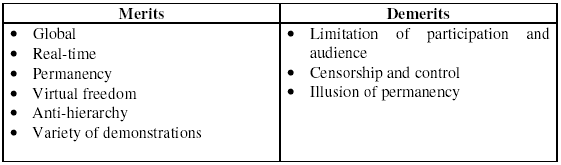
In sum, the meritorious and contrary points of the
cyber-demonstrations in comparison to the march processions in the street are
as shown in Figure 2.
Figure 2 Merits and demerits of the cyber-demonstrations in
comparison to the street marches
Consecration of the last Friday of Ramadan as International
Quds Day is among the precious legacies bequeathed to us by Imam Khomeini.
Since its consecration in August 1979, march demonstrations around the world
has intensified every year both in terms of the scope and number of
participation in the demonstrations.
With the advent of the Internet, Quds Day rallies and
marches have found a new space—the cyberspace. Now, the street marches in the
real world are complemented by the various forms of Quds Day demonstrations in
the virtual world, which have their own particular peculiarities as well as
limitations compared to the actual demonstrations.
In the cyberspace Quds Day is not only the last Friday
but a never-ending real-time online happening. In other words, in the virtual
world of the information superhighways everyday is Quds Day; hence,
transforming International Quds Day into “International Quds Daily”.
Nevertheless, given the innate constraints of the cyberspace compared to the
actual march procession in the real world, substitution of the latter by the
former can hardly be conceived in the foreseeable future. Instead,
complementation and supplementation are the order of the day.
Ali, Amirah. “Muslims and non-Muslims March Together
in
http://www.muslimedia.com/archives/world01/uk-march.htm,
“Al-Qods Day: The Day of Islam.” Personal Website, http://www.geocities.com/Athens/Oracle/1305/quods.html,
1998.
“Al-Quds Day Rallies on Friday.” Dawn Internet Edition, http://www.dawn.com/2000/12/18/nat12.htm,
“Al-Quds Day Statement –
“Al-Quds Day Today.” Independent Bangladesh Website,
http://www.independent-bangladesh.com/news/dec/14/14122001mt.htm,
“Announcement of International Quds Day.”
Islamic
http://www.irib.com/worldservice/imam/palestin_E/10.htm, 2002.
“‘Day of the Oppressed’ At the
http://allafrica.com/stories/200112160008.html,
“‘Day of the Oppressed’ at the
http://southafrica.indymedia.org/display.php3?article_id=655,
“Hizbollah Promises
http://www.unb.ca/bruns/9900/issue14/intnews/israel.html,
“Hizbullah on al-Quds Day: The Holy City is Alive.” Al-Moqawama Website,
http://www.moqawama.org/v_zionis/vzion_2000/jan_zion.htm,
“Islamic States Mark al-Quds Day.” Arabic News Website, http://www.arabicnews.com/ansub/Daily/Day/990518/1999051858.html.
Limba, Mansoor L. “The Islamic Revolution of
“Message of Imam Khomeini on the Occasion of the Day
of Quds.” The Dawn of the
Special Issue, vol. 1.
Osman, Firoz. “Al-Quds Day: A Time to Remember Martyrs.” Media Monitors, http://world.mediamonitors.net/content/viewfull/2291,
of Imam Khomeini’s Works, Autumn 1999.
“Participation in al-Quds Day Program Lands a Muslim
Activist in Turkish Jail.”
http://www.muslimedia.com/archives/world99/tur-quds.htm,
“President Saddam Hussein Chairs 9th
Cabinet Session.” Uruklink Website, http://www.uruklink.net/eindex.htm,
“Qods, Symbol of Honor and Solidarity” Exhibition
Opens in
http://palestinechronicle.com/article.php?story=20011214163407167, December 14, 2001.
Quarterman, John. “Is COM Primarily US or
International?” Matrix News 7(8) (1997).
“Quds Day.” Innovative
Minds Website, http://www.inminds.co.uk/qudsday.html,
2002.
“Quds Day 1422 [AH]/2001.” Innovative Minds Website, http://www.inminds.co.uk/qudsday2001.html.
“Radio 786 Goes International.” Radio 786 Website, http://www.ummah.org.uk/radio786/internat.htm.
“Rally in Front of the White House and US State
Department Condemning
Siddiqui, Iqbal. “One Million Join al-Quds Rally in
February 1-15, 1999.
Whittaker, Jason.
The Cyberspace Handbook.
“The World’s Qods Day.” Islamic City Website, http://www.islamic-city.com/events/events.html, December 2000.
al-Zakzaky, Ma‘allam Ibrahim. “Yaum al-Quds: The Day of the Oppressed.” Muslimedia International,
http://www.muslimedia.com/archives/features99/zak-quds.htm, 1999.