Euclidean Geometry -
Postulates and Theorems
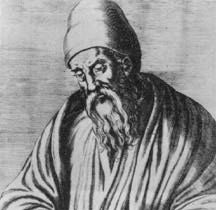
Euclid - (Third Century B.C.)
Euclid was one of the most famous Greek mathematicians and was probably the most successful scientific author who ever lived. His book, the Elements, was a treatise on geometry and the theory of numbers. For well over two thousand years, every student who learned geometry learned it from Euclid's book. And in all that time the Elements served as a model of logical reasoning for everybody.
Nobody knows, today, how much of the geometry in the Elements was original with Euclid. Some of it may have been based on earlier books, and some of the most important ideas in it are supposed to be due to Eudoxus, who lived at the same time. In any case, of the books which have come down to us, the Elements is the first one which presents geometry in an organized, logical fashion, starting with a few simple assumptions and building on them by logical reasoning.
This has been the basic method in mathematics ever since. The remarkable thing is that it was discovered so early and used so well. Logic plays the same part in mathematics that experiments do in physics. In mathematics and physics, one may get an idea one thinks is right. But in physics, one had better go to the laboratory and try it, and in mathematics, one had better think a little further and try to get a proof.
While Euclid's general method is here to stay, his postulates and the theory based on them are no longer widely used. Since the development of algebra, the use of numbers to measure things has become fundamental. This method does not appear in the Elements, because in Euclid's time algebra was almost unknown.
Excerpt courtesy Geometry, by Edwin E. Moise.
Postulates
- The Distance Postulate
- The Ruler Postulate
- The Ruler Placement Postulate
- The Line Postulate
- The Place-Space Postulate
- The Flat Plane Postulate
- The Plane Postulate
- Intersection of Planes Postulate
- The Plane Separation Postulate
- The Space Separation Postulate
- The Angle Measurement Postulate
- The Angle Construction Postulate
- The Angle Addition Postulate
- The Supplement Postulate
- The SAS Postulate
- The ASA Postulate*
- The SSS Postulate*
- The Parallel Postulate**
- The Area Postulate
- The Congruence Postulate
- The Area Addition Postulate
- The Unit Postulate
*The ASA and SSS Postulates can be proved indirectly, so they are theorems as well as postulates. See the Theorem section for more information.
**This Postulate is what defines Euclidean geometry. Otherwise, it could be elliptic geometry (0 parallels) or hyperbolic geometry (infinitly many parallels).
Postulate 1. The Distance Postulate - To every pair of different points there corresponds a unique positive number.
Postulate 2. The Ruler Postulate - The points on a line can be placed in correspondence with the real numbers in such a way that
1. To every point on the line there corresponds exactly one real number;
2. To every real number there corresponds exactly one point of the line; and
3. The distance between any two points is the absolute value of the difference of the corresponding numbers.
Postulate 3. The Ruler Placement Postulate - Given two points P and Q of a line, the coordinate system can be chosen in such a way that the coordinate P is zero and the coordinate of Q is positive.
Postulate 4. The Line Postulate - For every two points there is exactly one line that contains both points.
Postulate 5. The Plane-Space Postulate -
1. Every plane contains at least three non-collinear points.
2. Space contains at least four noncoplanar points.
Postulate 6. The Flat Plane Postulate - If two points of a line lie in a plane, then the line lies in the same plane.
Postulate 7. The Plane Postulate - Any three points lie in at least on plane, and any three noncollinear points lie in exactly one plane.
Postulate 8. Intersection of Planes Postulate - If two different planes intersect, then their intersection is a line.
Postulate 9. The Plane Separation Postulate - Given a line and a plane containing it. The points of the plane that do not lie on the line form two sets such that
1. Each of the sets is convex, and
2. If P is in one of the sets and Q is in the other, then the segment  intersects the line.
Postulate 10. The Space Separation Postulate - The points of space that do not lie in a given plane form two sets, such that
1. Each of the sets is convex, and
2. If P is in one of the sets and Q is in the other, then the segment intersects the plane
Postulate 11. The Angle Measurment Postulate - To every angle there is a real number between 0 and 180.
Postulate 12. The Angle Construction Postulate - Let  be a ray on the edge of the half-plane H. For every number r between 0 and 180 there is exactly on ray
  , with P in H, such that m< PAB = r
Postulate 13. The Angle Addition Postulate - If D is in the interior of < BAC,
then m < BAC = m < BAD + m < DAC.
Postulate 14. The Supplement Postulate - If two angles form a linear pair, then they are supplementary.
Postulate 15. SAS Postulate - Every SAS correspondence is a congruence.
Postulate 16. ASA Postulate - Every ASA correspondence is a congruence.
Postulate 17. SSS Postulate - Every SSS correspondence is a congruence.
Postulate 18. The Parallel Postulate - Through a given external point, there is at most one line parallel to a given line.
Postulate 19. The Area Postulate - To every polygonal region there corresponds a unique positive real number.
Postulate 20. The Congruence Postulate - If two triangles are congruent, then the triangular regions determined by them have the same area.
Postulate 21. The Area Addition Postulate - If two polygonal regions intersect only in edges and vertices (or do not intersect at all), then the area of their union is the sum of their vertices.
Postulate 22. The Unit Postulate - The area of a square region is the square of the length of its edges.
Theorems
Theorem 2-1. If a - b > 0, then a > b.
Theorem 2-2. If a = b + c and c > 0, then a > b.
Theorem 2-3. Let A, B, and C be points of a line, with coordinates x, y, and z respectively. If x < y < z, then A-B-C.
Theorem 2-4. If A, B, and C are three different points of the same line, then exactly one of them is between the other two.
Theorem 2-5. The Point-Plotting Theorem - Let be a ray, and let x be a postive number. Then there is exactly one point P of such that AP = x.
Theorem 2-6. The Mid-Point Theorem - Every segment has exactly one mid-point.
Theorem 3-1. If two different lines intersect, their intersection contains only one point.
Theorem 3-2. If a line intersects a plane not containing it, then the intersection contains only one point.
Theorem 3-3. Given a line and a point not on the line, there is exactly one plane containing both.
Theorem 3-4. Given two intersecting lines, there is exactly one plane containing both.
Theorem 4-1. Congruence between angles is an equivalence relation.
Theorem 4-2. If angles in a linear pair are congruent, then each of them is a right angle.
Theorem 4-3. If two angles are complementary, then both are acute.
Theorem 4-4. Any two right angles are congruent.
Theorem 4-5. If two right angles are both congruent and supplementary, then each is a right angle.
Theorem 4-6. The Supplement Theorem - Supplements of congruent angles are congruent.
Theorem 4-7. The Complement Theorem - Complements of congruent angles are congruent.
Theorem 4-8. The Vertical Angle Theorem - Vertical angles are congruent.
Theorem 4-9. If two lines are perpendicular, they form four right angles.
Theorem 5-1. Congruence for segments is an equivalence relation.
Theorem 5-2. Congruence for triangles is an equivalence relation.
Theorem 5-3. Angle Bisector Theorem - Every angle has exactly one bisector
Theorem 5-4. Isosceles Triangle Theorem - If two sides of a triangle are congruent, then the angles opposite these sides are congruent.
Theorem 5-5. If two angles of a triangle are congruent, then the sides opposite them are congruent.
Theorem 5-6. Two angles of a triangle are congruent if and only if the two sides opposite them are congruent.
Theorem 5-7. A triangle is equiangular if and only if it is equilateral.
Theorem 6-1. The "Benevolent" Theorem - In a given plane, through a given point of a given line, there is one and only one point perpendicular to the given line.
Theorem 6-2. The Perpendicular Bisector Theorem - The perpendicular bisector of a segment, in a plane, is the set of all points of the plane that are equidistant from the endpoints of the segment.
- Corollary 6-2.1. Given a segment
 and a line L in the same plane. If two points of L are each equidistant from A and B, then L is the perpendicular bisector of .
Theorem 6-3. Through a given external point there is at least one line perpendicular to a given line.
Theorem 6-4. Through a given external point there is at most one line perpendicular to a given line.
Theorem 6-5. If M is between A and C on a line L, then M and A are on the same side of any other line that contains C.
Theorem 6-6. If M is between B and C, and A is any other point not on  , then M is in the interior of < BAC.
Theorem 6-7. In a plane, if a line intersects a side of a triangle not on a vertx, then it must intersect at least one of the other two sides of the triangle.
Theorem 6-8. In any triangle each point of a side of the triangle other than the end points lies in the interior of the angle opposite that side.
Theorem 6-9. ASA Theorem - Every ASA correspondence is a congruence.
- Click here for the proof of this theorem.
Theorem 6-10. SSS Theorem - Every SSS correspondence is a congruence.
- Click here for the proof of this theorem.
Theorem 7-1. The Parts Theorem -
1. If D is a point on between A and B, then >  and >
and >  .
.
2. If D is a point on the interior of < ABC, then < ABC > < ABD and < ABC > < DBC.
Theorem 7-2. The Exterior Angle Theorem - An exterior angle of a triangle is greater than each of its remote interior angles.
Theorem 7-3. The SAA Theorem - Every SAA correspondence is a congruence.
- Click here for the proof of this theorem.
Theorem 7-4. The Hypotenuse-Leg Theorem - Given a correspondence between two right triangles. If the hypotenuse and one leg of one of the triangles are congruent to the corresponding parts of the second triangle, then the correspondence is a congruence.
- Click here for the proof of this theorem.
Theorem 7-5. If two sides of a triangle are not congruent, then the angles opposite them are not congruent, and the larger angle is opposite the longer side.
Theorem 7-6. If two angles of a triangle are not congruent, then the sides opposite them are not congruent, and the longer side is opposite the larger angle.
Theorem 7-7. The First Minimum Theorem - The shortest segment joining a point to the line is the perpendicular segment.
Theorem 7-8. In a right triangle, the hypotenuse is the longest side.
Theorem 7-9. The Triangle Inequality - The sum of the length of any two sides of a triangle is greater than the length of the third side.
Theorem 7-10. The Hinge Theorem - If two sides of one triangle are congruent, respectively, to two sides of a second triangle, and the included angle of the first triangle is larger than the included angle of the second, then the third side of the first triangle is longer than the third side of the second.
Theorem 7-11. The Converse Hinge Theorem - If two sides of one triangle are congruent respectively to two sides of a second triangle, and the third side of the first triangle is longer than the third side of the second, then the included angle of the first triangle is larger than the included angle of the second.
Theorem 9-1. Two parallel lines line in exactly one plane.
Theorem 9-2. In a plane if two lines are perpendicular to the same line, then they are parallel.
Theorem 9-3. Existence of Parallels - Let L be a line and let P be a point not on L. Then there is at least one line through P, parallel to L.
Theorem 9-4. If two lines are cut by a transversal, and one pair of alternate interior angles are congruent, then the other pair of alternate interior angles are also congruent.
Theorem 9-5. The AIP Theorem - Given two lines cut by a transversal. If a pair of alternate interior angles are congruent, then the lines are parallel.
Theorem 9-6. Given two lines cut by a transversal. If a pair of corresponding angles are congruent, then a pair of alternate interior angles are congruent.
Theorem 9-7. The CAP Theorem - Given two lines cut by a transversal. If a pair of corresponding angles are congruent, then the lines are parallel.
Theorem 9-8. Given two lines cut by a transversal. If a pair of interior angles on the same side of the transversal are supplementary, the lines are parallel.
Theorem 9-9. For two lines cut by a transversal, if a pair of corresponding angles are congruent, then a pair of alternate interior angles are congruent.
Theorem 9-10. The PAI Theorem - If two parallel lines are cut by a transversal, then alternate interior angles are congruent.
- Corollary 9-10.1. The PCA Corollary - If two parallel lines are cut by a transversal, each pair of corresponding angles are congruent.
- Corollary 9-10.2. If two parallel lines are cut by a transversal, the interior angles on the same side of the transversal are supplementary.
Theorem 9-11 In a plane, if a line intersects one of two parallel lines in only one point, then it intersects the other.
Theorem 9-12. In a plane, if two lines are each parallel to a third line, then they are parallel to each other.
Theorem 9-13. In a plane, if a line is perpendicular to one of two parallel lines, it is perpendicular to the other.
Theorem 9-14. For every triangle, the sum of the measures of the angles is 180.
This is the 2nd most important theorem in mathematics (the 1st being the Pythagorean Theorem), and therefore deserves a proof.
- Click here for the proof of this theorem.
This theorem yields some very important corollaries.
- Corollary 9-14.1. Given a correspondence between two triangles. If two pairs of corresponding angles are congruent, then the third pair of corresponding angles are also congruent.
- Corollary 9-14.2. The acute angles of a right triangle are complementary
- Corollary 9-14.3. For any triangle, the measure of the exterior angle is the sum of the measures of the remote interior angles.
Theorem 9-15. Each diagonal seperates a parallelogram into two congruent triangles.
Theorem 9-16. In a parallelogram, any two opposite sides are congruent.
- Corollary 9-16.1. If two lines are parallel, then all points of each line are equidistant from the other line.
Theorem 9-17. In a parallelogram, any two opposite sides are congruent.
Theorem 9-18. In a parallelogram, any two consecutive angles are supplementary.
Theorem 9-19. The diagonals of a parallelogram bisect each other.
Theorem 9-20. Given a quadrilateral in which both pairs of opposite sides are congruent. Then the quadrilateral is a parallelogram.
Theorem 9-21. If two sides of a quadrilateral are parallel and congruent, then the quadrilateral is a parallelogram.
Theorem 9-22. If the diagonals of a quadrilateral bisect each other, then the quadrilateral is a parallelogram.
Theorem 9-23. The Midline Theorem - The segment between the midpoints of a triangle is parallel to the third side and half as long.
- Click here for the proof of this theorem.
Theorem 9-24. If a parallelogram has one right angle, then it has four right angles, and the parallelogram is a rectangle.
Theorem 9-25. In a rhombus, the diagonals are perpendicular to one another.
Theorem 9-26. The diagonals of a rectangle are congruent.
Theorem 9-27. If the diagonals of a quadrilateral bisect each other and are perpendicular, then the quadrilateral is a rhombus.
Theorem 9-28. If the diagonals of a parallelogram bisect each angle, then the parallelogram is a rhombus.
Theorem 9-29. The median to the hypotenuse of a right triangle is half as long as the hypotenuse.
Theorem 9-30. The 30-60-90 Triangle Theorem - If an acute angle of a right triangle has a measure 30, then the opposite side is half as long as the hypotenuse.
Theorem 9-31. If one leg of a right triangle is half as long as the hypotenuse, then the opposite side has measure 30.
Theorem 9-32. If three parallel lines intercept congruent segements on one transversal T, then they intercept congruent segments on every transversal TI which is parallel to T.
Theorem 9-33. If three parallel lines intercept congruent segments on one transversal, then they intercept congruent segments on any other transversal.
Theorem 9-34. If three or more parallel lines intercept congruent segments on one transversal, then they intercept congruent segments on any other transversal.
Theorem 9-35. The Median Concurrence Theorem - The medians of the triangle are concurrent. Their point of concurrency is two-thirds of the way from each median, from the vertex to the opposite side.
Theorem 11-1. The area of a rectangle is the product of its base and altitude.
Theorem 11-2. The area of a right triangle is half the product of its legs.
Theorem 11-3. The area of a triangle is half the product of any base and the corresponding altitide.
Theorem 11-4. The area of a trapezoid is half the product of its altitude and the sum of its bases.
Theorem 11-5. The area of a parrallelogram is the product of any base and the corresponding altitude.
Theorem 11-6. If two triangles have the same base b and the same altitude h, then they have the same area.
Theorem 11-7. If two triangles have the same altitude h, then the ratio of thier areas is equal to the ratio of their bases.
Theorem 11-8. The Pythagorean Theorem - In a right triangle, the square of the hypotenuse is equal to the sum of the squares of the legs.
This is the most important theorem in mathematics, and from which we derive many several important theorems which lead into the study of trigonometry. A proof is only natural. It should be noted, however, that there is not only one proof for the Pythagorean Theorem. A book was written which contained literally hundreds of ways one could solve this theorem. So do not be trapped into thinking that the one way listed on this site is the only way. It is the way the webmaster was taught and is most comfortable with.
- Click here for the proof of this theorem.
It should also be noted that the converse of the Pythagorean Theorem is also true.
Theorem 11-9. The Converse of the Pythagorean Theorem - If the square of one side of a triangle is equal to the sum of the squares of the other two sides, then the triangle is a right triangle, with its right angle opposite its longest side.
Theorem 11-10. The Isosceles Right Triangle Theorem - In an isosceles right triangle, the hypotenuse is  times as long as each of the legs.
Theorem 11-11. Converse of the Isosceles Right Triangle Theorem - If the base of an isosceles triangle is times as long as each of the congruent sides, then the angle opposite the base is a right angle.
Theorem 11-12. In a 30-60-90 triangle, the longer leg is  times as long as the hypotenuse.
Theorem 12-1. Proportionality between sequences is an equivalence relation.
Theorem 12-2. The Basic Proportionality Theorem - If a line parallel to one side of a triangle intersects the other two sides in distinct points, then it cuts off segments which are proportional to these sides and to each other.
Theorem 12-3. The Converse of the Basic Proportionality Theorem - If a line intersects two sides of a triangle, and cuts off segments proportional to these two sides, then it is parallel to the third side.
Theorem 12-4. The AAA Similarity Theorem - Given a correspondence between two triangles. If corresponding angles are congruent, then the correspondence is a similarity.
Theorem 12-5. The AA Similarity Theorem - Given a correspondence between two triangles. If two pairs of corresponding angles are congruent, then the corresponddnce is a similarity.
Theorem 12-6. If a line parallel to one side of a triangle intersects the other two sides in distinct points, then it cuts off a triangle similar to a given triangle.
Theorem 12-7. Any two corresponding altitudes of similar triangles have the same ratio as the corresponding sides.
Theorem 12-8. Similarity between triangles is an equivalence relation.
Theorem 12-9. The SAS Similarity Theorem - Given a correspondence between two triangles. If two pairs of corresponding sides are proportional, and the included angles are congruent, then the correspondence is a similarity.
Theorem 12-10. The SSS Similarity Theorem - Given a correspondence between two triangles. If corresponding sides are proportional, then the correspondence is a similiarity.
Theorem 12-11. In any right triangle, the altitude to the hypotenuse separates the triangle into two triangles which are similar to each other and to the original triangle.
Theorem 12-12. Given a right triangle and the altitude to the hypotenuse.
- The altitude is the geometric mean of the segments into which it separates the hypotenuse.
- Each leg is the geometric mean of the hypotenuse and the segment of the hypotenuse adjacent to the leg.
Theorem 12-13. If two triangles are similar, then the ratio of their areas is the square of the ratio of any two corresponding sides.