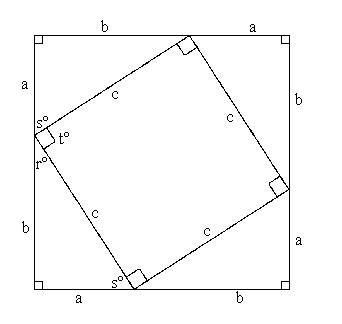
First, we take the square with edges of length a + b. In the square, we draw four right triangles with lengths a and b. By the SAS postulate, each of these four triangles is congruent to one another. By CPCTC, all of the hypotenuses are congruent to each other. Since the acute angles of a right triangle are supplementary, we can conclude that r + s = 90. Since r + s + t = 180, it follows that t = 90. For quadrilaterals, if one angle is a right angle, then all of the quadrilateral's angles are right angles. In the quadrilateral, all of the sides are congruent and all of the angles are congruent, and therefore the quadrilateral is a square. By the Area Addition Postulate, the area of the large square is equal to the area of the small square, plus the sum of the areas of the four congruent triangles. This gives