The previous chapters reviewed the technology applied in video coding, communication, and robust transmission. This chapter aims to select appropriate technologies for a reliable video communications scheme over packet networks, particularly IP-based networks.
Therefore, this chapter deals with decisions. One way of taking decisions is to adopt a centralised pyramidal model, following top-down or bottom-up approaches. Another option is that of a serialised procedural approach. And yet another is a fully parallel model, in which concurrent decisions are taken for all the parts of a system.5.1
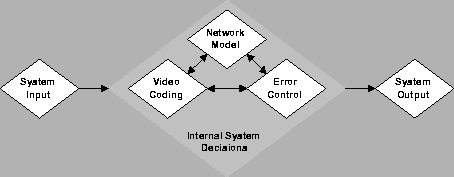
For this work, a combination of the procedural and the parallel model was considered simpler and easier to formulate. Particularly, the design problem is formulated in three phases. The first is the selection of the video sequences for the scheme, in other words, this is the system input decision stage. The second is the internal system decisions stage, which comprises the selection of a video codec, the network model for the transmission, and the techniques to provide robustness. The third deals with the selection of appropriate methods of assessing the quality of the system output. The decision-taking model is illustrated in Figure 5.1.
In the following sections, the criteria that have to be set and the requirements that have to be met for each of the parts depicted in Figure 5.1 are discussed, along with an evaluation of the available technologies. In the end of each section, the most appropriate options for the target reliable video communications scheme are suggested.