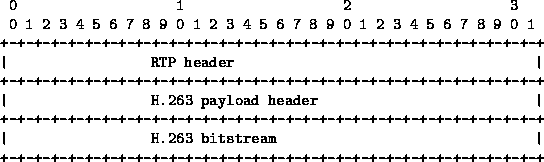
For example, in RFC 2190 [Zhu97], the RTP payload format for H.263 is
defined. The general format of a video packet is illustrated in
Figure 4.5. The H.263 payload header contains essential information
such as predictor, entropy encoder, and quantiser parameters, which make the
decoding of each packet nearly independent of whether its predecessors or
successors have been correctly received and decoded. The task of decorrelating
information is not always straightforward; particularly, in the H.263 example
the RFC suggests intervention in source coder parameters, such as picture type
and prediction range decisions, in order to accomplish this task.
The above RTP packets contain data from several blocks, usually whole GOBs. Thus, a loss of one packet affects a contiguous region of the picture, with frustrating results. Other schemes apply interleaved packetisation, by which successive image blocks are stored into nonadjacent packets. However, this increases the complexity not only of the transport codec, but also of the source encoder, as it has to confine block-level prediction to only the blocks within a packet.
Other techniques applied at the transport coder stage, use the idea of layered coding, replacing channels with transport protocols. According to them, the base layer, containing the most important information, could be transmitted using the reliable TCP, while all the remaining information could be sent with UDP.