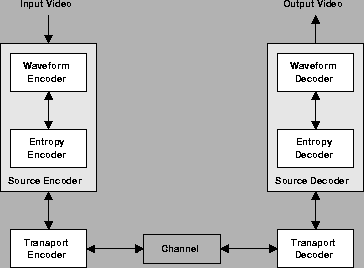
The functional diagram depicted in Figure 4.2 is introduced in order to describe the techniques for enhancing the robustness of real-time video communications systems. The familiar from the previous chapters waveform and entropy encoding functions are appearing in the source encoding stage. Before the actual transmission, transport coder functions, such as packetisation, channel coding, and transport-layer control, are performed to convert the bistream to data units suitable for transmission [WZ98]. In Figure 4.2, double arrows are used to indicate that it is possible to have feedback information from the receiver to the sender.
Generally, redundancy could be added at each of the functional stages to help the receiver recover lost packets or conceal errors. The problem of error control and concealment can be formulated as designing a pair of source encoder/decoder and transport encoder/decoder so that the error distortion at the decoder is minimised with a given video source model, channel bandwidth, and channel error characteristics [WZ98]. Obviously, the solution to this problem is not straightforward.