


Next: Multimedia over the Internet
Up: Evolution to Multimedia Network
Previous: Evolution to Multimedia Network
ATM is using short fixed-sized packets, or cells, which are transported at
regular time intervals, so as to minimise the processing time associated with
their processing, buffering and routing. It is a connection-oriented network,
usually operating at very high speeds.
ATM provides a mechanism for logical connections, called Virtual Circuit
Connections (VCC). A VCC is setup between two end users through the network, and
a variable rate, full-duplex flow of cells is exchanged over the
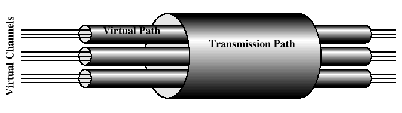
connection [Sta98]. A Virtual Path Connection (VPC) is a bundle of VCCs
that have the same end points, and it helps to restrain the signalling and
control cost of multiple connections by grouping them into a single unit, as
shown in Figure 3.2.
Figure:
ATM connection relationships, source: [Sta98].
 |
The real-time services of ATM are classified to constant and variable bitrate
services, or CBR and VBR respectively. ATM defines a range of QoS guarantees for
its connections. These can be generally described by the term traffic control,
and refer to the actions taken to avoid congestion conditions or to minimise
congestion effects, and include [Sta98]:
- Resource management using virtual paths, which is allocating the
available network resources in such a way as to separate traffic flows according
to their required service characteristics.
- Connection admission control, which ensures that a new connection
can get the QoS agreed in the traffic contract, otherwise it rejects the
request.
- Usage parameter control, which monitors established connections to
determine whether the traffic conforms to the traffic contract.
- Selective cell discard, which discards low-priority cells tagged by
the data source or the usage parameter control.
- Traffic shaping, which regulates and smooths out the traffic flow so
it does not exceed the agreed QoS parameters.
Next: Multimedia over the Internet
Up: Evolution to Multimedia Network
Previous: Evolution to Multimedia Network
Isaac Kokkinidis
1998-08-27