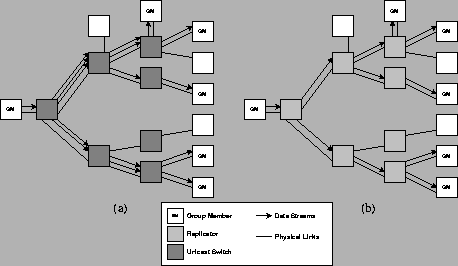
``Multicasting is the capability of the network to replicate, at certain internal points, the data emitted by a source. Replicated data should be forwarded to the recipient end-systems which are part of the multicast group so as to avoid segments of the network to be traversed by multiple copies of the same data.''
The resource savings by using multicast transmission are considerable, as shown in Figure 3.1. New versions of IP provide the functionality for multicast connections, but it is not currently implemented in all the Internet routers. Currently there are some interconnected via tunnels multicast-capable islands, forming an overlay network on top of the Internet, namely the Multicast Backbone (Mbone).
The Mbone, as a testbed for multimedia applications, is a glimpse to the future of the Internet. It has been successfully used to broadcast several Internet Engineering Task Force (IETF) video and audio meetings to whoever joining the multicast session. Current research is targeting in improving the QoS for such connections. It is well understood that this task is much more complex than the respective for unicast connections.