


Next: The ISO MPEG Family
Up: The ITU H.26x Family
Previous: H.261
The bandwidth requirements of H.261 are considered high for the majority of
domestic and mobile users, so a new standard was developed for bitrates near
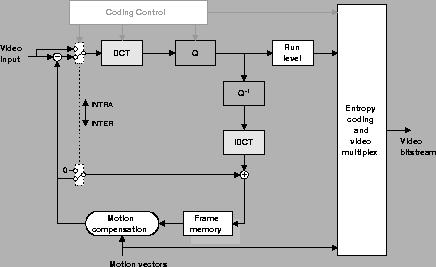
30 kbps. The H.263 encoder is fundamentally the same with the H.261 encoder, as
shown in Figure 2.6. However, some modifications were incorporated
in the recommendation to improve the video quality at low bit rates, including:
Figure 2.6:
A simplified block diagram of an H.263 encoder
 |
- The use of new input video formats, as sub-QCIF (
 ), 4CIF
(
), 4CIF
(
 )
and 16CIF (
)
and 16CIF (
 ).2.2
).2.2
- The use of half-pel prediction in block matching, unlike H.261, where
candidate blocks are displaced only to integer pel positions, and motion
estimation is coarser.
- Unrestricted search range for motion vectors, allowing better prediction
near the frame boundaries.
- Advanced prediction mode, which assigns different motion vectors to each
of the four
 blocks comprising a macroblock.
- Arithmetic coding rather than Huffman encoding.
- PB-frames, which are combinations of a forward and a bidirectionally
predicted frame, see the next paragraph for definition of P and B frames.
These features make the codec much more complex than the respective H.261
implementations, but, with the continually improving hardware available at
continually decreasing prices, they can be justifiable, especially for mobile
users and terminals.
Next: The ISO MPEG Family
Up: The ITU H.26x Family
Previous: H.261
Isaac Kokkinidis
1998-08-27