Decades ago, a chemical industry came up with different kinds of synthetic thermoplastic and polymer coatings, because they believed they would be more stable than natural resins. However, there was little to no scientific understanding of how the materials would work as art supplies, and it turned out that these synthetic resins would just be even harder to remove from paintings when they deteriorated. I would like to say that thanks to one scientist, the problem was solved, but we have many individuals to thank:
ROBERT L. FELLER - a conservation scientist/former science advisor to National Gallery of Art/director of the Mellon Institute in Pittsburgh. During the 80's introduced Acryloid B-72, an ethyl acrylate/methyl methacrylate copolymer (this too had its downside: it didn't make the paintings look as nice as those with the old-school varnishes).
RENE DE LA RIE - former conservation scientist for the Metropolitan Museum of Art in New York City/head of scientific research at NGA. His theory was that low viscosity and low molecular weight was what they needed to find stable synthetic resins with optical properties (aka, it would be easy to remove and look pretty!). He found hydrogenated hydrocarbon resins and aldehyde resins, which stayed transparent and glossy and didn't yellow or crack. Remained soluble in less-toxic, low aromatic hydrocarbon solvents (aka, they'd be easier to remove!). He found a natural resin, rather than synthetic.
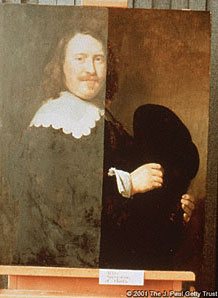
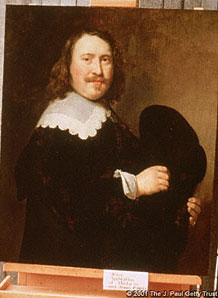
Confident of La Rie's results, a daring experiment was conducted: restoring the Govaert Flinck's "Portrait of a Man," testing the natural resin with the synthetic resin. The pictures at left show the difference.