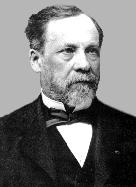
Louis Pasteur was born December 27, 1822 in Dole, Jura, France, and grew up in Arbois as the only son of a poorly educated tanner, Jean Pasteur. Louis preferred fishing and drawing instead of school, and he could have easily become a successful portrait artist. Jean did not want Louis to be an artist, and luckily, Louis began showing a strong interest in chemistry and other scientific subjects. Jean wanted Louis to become a professor at the local college in Arbois, but the headmaster believed he could do much better than that, so Louis ended up at the Ecole Normale Superieure in Paris.

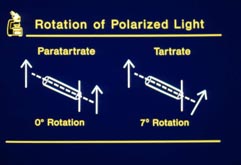
What started his scientific career was studying the shapes of organic crystals. When he was 26 years old, he was working for his doctorate in chemistry in the lab of Antoine Balard, as crystallography was just beginning. His project was to crystallize different compounds, and he started with tartaric acid, and this acid's crystals are found in large amounts in the sediments of fermenting wine. It could be found in the sediments of wine barrels crystals of another acid called paratartaric acid ("racemic acid"), and a few years earlier, it was determined that tartaric and paratartaric acids were identical. However in solution, tartaric acid rotated a beam of polarized light passing through it to the right, whereas the paratartaric acid did not rotate the light (Fig. 1). Louis was confused by this, and refused to believe the two acids were identical. He was sure that the internal structures were different, and that it would show in crystal form. Beneath a microscope, Louis found that every crystal of pure tartaric acid was identical, and that with the paratartrate crystals, there were two types of crystals: one was the mirror image of the other. Louis separated the left and right crystal shapes into two piles, and showed that in solution, one rotated light to the left, the other to the right. He proved that organic molecules with the same chemical composition can exist in space in unique stereospecific forms. This was the start of stereochemistry.

In 1854, Louis became Dean and Chemistry Professor at the Faculty of Sciences in Lille, France (an industrial town full of distilleries and factories). Here he began his work with fermentation. When alcohol was produced normally, the yeast cells were plumb and budding, but when lactic acid was formed, small rod-like microbes were mixed with the yeast cells. Also, analysis of the alcohol showed that amyl alcohol and other complex organic compounds were being formed during the fermentation. This was way too complicated to be explained by Lavoisier's theory of sugar's catalytic breakdown. Also, some of these compounds rotated light (aka, they were asymmetric), but Pasteur believed that only living cells produced asymmetrical compounds. He concluded that the yeast was what was causing the forming of alcohol from sugar, and that contaminating microorganisms turned the fermentations sour. Pasteur spent the next several years identifying and isolating the specific microorganisms that were responsible for normal and abnormal fermentations in the production of wine, beer, and vinegar. He also found, and showed to the world, that if you heated wine, beer, and milk to moderately high temperatures for a few minutes, you can kill living microorganisms and sterilize the substance, preventing their degradation. This was the start of pasteurization.
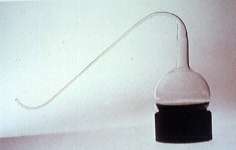
This is the idea that life could occur "spontaneously" from non-living matter. It's like when people assume that maggots just appear in trash out of nowhere. Louis used what he found from fermentation as a basis for his research on spontaneous generation, that being that microorganisms come from outside. In 1859, Louis boiled meat broth in a flask, and heated the neck until it was pliable, where he then formed it into the shape of a swan's neck (Fig. 2). Now, only air could enter the flask, and not microorganisms, which, due to gravity, would settle in the neck. Louis tilted the flask so the broth could reach the lowest point in the neck, and when it mixed with the microorganisms, it became full of life.