|
5 |
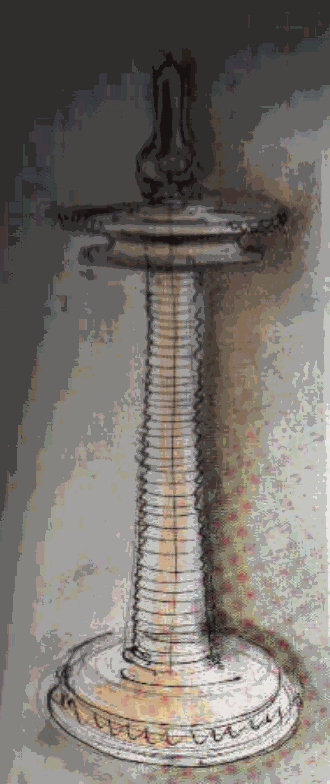
Sketch of lamp in Trivandrum Museum.
In 1975, Robert was invited by the All India Handicraft Board to tour the country and make an independent survey of contemporary art metalwork. In fact, there was an historical symmetry to the visit. From 1907 to 1910, Broad Campden in Gloucester had been host to a remarkable Indian visitor, Ananda Coomaraswamy, a distinguished historian of Indian art, who was drawn to the region by the presence at nearby Chipping Campden of CR Ashbee and the Guid of Handicraft. On his first day at his new studio in 1953 Robert discovered one of Coomaraswamy's prize possessions, a fine stringed musical instrument known as a Vena. He later bought it. He also found the Indian historian's glass photo negatives, hundreds of them, and they were prove an invaluable research archive.
Following his extensive ten-week tour, he drew attention to the very remarkable bronze casting work carried out by craftsmen at Kerala in southern India. The method, one of high complexity and incomparable finesse, the lost wax process, is of course older than civilisation, stretching back before the 4th millennium BC. Robert observed the craftsmen making huge bronze bowls of very thin, delicate section and beautiful proportion, and magnificent oil lamps, tall and robust, used to illuminate the performances of the famous Kata Kali dancers. Eventually, he set out a design programme in association with Government departments such as the Handloom and Handicraft Export Corporation in Delhi and the National Institute of Design at Ahmadabad. He was asked to help establish export markets for these superlative examples of the metal worker's art. His pioneering work when he returned to the 'cool and temperate well ordered calm' of his studio resulted in a range of shapes and mouldings that enabled him, in his own words, 'to distil the flavour of the traditional form of this craft...and to finish the bronze ware to a very high standard'. He tried to encourage a reciprocal effort on the part of the Indian craftsmen, to create products 'suitable for the western market place', and so to 'complete the equation'. Much progress was made in Robert's lifetime. Much remains to be done.