For Some, Fear Of Violence Borders On Syndrome
September 8, 2000
LOS ANGELES (Los Angeles Daily News)
-
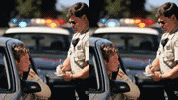
Call it secondhand fear - most people, even those who are not crime victims, feel threatened by the perception that violence lurks everywhere, a trio of clinical psychologists at California State University, Northridge, said Thursday. The researchers have dubbed the condition Secondary Violence Syndrome, characterized by chronic underlying feelings of alienation, depression, anger and anxiety. Although more criminals are in prison than ever before and crime declined sharply over the past decade, many people still cloister their children, covet walled homes in gated communities or even keep weapons because of this affliction, they say. "The assault on your feelings of safety and security is attacking us from all directions," wrote the three Ph.D's, Corinne Wilburne Barker, Marshall Bloom and Bruce Shapiro. "Whether real or imagined, most of us feel we are not safe on the streets, the highways, in our homes, in our schools or even in the workplace." The study, which is nearing completion after four years of research, included a recent survey of faculty and staff members at CSUN and a 1998 survey of employees of a large corporation. The team also drew on other research and the members' own observations about society and tolerance for violent or threatening behavior and speech. "If you move in the wrong way, or I give you an aggressive look, there's that threat of violence" that pervades and suppresses human interaction, Bloom said. After seeing reports about high school and elementary school shootings, even such simple activities as signing one's child up for kindergarten can be filled with apprehension, Barker said. "Now, do we need to check out the other parents to see if they might keep a loaded gun at home?" she asked. "Hesitance in meeting new people and helping new people" because of an overwhelming fear of crime, Shapiro said, "that becomes a restriction on our freedom." About 2,500 people responded to the statewide company survey, which the researchers describe as a good cross-section of incomes, education levels and urban/suburban/rural dwellers. More than half of those surveyed, or 58 percent, said they were likely to be the victim of violence or a criminal act. Even more, 81 percent, said they were concerned about becoming a crime victim. Like many people, Mike Winnik, 44, of Tarzana said he could identify with the issues raised by the study. "I came out to live here (from New York) because of the difference in raising kids," he said as he collected his two daughters, Mariana, 6, and Julia, 3, from a fenced-in playground at a local park. "I don't read the newspapers and I don't watch television just for that reason: Because I don't want to learn about it. I hate hearing about a child who just got killed today by a stray bullet or there's a maniac on the loose." Although only about 8 percent of the respondents in the statewide survey said they "stopped watching the news" to "cope with violence and crime in our society," it did find that many people had changed their lives in other ways. Sixty percent agreed with the statement, "I try not to open my door to strangers or solicitors." Thirty-nine percent said, "I watch my children more closely in public," and 32 percent selected, "I use my car horn with caution." Even Barker said she recently honked her horn at an errant motorist, "and I thought, uh-oh, this is not a great area of town, maybe a gun's going to come out." A significant number of respondents also took more drastic measures to help them feel safer in what they perceive, correctly or not, to be a crime-infested world. A full quarter of them said they kept a weapon at home, 14 percent said they carried pepper spray and 15 percent checked off, "I do not go out at night." The three said they hope their research, which they are incorporating into a book on the fear of crime, will lead to the development of strategies to help people cope with the condition. Calling attention to the side effects of a fear of crime - often an irrational fear - is a worthwhile pursuit in the eyes of Barry Glassner, a University of Southern California sociology professor and author of "Culture of Fear: Why Americans are Afraid of the Wrong Things." "I think it's time that we recognized that the fear of crime is dangerous in and of itself," Glassner said. "It results in parents raising frightened children. It results in people voting their fears, rather than their ambitions or self-interests in an election." Copyright 2000 The Los Angeles Daily News. All rights reserved.
(Printer-friendly format)
WILL WE SELL OUR FREEDOM FOR SECURITY??
FBI To Schools: Be Alert To Violence
September 6, 2000
WASHINGTON (AP)
- The FBI said school officials should be alert to students who show "preoccupation with themes of violence" but cautioned that its two-year study of school shootings cannot be used to pinpoint teens likely to attack classmates or teachers.
But news of the report, being released Wednesday, prompted concerns that schools might use the FBI recommendations to identify - and punish - students who behave suspiciously.
"The American public is not going to want the FBI profiling their kids," said Vincent Schiraldi of the Justice Policy Institute, a youth advocacy think tank.
The FBI, which says the report "will help those children who show a propensity for violence," evaluated 18 school shooting cases, which are not identified in the report.
High-profile shootings like the 1999 killings at Columbine High School in Littleton, Colo., have heightened concerns about school violence. Another federal law-enforcement agency, the Secret Service, will present a school-violence report to the Education Department this fall.
The FBI report, written by its National Center for the Analysis of Violent Crime in Quantico, Va., lists dozens of risk factors gleaned from a study of school shooting cases begun in May 1998 - a full year before the Colorado deaths.
The report identifies risk factors usually found among the shooters in the cases studied. Such factors were grouped into four categories: personality traits, family situations, and school and social interaction.
It raises questions for educators to ask about a troubled child: What is the culture of the school and how is it affecting the child? Does she have problems expressing anger? Does he show an inordinate fascination with violent movies, books and music? Has she talked or written about committing violent acts?
Other traits listed in the 36-page report include poor coping skills, access to weapons, signs of depression, drug and alcohol abuse, alienation, narcissism, inappropriate humor, no limits or monitoring of television and Internet use.
The report also classifies levels and types of threats. Direct threats are clear: "I am going to place a bomb in the school's gym." Medium-level threats indicate possible place and time; high-level threats indicate practice with a weapon or surveillance of a victim.
The report stresses over again that it is not a profiling tool: "trying to draw up a catalogue or 'checklist' of warning signs to detect a potential school shooter can be shortsighted, even dangerous." It cautions that having more than one trait will not necessarily produce a shooter. It says the roots of a violent act are "multiple, intricate and intertwined."
It cautions school officials not to use the results to predict student behavior, or use those predictions to violate privacy rights.
Bruce Hunter, a lobbyist who represents school superintendents for the American Association of School Administrators, said school leaders do keep an eye on children who act strangely, many who exhibit some of the behaviors listed in the FBI report. Often troubled children are referred to the alternative classrooms and schools that have doubled in number in the last few years, he said.
But officially profiling students is not the answer, he said. "I doubt that would hold a lot of promise for us. Kids are forming their personalities."
Schools should evaluate all the help they get, even from the federal government, said Bill Modzeleski, director of the Department of Education's Safe and Drug-Free Schools program. His office worked with the Secret Service, feeling that such expertise that might be useful to educators.
"We're not saying law enforcement should not be a part of the solution; we are saying it should not be the solution," Modzeleski said. "We welcome law enforcement as partners."
But some child advocates say law enforcement involvement has clouded the response to fears fueled by rare, but deadly multiple shootings. School suspensions and juvenile crime codes have increased in the wake of Columbine, said Schiraldi of the Justice Policy Institute.
"I'm fearful once we start putting these things out, every principal in America is going to come up with (the names of) 10 kids," Schiraldi said. "Putting out a profile booklet, slapping a couple of cameras up, a metal detector or two are bromides while the ulcer festers beneath.
"I think when we're trying to figure out what makes kids tick, we ought to talk to parents, teachers, child psychologists, students themselves, not people called 'special agent,"' he said.
Copyright 2000 The Associated Press. All rights reserved.
( Printer-friendly format )
Trivial fears:
 Stepping out alone
By Carolina Carlessi
Not long ago, Carmen came to the Opera House and my trivial tragedy unfolded: I didn't have anybody to go with. My friends were either sick, out of town, had previous commitments or plain didn't have the money.
My friend Susan could not accept my offer to buy her a ticket because she had a meeting at school and suggested I go alone. "By myself? No!" My voice quivered. The palms of my hands got all sweaty just thinking about entering the theater alone.
We experience these vital fears, fears that threaten our lives or our integrity. We also experience trivial fears, those almost insignificant anxieties that often define our lives.
Years ago I lived in Lima, Peru, raising two kids as a single mother. Peru was undergoing the most violent time in its history. Terrorists tried to erase every hint of "capitalist society" through bombings, kidnappings and executions. As a reaction, the anti-terrorist forces tried to erase everyone who looked like a terrorist � which could mean anybody.
We, the people, were in the middle of their war.
I call those fears vital. They showed their ugly faces especially at night. In the darkness of the blackouts, the explosions would shake the house as if in an earthquake. I would lie awake wondering which government building, which bank, which mall had been destroyed that night. Whether or not a night guard or passerby had been blown to pieces and his limbs scattered with the rubble. Sometimes, gunshots whistled in the nearby park. Holding a candle, I would check the doors and windows and then step into my sons� room, look at their beautiful faces and wonder what would I do if violence came even closer.
Sleep would eventually come, with me tired and weary, thinking the end of the world was indeed very near.
Invariably the next morning, the gardener at the nearby park saluted the sun with his Andean tunes. He pruned the roses while whistling with all the power in his lungs. The house woke up to the bright light, to the familiar sounds of the milk and bread delivery, to the smell of fresh brewed coffee. I got up, got the kids ready for school, and went to work at an international magazine.
And every morning, life went on in Lima. It was as if the night terror dissolved with the sheer energy of determination. People walked briskly to work, filled the buses to the utmost, and drove their cars with a purpose. People in Peru were not giving up, they were embracing life.
Life is stronger than war and terror. Life is resilient, stubborn, stoic and optimistic.
Trivial fears are not that overwhelming. Trivial fears lurk in the back of our unconscious and present themselves as one element of the makeup of our personalities, as an insignificant characteristic, a small idiosyncrasy. But beware, there are certain moments when these trivial fears can define aspects of our life. They keep us in a house when we should be talking in public, they cause us to lose a cherished job for fear of losing the guy. They can make us miss a great play because we don't have anybody to go with.
That night and the following day after I heard about the opera, my thoughts kept going to the same question. Why do I feel so scared? Where does this fear come from? The image of me as a shy girl came to my mind together with a sinking feeling in my guts. Boys calling me ugly and me running past them to get to the shop and buy noodles for dinner. And the Sunday matinee. I entered the movie theater convinced that everybody had their eyes fixed on me, made fun of my big nose, ugly dress and dark skin. Their glances made my feet become heavy and clumsy.
If I didn�t still feel that way, then why was I terrified of going to the theater by myself? It was fear also, but a different kind. People might criticize me for not having a man at my side, for not being able to attract a guy, for not being woman enough to keep one. Or they might pity me, which is worse.
The idea came as a revelation. If I am complete without a man, why should I care what people think?
One ticket for a single woman, I said jokingly to the woman at the ticket booth, when I arrived at the Opera House.
And here is the best place in the house for her, she answered with a wink, offering me the numbered ticket. (It is easier to find tickets for singles. Odd seats remain unsold after couples buy theirs.)
The main floor of the Opera House swarmed with people. Some dressed elegantly, and some just wore their working attire, like me. I sailed easily around the groups and climbed the curved stairs leading to a glass foyer overlooking the river. I waited there.
Rosy clouds peeked behind the clock tower of the river park. I watched a couple, almost hiding under the bent willow branches. The man embraced the woman from behind while she threw the pieces of bread up, high into the air, for the swans to catch. I watched them with no envy. I was going to see Carmen by myself.
When the time came to enter the auditorium, my nerves didn�t fail me. I went to the right door and found a uniformed usher who guided me to an aisle.
People were trying to find their seats. No eyes were fixed on me. Signaling to an empty seat, the usher gave me the ticket back and said, There is J-15, beside that gentleman.
Seat J-15 was located in the center of the mezzanine. It dominated everything, the scenario, the orchestra pit, and the audience. A sense of power grew inside me. I relaxed in my seat, smiled, and felt the presence of the man at my side. He said hello, and I noticed sparks of intelligence in his eyes. He was the perfect guide for the evening, a musician exempt from playing for the night.
And across the centuries, Bizet's dreams enchanted me.
Afterward, the musician invited me to the artists' cocktail party and gave me a ride home. He did not send a dozen roses thanking me for the wonderful evening. I did not either. We did not date and fall in love. He is not practicing his violin in the next room while I write this article. Nothing romantic ever happened between the violinist and me.
The evening when I saw Carmen didn�t have to do with finding a man. It was a lesson in joy and discovery.
Joy, because the little shy girl was no more, discovery because I realized that living as a single woman requires a constant shedding of vital and trivial fears.
Carolina Carlessi is a regular contributor to UnderWire. See In the time of Dona Elena.
SHARE WITH SOMEONE YOU LOVE
PASS THIS ON


SHOW YOU CARE-SHARE