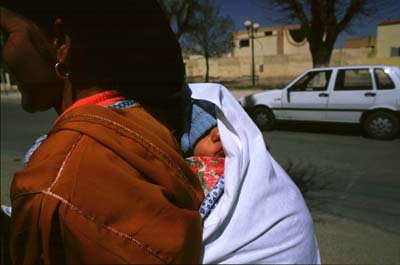
Here, not far from the beachfront Nagjir hotel and the mouth of the dried-out Sakia el Hamra river, she levered herself over the side of a small, green fishing boat with Arabic lettering painted on the bow.
Nineteen other people from all over Africa were packed into the boat beside her. A young Moroccan fixed a small outboard motor to the stern, settled his human cargo evenly, jerked the engine into life and, taking out a rudimentary compass, set of on a course just west of north. As they pulled off into the night, a second boat, also packed with black Africans, slipped into their wake.
For Mercy, 25 years old and eight months pregnant, it was the final stage in a 14-month journey from her market stall in Jenin City, Nigeria. At nightfall the following day, after hours of praying, vomiting and bailing water, Mercy and her companions could pick out a thin pinprick of light blinking in the distance.
Mercy was looking at the Entallada lighthouse on Fuerteventura, the nearest of Spain's Canary Islands to the African coast, and the welcome-sign on what is now the main illegal immigrant route into Europe from Africa. A few hours later a Spanish civil guard patrol boat steamed into sight tointercept them. As it came alongside, the immigrants scrambled aboard and were delivered on to European soil at the small port of Grand Tarajal. Within hours Mercy was lying in a bed in the hospital at Puerto del Rosario, the island's capital. Two days later, her son was born. She called him Blessed.
But another boat with Moise Obama, a 41-year-old mechanic from the Cameroon capital, Yaounde, made trip in March. "Two of my friends drowned the day before. Five others drowned with them," he said. "I have told my family not to send anyone else."
All the immigrants paid for their trips in Rabat. There, in the Tukum shanty town, a shifting population of thousands of sub-Saharan Africans work or steal to raise the US$ 600 for the trip to Fuerteventura. They are driven the 900 miles south in fleets of Land Rovers, avoiding Police. The trip usually ends short of Laayoune itself. There, a local Saharawi guide drives them into the massive sand dunes that stretch towards the sea. The temporary camps are set up just inland along a 60-mile stretch of wilde coastline dotted with wrecked ships that stretches from the fishing town of Tarfaya south to Laayoune.